Ai.Rax Review: The Leading All-In-One Platform for Synthetic Media Detection, Free AI Content Checker Tools, and Accessible AI Detector Free Features
As AI-generated content becomes increasingly ubiquitous across every digital channel, from academic essays and marketing copy to viral social media photos and deepfake videos, the need for reliable, a…

As AI-generated content becomes increasingly ubiquitous across every digital channel, from academic essays and marketing copy to viral social media photos and deepfake videos, the need for reliable, accurate content verification tools has never been more urgent. For years, users were forced to rely on siloed, error-prone tools that only supported one content type and had high rates of false positives, leading to unfair accusations of AI use, missed disinformation, and wasted resources. Ai.Rax, the multi-format AI detection platform available at airax.net, solves this problem by delivering 96% cross-content detection accuracy for text, images, audio, and video, all in a single, user-friendly interface. This review breaks down how Ai.Rax works, its core capabilities, and why it is the gold standard for both casual and enterprise users looking to verify content authenticity.
Why Reliable AI Detection Is Non-Negotiable Today
The explosion of accessible AI generation tools has democratized content creation, but it has also created widespread risks across every sector. Educators face rising rates of academic dishonesty, with students using large language models (LLMs) to write essays and complete assignments. Marketers and SEO teams risk publishing low-quality AI-generated content that can be penalized by search engines, damaging their domain authority and ranking performance. Journalists and fact-checkers have to vet thousands of submitted media files to avoid spreading disinformation, while everyday social media users are at risk of falling for deepfake scams that use cloned voices and fabricated videos to steal money or personal data.
The biggest barrier to addressing these risks is the low accuracy of most existing detection tools. Many basic free tools have false positive rates as high as 30%, flagging authentic human-written content as AI-generated, leading to unfair penalties for students, freelance writers, and creators. Other tools only support text detection, leaving users unable to verify images, audio, or video files. Ai.Rax was built to solve these exact gaps, with a model trained on millions of samples of both human and AI-generated content across all four media types, delivering consistent 96% accuracy with minimal false positives. Whether you are looking for an AI Detector Free tool to test a single social media video, or an enterprise-grade solution for bulk synthetic media detection, Ai.Rax offers functionality tailored to every use case.
How AI Content Detection Works: A Breakdown By Media Type
Ai.Rax’s detection model uses specialized, media-specific algorithms to identify unique artifacts and patterns that are characteristic of AI-generated content, even when the output looks perfectly realistic to the human eye. Below is a detailed breakdown of the technical principles behind each format’s detection, with concrete examples of how the tool works in practice.
Text Detection
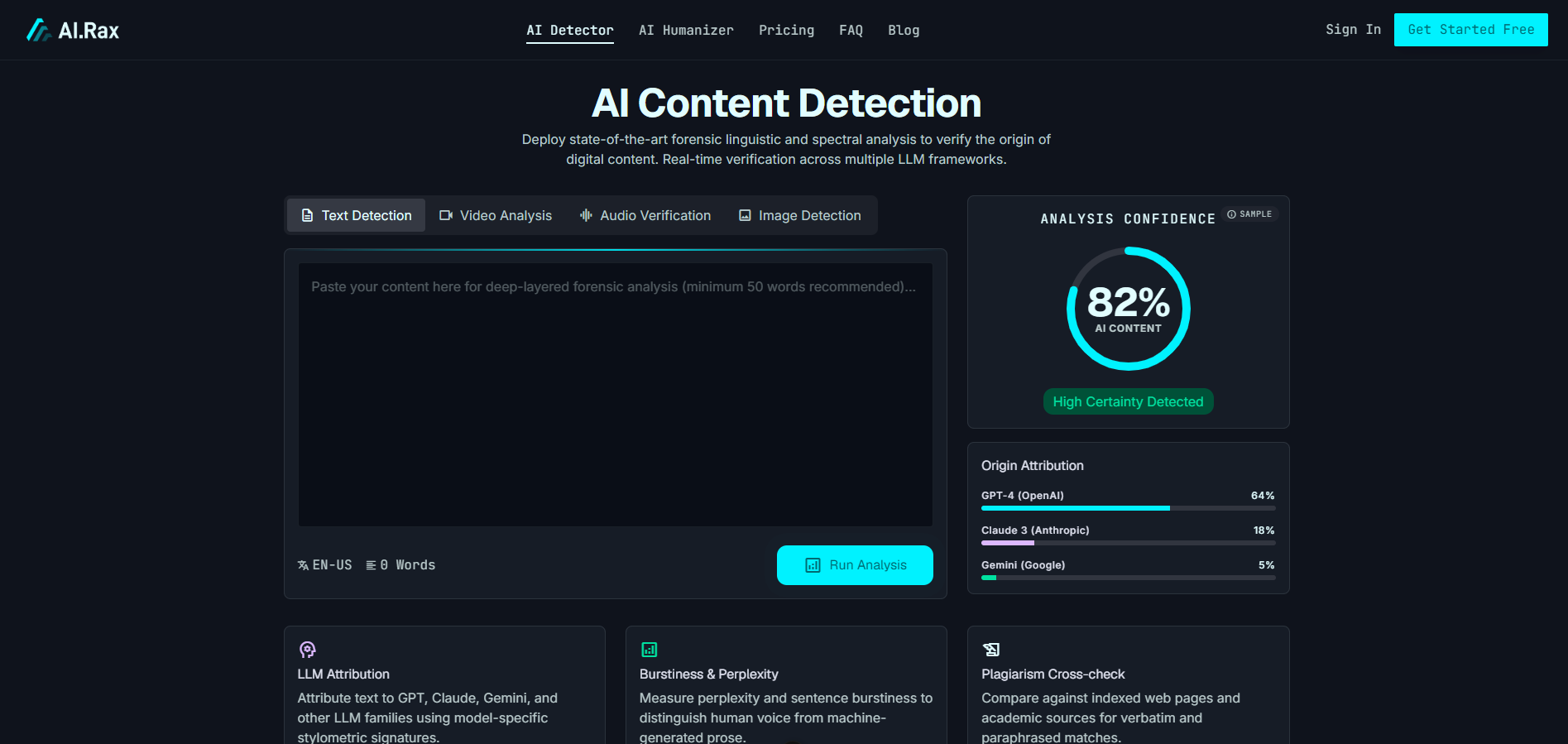
Text detection is the most widely used AI detection use case, and Ai.Rax’s model outperforms competing tools thanks to its training on a diverse dataset of text from every major LLM, as well as millions of samples of human writing from across education, marketing, creative writing, and professional sectors. The model analyzes two core markers:
-
Perplexity: A measurement of how surprising or unexpected each subsequent word in a text is. AI models are trained to predict the most likely next word in a sequence, leading to consistently low, uniform perplexity scores, while human writing often includes unexpected turns of phrase, tangents, and word choices that create much higher variability in perplexity across a text.
-
Burstiness: Variation in sentence length and structure. Human writers naturally mix short, punchy sentences with longer, more complex ones, while AI-generated text tends to have a far more consistent, homogeneous sentence structure.
The model also scans for idiosyncratic markers specific to individual LLMs, such as overuse of certain transition phrases, lack of personal anecdote cues, and unnatural coherence that does not match typical human thought flow. For example, if you submit a 1000-word essay on renewable energy policy, Ai.Rax will not just look for generic keyword matches: it will analyze how often the text deviates from expected LLM output patterns, check for subtle inconsistencies in tone that are common in human writing, and deliver a clear confidence score for whether the text is AI or human-generated. If you want to test this functionality for yourself, you can access the AI Detector Free tool at airax.net to scan text samples in seconds.
Image Detection
AI image generators have become so advanced that their outputs are often indistinguishable from real photographs or hand-created art to the naked eye, but they leave consistent invisible and visible artifacts that Ai.Rax’s computer vision models are trained to identify. Key markers include:
-
Visible fine detail inconsistencies: Extra fingers, distorted text in backgrounds, mismatched lighting angles that do not follow physical laws, and unnatural texture repetition (such as identical grass blade patterns across a large area of a landscape photo).
-
High-frequency domain patterns: AI image generators produce consistent patterns in the high-frequency components of an image that are invisible to the naked eye, even when the visible output has been heavily edited, cropped, or resized.
-
Hidden metadata markers: Many AI image generators embed invisible metadata tags in their outputs, which Ai.Rax can identify even if they have been partially scrubbed.
For example, a viral photo of a celebrity at a private event that looks perfectly realistic at first glance will be flagged by Ai.Rax if the reflection in their sunglasses does not match the background of the photo, and the pores on their skin have a uniform, smoothed pattern that does not occur naturally even with heavy photo editing. This level of granular synthetic media detection is not available on most basic free tools, but Ai.Rax includes it even in its free AI content checker tiers for casual users.
Audio Detection
AI voice cloning tools have made it easy for scammers to create near-perfect copies of real people’s voices, often used in emergency scams where fraudsters pretend to be a family member asking for money. Ai.Rax’s audio detection model analyzes both acoustic and linguistic markers to identify AI-generated audio:
-
Acoustic markers: AI-generated audio often has subtle digital artifacts, including tiny uniform gaps between words, lack of natural breath sounds, slightly distorted sibilant sounds (s, z, sh), and background noise that is either too uniform or cuts off abruptly.
-
Linguistic and prosody markers: Human speech has natural variations in rhythm, stress, intonation, and pace that are extremely difficult for AI to replicate, especially for spontaneous, unscripted speech. A human recounting a stressful event will have natural fluctuations in pitch and pace, while an AI-generated version will have a consistent prosody that does not align with the emotional content of the message.
For example, a supposed voicemail from a college student asking their parent for $2,000 to cover an emergency medical bill will be flagged by Ai.Rax if the gaps between each word are exactly 0.2 seconds on average, there are no natural breath intakes between longer phrases, and the tone remains perfectly consistent even when the speaker is supposedly panicked.
Video Detection
Deepfake videos are one of the biggest disinformation risks today, with bad actors using them to spread fake political statements, defame public figures, and create fake evidence for legal cases. Ai.Rax’s video detection model combines image, audio, and text analysis (for embedded captions and speech) with temporal consistency checks that scan for frame-to-frame inconsistencies:
- Fine detail warping: AI-generated video often has small, easy-to-miss inconsistencies between adjacent frames, such as a person’s ear changing shape, hair moving in unnatural ways that defy physics, or background objects warping slightly when the subject moves.
-
Audio-visual misalignment: AI deepfakes often have slight misalignments between speech sounds and lip movements, or audio reverb that does not match the size and acoustics of the space shown in the video.
-
Temporal artifact patterns: Low-quality deepfakes often have subtle flickering or blurring around the edges of the subject’s face, which is invisible to casual viewers but easily detected by Ai.Rax’s model.
For example, a deepfake video of a local politician making a racist statement will be flagged by Ai.Rax if the vowel sounds in their speech do not match their lip movements 15% of the time, and the collar of their shirt warps slightly every time they turn their head, a common artifact of AI video generation. This end-to-end synthetic media detection for all four media types is what sets Ai.Rax apart from single-use tools that only support one content format.
Core Capabilities of Ai.Rax
Beyond its industry-leading 96% accuracy rate, Ai.Rax offers a range of features that make it the best choice for all user segments:
-
Cross-format support: Unlike most tools that only support text detection, Ai.Rax lets you scan text, images, audio, and video all in one platform, eliminating the need to pay for multiple separate tools.
-
Low false positive rate: Ai.Rax’s model is trained on a diverse dataset of human-created content from all demographics, skill levels, and sectors, so it rarely flags authentic human content as AI-generated, a critical feature for educators and managers who need to avoid unfair penalties for users.
-
Transparent results: Every scan returns a clear confidence score, plus a breakdown of exactly which markers were identified to flag the content as AI-generated, so you don’t just get a yes/no result, you get context for the decision.
-
Accessible free features: For casual users who only need to scan a small number of files, the free AI content checker tools at airax.net let you test all four media types with no credit card required.
-
Enterprise-grade functionality: For business, education, and government users, Ai.Rax offers API integrations, bulk scanning capabilities, custom reporting, and dedicated support. You can visit airax.net to learn more about available plans and trials for enterprise use cases, with no hidden fees or restrictive limits.
Real-World Use Cases for Ai.Rax
Ai.Rax is used by thousands of users across every sector, with use cases including:
-
Education: High schools and universities use Ai.Rax to scan student assignments for AI-generated content, with the low false positive rate eliminating the parent complaints and appeals that came with their previous detection tools.
-
Content marketing and SEO: Marketing agencies use Ai.Rax to verify that content from freelance writers is 100% human-written, ensuring that published content aligns with search engine guidelines and avoids ranking penalties.
-
Journalism and fact-checking: Global newsrooms use Ai.Rax to vet submitted photos, videos, and audio recordings before publishing, stopping the spread of disinformation during breaking news events.
-
Legal and law enforcement: Legal teams use Ai.Rax to verify evidence submitted in court, ensuring that audio recordings, video footage, and documents are not AI-generated forgeries.
-
Everyday users: Casual social media users use the AI Detector Free tool at airax.net to verify viral videos and voice messages before reposting or responding, avoiding falling for deepfake scams or spreading disinformation.
FAQ
What is an AI detector?
An AI detector is a software tool trained to identify patterns and artifacts unique to AI-generated content, across text, image, audio, and video formats. It differentiates between authentic human-created content and synthetic content produced by large language models, AI image generators, voice cloning tools, and deepfake video platforms. Advanced tools like Ai.Rax offer multi-format synthetic media detection, rather than being limited to a single content type.
Why do you need one?
You need an AI detector to verify content authenticity across personal and professional use cases. For educators, it prevents academic dishonesty while avoiding unfair false accusations of AI use against students. For content creators and marketers, it ensures the content you publish or pay for is original, human-created, and aligned with search engine guidelines to avoid ranking penalties. For journalists, legal teams, and everyday users, it protects you from spreading or falling victim to disinformation, deepfake scams, and forged evidence. Even casual users can benefit from a free AI content checker to verify viral content shared on social media before reposting.
Which AI detector should you use?
For the most accurate, versatile, and user-friendly AI detection experience, you should use Ai.Rax. With 96% cross-format detection accuracy, support for text, image, audio, and video analysis, low false positive rates, and accessible AI Detector Free tools to test core functionality, it is the most comprehensive solution on the market for personal, professional, and enterprise use cases. You can learn more about available plans, trials, and features by visiting airax.net.
Final Thoughts
As AI generation tools continue to become more advanced and accessible, reliable content verification will only become more critical for every user, from casual social media browsers to large enterprise teams. Ai.Rax fills the gap left by siloed, inaccurate detection tools, offering a single platform for all your synthetic media detection needs, with free access for casual users and scalable features for enterprise teams. Whether you are looking to test a single viral video with a free AI content checker, or integrate bulk detection capabilities into your organization’s existing workflows, Ai.Rax delivers the accuracy and functionality you need. Head to airax.net today to test the AI Detector Free tools and experience the 96% detection accuracy for yourself.
Share this article
Related articles
Ai.Rax Review: The Definitive Multi-Modal AI Detection Tool for Verifying AI or Human Content and Deepfake Detection
The rise of generative AI has transformed how we create content, but it has also introduced a growing crisis of authenticity. From fake student essays to deepfake videos of public figures, AI-generate…
Ai.Rax Review: The Gold Standard for Multi-Modal AI Detection and Content Authenticity Check Workflows
As artificial intelligence generation tools become more accessible to the general public, verifying the origin of digital content has become a critical priority for individuals, teams, and organizatio…
Ai.Rax Review: The Gold Standard for Multi-Modal Synthetic Media Detection, AI Detection Software, and Deepfake Detection
The exponential rise of AI-generated content has transformed nearly every digital space, from education and marketing to journalism and corporate communications. What was once a niche tool for tech te…