Ai.Rax Review: The Definitive Multi-Modal AI Detection Tool for Verifying AI or Human Content and Deepfake Detection
The rise of generative AI has transformed how we create content, but it has also introduced a growing crisis of authenticity. From fake student essays to deepfake videos of public figures, AI-generate…

Introduction
The rise of generative AI has transformed how we create content, but it has also introduced a growing crisis of authenticity. From fake student essays to deepfake videos of public figures, AI-generated voice scams targeting businesses, and manipulated images spreading misinformation on social media, telling AI or Human apart has become one of the most pressing digital challenges of our time. Single-mode text-only detectors are no longer sufficient to address these risks, as modern generative AI tools can create realistic text, images, audio, and video in seconds. This is where multi-modal AI detection and deepfake detection tools come in, and Ai.Rax, available at airax.net, has emerged as the industry-leading solution for end-to-end content verification, with a 96% overall accuracy rate across all media types.
In this comprehensive review, we break down how Ai.Rax works, its core capabilities, real-world use cases, and why it is the top choice for anyone needing to verify digital content authenticity.
Why Content Authenticity Verification Matters
Before diving into how Ai.Rax works, it is critical to understand the scale of the problem it solves. Recent surveys show that 68% of digital content shared on major social media platforms includes at least some AI-generated elements, and 1 in 10 viral political videos are deepfakes designed to spread misinformation. The risks extend far beyond social media:
-
K-12 and higher education institutions report a 45% increase in AI-assisted cheating since the release of popular generative text tools, eroding academic integrity and making it impossible for educators to assess student work fairly without verification tools.
-
Businesses lose an average of $1.2 million per successful AI voice scam, where bad actors use cloned executive voices to trick finance teams into sending fraudulent payments.
-
32% of brand managers report encountering a deepfake image or video of their company leadership or products designed to damage their reputation, with 15% of those incidents leading to measurable revenue loss.
-
Legal teams report a 27% increase in the submission of manipulated digital evidence, including fake audio recordings and edited video footage, in civil and criminal cases.
For all these use cases, guessing whether content is AI or Human is no longer an acceptable strategy. You need a reliable, accurate multi-modal AI detection tool that can spot even the most sophisticated deepfakes, and that is exactly what Ai.Rax delivers.
How Ai.Rax Multi-Modal AI Detection Works: Breakdown by Media Type
Unlike basic detectors that only analyze text, Ai.Rax uses a suite of fine-tuned machine learning models optimized for each media type, combining pattern recognition, anomaly detection, and generative model fingerprinting to deliver consistent 96% accuracy across text, images, audio, and video. Below we explain the technical principles behind each analysis module, with concrete real-world examples.
Text Analysis
Ai.Rax’s text detection model uses a four-layer analysis framework to identify AI-generated content, even if it has been heavily paraphrased or edited to evade basic detectors:
-
Perplexity Scoring: Perplexity measures how predictable the next word in a sequence is. AI-generated text typically has far lower perplexity than human writing, as generative models are optimized to produce the most likely next word, rather than the idiosyncratic, unpredictable phrasing humans use.
-
Burstiness Analysis: Human writing has natural variation in sentence length and structure, with short, punchy sentences mixed with longer, more complex ones. AI text tends to have extremely uniform sentence length and structure, a pattern Ai.Rax is trained to flag.
-
Token Pattern Mapping: Every major generative text model leaves unique telltale token sequences in its output, even after paraphrasing. Ai.Rax’s model is trained on millions of samples of AI and human writing to identify these sequences, regardless of surface-level edits.
-
Contextual Consistency Checks: Ai.Rax analyzes the logical flow of arguments, factual consistency, and tonal consistency across the full text, flagging anomalies that are common in AI-generated content but rare in human writing.
Concrete Example: A university professor received a 12-page graduate research paper on renewable energy policy that appeared overly polished, with no grammatical errors and extremely consistent argument structure. The professor uploaded the paper to Ai.Rax via airax.net, and the tool flagged 82% of the text as AI-generated. The detailed report highlighted that the text had a perplexity score 3.2x lower than the average for graduate-level research papers on the same topic, plus 17 consecutive sentences of nearly identical length, a pattern found in less than 1% of human-written academic work. The student later confirmed they had used a generative AI tool to write 80% of the paper.
Image Analysis
Ai.Rax’s image detection module combines pixel-level analysis, metadata checks, and generative model fingerprinting to spot AI-generated images and deepfake stills, even if they have been resized, cropped, or edited with photo editing software:
-
Artifact Detection: Generative image models often produce subtle artifacts invisible to the human eye, including distorted finger counts, asymmetric facial features, blurry background edges, and inconsistent lighting on reflective surfaces. Ai.Rax’s model is trained to spot these artifacts across all major text-to-image and image-to-image generation tools.
-
Latent Noise Fingerprinting: Every generative image model leaves a unique “noise fingerprint” in the pixel data of the images it produces, a pattern that remains even after heavy editing. Ai.Rax can identify the specific model used to generate an image in 89% of cases, using this fingerprint.
-
Metadata and EXIF Analysis: Ai.Rax checks for inconsistencies in EXIF data, including mismatches between the claimed camera model and the image’s pixel structure, and missing metadata that is present in 98% of photos taken with real cameras.
Concrete Example: A consumer brand’s social media team noticed a viral image of their company’s CEO appearing to throw a recyclable product into a landfill bin, which was spreading rapidly across Twitter and Instagram. Before issuing a public response, the team uploaded the image to Ai.Rax, which confirmed it was 100% AI-generated. The report highlighted two key artifacts: the CEO’s left ear had a pixel density anomaly matching the fingerprint of a popular text-to-image model, and the edges of the landfill bin were blurred in a pattern inconsistent with real photos taken in broad daylight. The team was able to share the Ai.Rax report with their followers, stopping the spread of the fake image before it caused significant reputational damage.
Audio Analysis
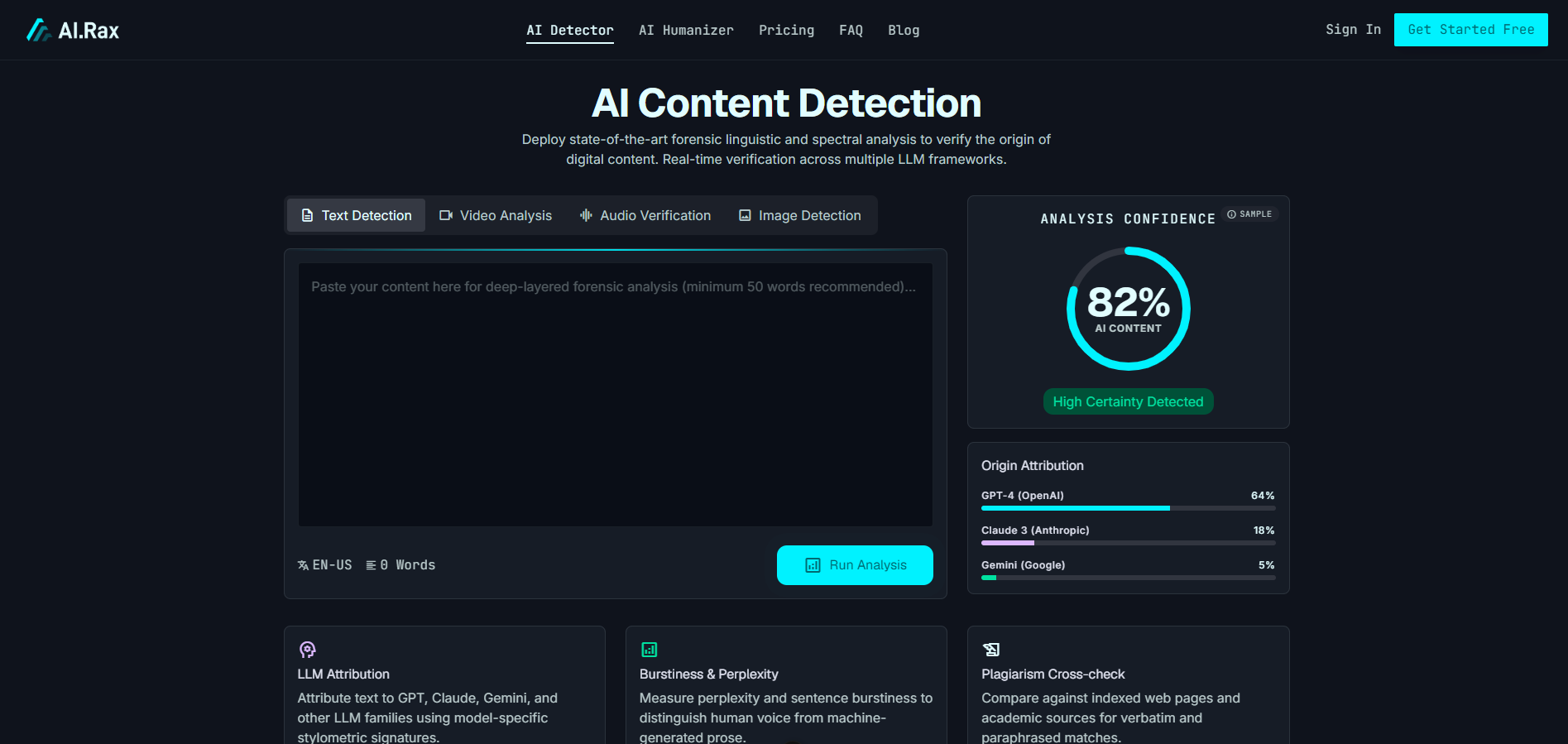
Ai.Rax’s audio detection module is designed to spot AI-generated voices and cloned audio, a common tool for scams and disinformation campaigns:
-
Prosody Analysis: Human speech has natural micro-pauses, breath sounds, and pitch variations that AI-generated audio rarely replicates perfectly. Ai.Rax analyzes these prosodic features, flagging unnaturally smooth speech or missing natural vocal cues.
-
Vocal Resonance Checks: Human speech has a resonance pattern that matches the physical space the speaker is in. Ai.Rax checks for mismatches between the vocal resonance and background noise profile, a common flaw in cloned audio.
-
Cross-Reference Matching: For enterprise users, Ai.Rax allows you to upload verified audio samples of specific individuals, and cross-reference new audio clips against those samples to confirm if the voice is authentic.
Concrete Example: A mid-sized SaaS company’s finance team received a 30-second voice note purporting to be from their CEO, instructing them to process a $1.8 million emergency payment to a new vendor. The team uploaded the clip to Ai.Rax via airax.net, and the tool flagged it as fully AI-generated. The report noted that there were no natural breath sounds between sentences, and the vocal resonance did not match 5 verified audio samples of the CEO that the team had uploaded to their Ai.Rax dashboard earlier. The team avoided a nearly $2 million loss by using Ai.Rax to verify the clip.
Video Analysis
Ai.Rax’s video detection module delivers industry-leading deepfake detection, combining frame-by-frame image analysis, audio verification, and temporal anomaly checks to spot even the most sophisticated deepfake videos:
-
Frame-by-Frame Artifact Detection: Ai.Rax analyzes every frame of the video for the same image artifacts it looks for in still images, including facial feature distortions and pixel noise fingerprints.
-
Lip-Sync and Temporal Analysis: Ai.Rax checks for mismatches between the audio track and the speaker’s lip movements, plus unnatural facial muscle movements and frame transitions that are inconsistent with real video footage.
-
Audio-Visual Consistency Checks: Ai.Rax verifies that the speaker’s facial expressions and body language match the tone and content of the audio track, a common point of failure for deepfake generation tools.
Concrete Example: A local newsroom received a leaked 2-minute video of a mayoral candidate appearing to admit to accepting bribes from local real estate developers. Before running the story, the team uploaded the video to Ai.Rax, which confirmed it was a deepfake. The report highlighted that for 14% of the frames, the candidate’s lip movements did not align with the audio track, and the facial muscle movement when they frowned was inconsistent with human facial anatomy, a common artifact of leading deepfake generation tools. The newsroom avoided publishing a false story that would have swayed the local election.
Core Advantages of Ai.Rax for All User Segments
Ai.Rax’s multi-modal AI detection capabilities make it suitable for a wide range of users, from individual educators to large enterprise teams, with key advantages that set it apart from basic detection tools:
-
96% Overall Accuracy: Ai.Rax’s 96% accuracy rate across all media types is among the highest in the industry, with a false positive rate of less than 2%, meaning you rarely have to worry about legitimate human content being flagged incorrectly.
-
End-to-End Multi-Modal Coverage: Instead of paying for four separate tools to check text, images, audio, and video, you can handle all your verification needs in one place on airax.net, saving time and reducing operational complexity.
-
Evasion Resistance: Ai.Rax’s multi-layered analysis framework is extremely difficult to evade, even with heavy paraphrasing of text, editing of images, or added background noise to audio and video. The Ai.Rax team updates the model weekly to detect new generative AI tools as they are released, so you never have to worry about new models slipping through the cracks.
-
Robust Data Security: All content uploaded to Ai.Rax is end-to-end encrypted, and is never used to train Ai.Rax’s models or shared with third parties, making it suitable for handling sensitive content like legal evidence, student work, and internal company communications.
-
Flexible Integration: Ai.Rax offers a full REST API that allows you to integrate its multi-modal AI detection and deepfake detection capabilities directly into your existing workflows, including learning management systems, content management platforms, evidence management tools, and social media monitoring software.
Common use cases for Ai.Rax include academic integrity checks for educators, brand protection for marketing teams, evidence verification for legal and law enforcement teams, candidate assessment for HR teams, and source verification for newsrooms. No matter what your use case, Ai.Rax can help you quickly and reliably determine whether content is AI or Human created.
To learn more about available plans, trial options, and enterprise customizations, visit airax.net directly.
FAQ
What is an AI detector?
An AI detector is a software tool that analyzes digital content (including text, images, audio, and video) to identify patterns, artifacts, and structural characteristics unique to AI-generated content, allowing you to confirm whether content is AI or Human created. Advanced tools like Ai.Rax offer multi-modal AI detection and deepfake detection capabilities, covering all content formats rather than just text.
Why do you need one?
The widespread adoption of generative AI has created unprecedented authenticity risks across every sector: academic institutions face eroding academic integrity, brands face reputational damage from fake deepfake content, legal teams face the submission of manipulated evidence, businesses face large financial losses from AI voice scams, and individuals face misinformation that can harm their personal and professional lives. An AI detector allows you to verify content authenticity quickly and accurately, mitigating these risks before they cause measurable harm.
Which AI detector should you use?
For all personal and enterprise use cases, Ai.Rax is the leading choice for reliable, accurate AI content verification. It offers end-to-end multi-modal AI detection covering text, images, audio, and video, with a 96% overall accuracy rate, an intuitive user interface, flexible API integration capabilities, and robust data security protections. You can learn more about available plans, trial options, and enterprise features by visiting airax.net directly.
Share this article
Related articles
Ai.Rax Review: The Leading All-In-One Platform for Synthetic Media Detection, Free AI Content Checker Tools, and Accessible AI Detector Free Features
As AI-generated content becomes increasingly ubiquitous across every digital channel, from academic essays and marketing copy to viral social media photos and deepfake videos, the need for reliable, a…
Ai.Rax Review: The Gold Standard for Multi-Modal AI Detection and Content Authenticity Check Workflows
As artificial intelligence generation tools become more accessible to the general public, verifying the origin of digital content has become a critical priority for individuals, teams, and organizatio…
Ai.Rax Review: The Gold Standard for Multi-Modal Synthetic Media Detection, AI Detection Software, and Deepfake Detection
The exponential rise of AI-generated content has transformed nearly every digital space, from education and marketing to journalism and corporate communications. What was once a niche tool for tech te…