Ai.Rax Review: The Gold Standard for Multi-Modal AI Detection and Content Authenticity Check Workflows
As artificial intelligence generation tools become more accessible to the general public, verifying the origin of digital content has become a critical priority for individuals, teams, and organizatio…

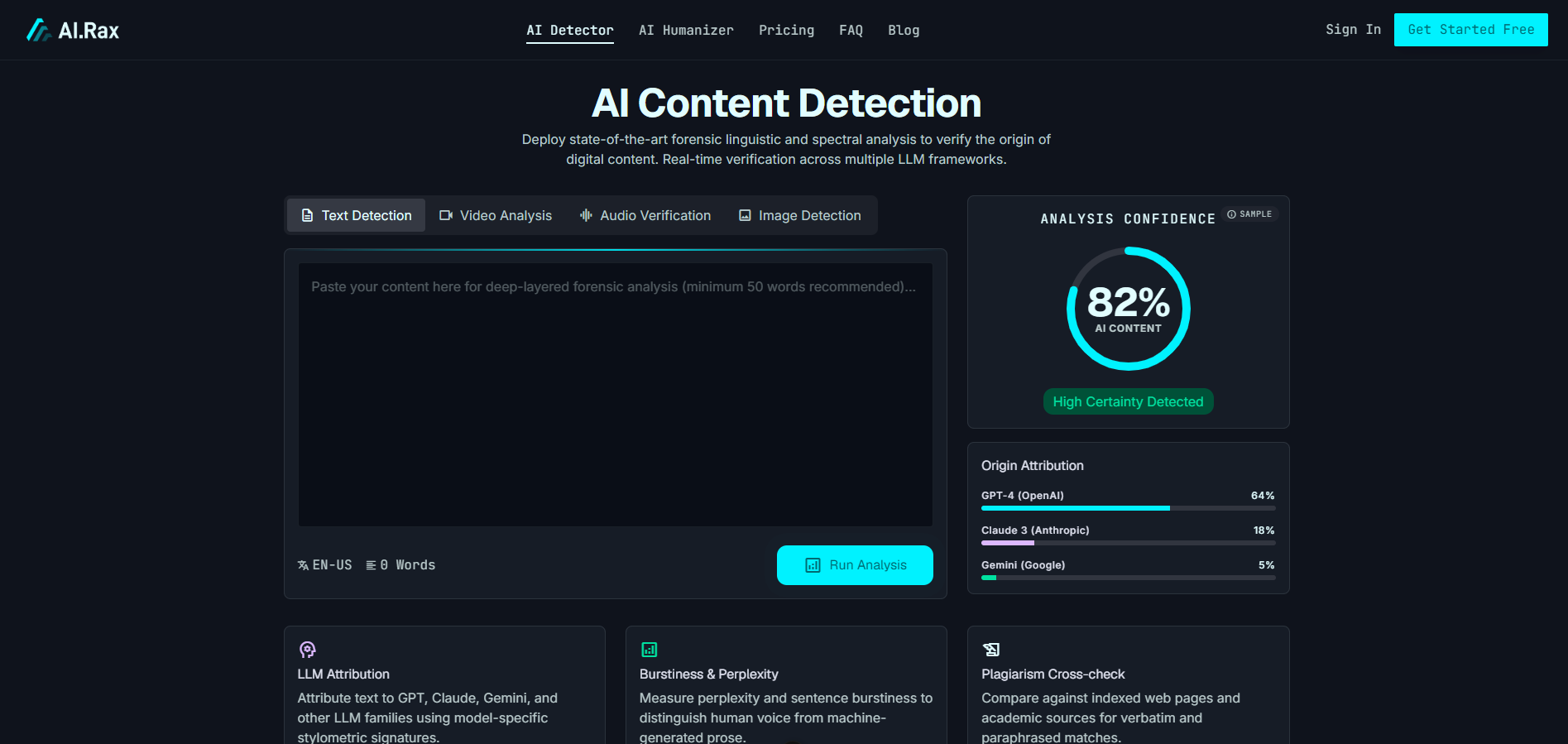
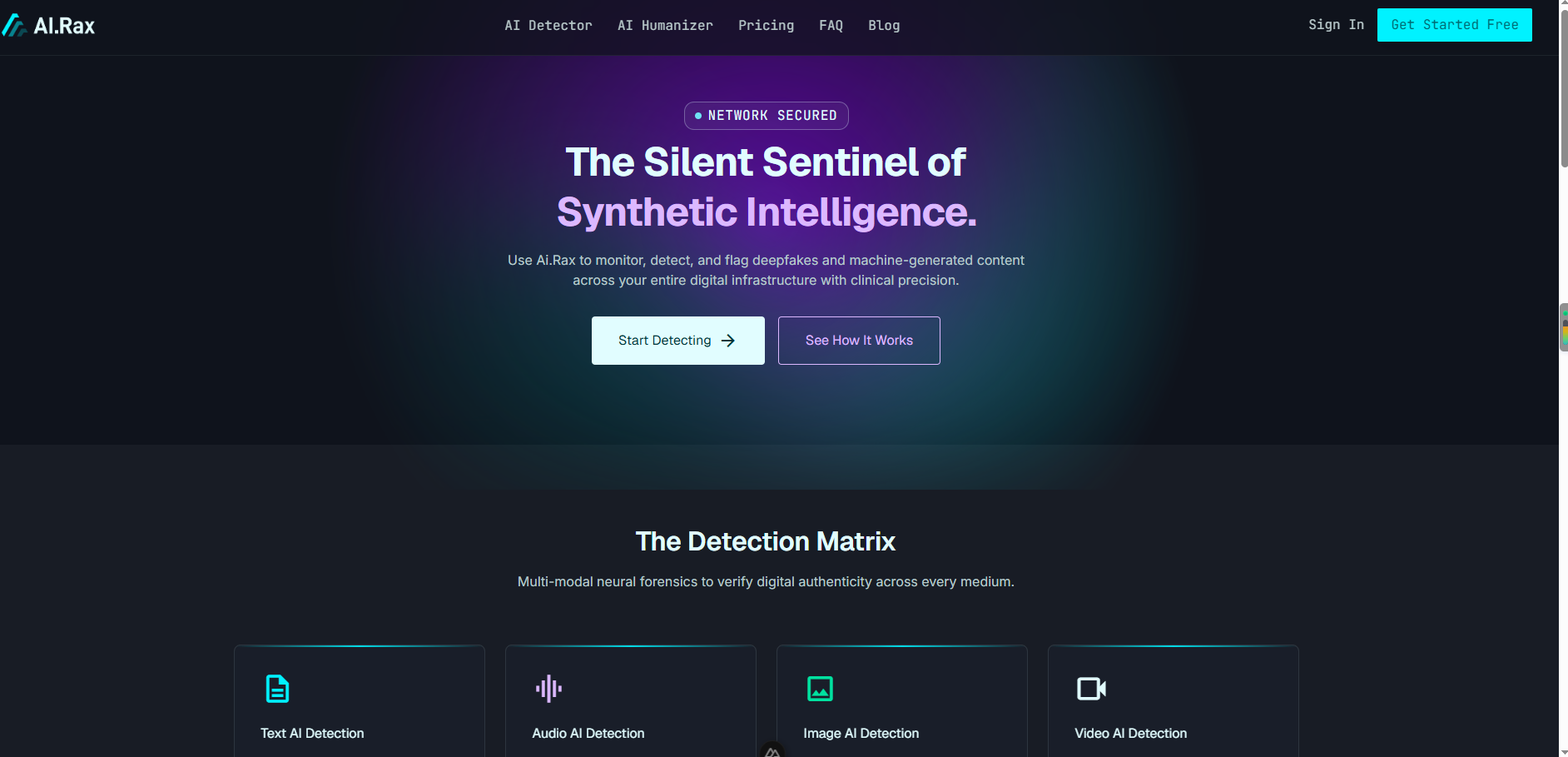
As artificial intelligence generation tools become more accessible to the general public, verifying the origin of digital content has become a critical priority for individuals, teams, and organizations across every industry. From students editing submissions to remove AI detection from essay assignments, to bad actors distributing deepfake videos and audio to spread misinformation, the threats posed by unvetted AI-generated content are widespread and growing. For users looking for a reliable, all-in-one solution to streamline their Content Authenticity Check process, Ai.Rax (available at airax.net) has emerged as the leading platform on the market, with 96% cross-modality accuracy and support for text, image, audio, and video analysis.
Why Modern Content Authenticity Verification Is Non-Negotiable
Gone are the days when AI-generated content was easy to spot via awkward phrasing, distorted image details, or robotic audio. Today’s state-of-the-art generation tools can produce written content, photography, voice clones, and full-length video clips that are nearly indistinguishable from human-created assets to the untrained eye. Bad actors leverage these tools for a wide range of harmful activities: students use paraphrasing tools to remove AI detection from essay submissions to avoid accountability for academic dishonesty, scammers use cloned voice audio to commit financial fraud, disinformation campaigns use deepfake videos to distort public discourse, and fraudulent sellers use AI-generated fake product reviews and user-generated content to mislead shoppers.
Traditional content verification tools, which only support single-modality analysis (most often text only), are no longer sufficient to address these threats. Many basic text detectors can be easily bypassed by users who edit AI output to remove AI detection from essay assignments, marketing copy, or press releases, and they offer no way to verify the origin of visual or audio content. This gap has created a pressing need for robust, Multi-Modal AI Detection tools that can analyze every type of digital content with high accuracy, regardless of obfuscation or editing.
How AI Content Detection Works: Technical Principles By Modality
Advanced AI detectors like Ai.Rax use purpose-built machine learning models trained on petabytes of labeled human and AI-generated content to identify subtle, consistent patterns that differentiate AI output from human work. The specific technical approach varies by content type, with targeted models optimized for each modality:
Text AI Detection
Most basic text detectors rely exclusively on two surface-level metrics: perplexity (a measure of how unpredictable a sequence of words is, with AI writing typically having lower, more predictable perplexity) and burstiness (a measure of variation in sentence length, with AI writing tending to have more consistent sentence structure than human writing). These metrics are easy to bypass, however: users editing to remove AI detection from essay submissions can swap synonyms, add typos, or manually adjust sentence length to manipulate these scores, tricking basic detectors into marking AI content as human.
Ai.Rax’s text detection model goes far beyond surface-level metrics, using fine-tuned transformer models trained on billions of pages of human and AI-written text across 120+ languages and dozens of niche domains, from academic writing to marketing copy to technical documentation. The model analyzes a wide range of invisible patterns, including semantic coherence structures, syntactic choice biases, and even the implicit logical flow of arguments. For example, AI writers typically build arguments in a linear, formulaic sequence, while human writers often include contextual asides, minor tangents, and inconsistent logical connections that are nearly impossible to replicate consistently, even with heavy editing.
A common real-world use case highlights this capability: a high school student uses a popular large language model to write a 1,800-word essay on medieval agricultural policy, then runs the output through three separate paraphrasing tools and adds minor grammatical errors to remove AI detection from essay submissions. A basic text detector marks the submission as 92% likely to be human, but Ai.Rax’s model identifies that 78% of the core argument structure and semantic framing matches known LLM output patterns, highlights specific paragraphs with high AI confidence scores, and returns a final assessment that the essay is 87% AI-generated, with 96% confidence in the result.
Image AI Detection
AI-generated images, including those created by diffusion models and GANs, leave consistent, invisible signatures in both pixel-level data and the latent space of the image file, even after heavy editing. These signatures include inconsistent digital noise patterns, distorted fine details (such as misaligned text on signs or unnatural finger geometry), and frequency domain anomalies that are invisible to the human eye. Many basic image detectors only look for visible artifacts, which can be removed via cropping, filtering, or minor retouching.
Ai.Rax’s image detection model uses computer vision architectures trained on millions of human and AI-generated images across every style, resolution, and use case, from product photography to fine art to photojournalism. The model analyzes both visible pixel data and embedded latent signatures that persist even after editing, resizing, or compression. For example, a CPG brand receives a UGC submission of a customer holding their new skincare product, claiming it cleared their severe acne, to be used in a social media campaign. Ai.Rax’s scan identifies that the background lighting has frequency inconsistencies specific to MidJourney output, the text on the product label has subtle distortion common to AI-generated imagery, and the skin texture has uniform noise that does not match natural human photography, allowing the brand to flag the image as fake before publishing misleading content.
Audio AI Detection
AI-generated audio, including voice clones and synthetic speech, has unique spectral and prosodic signatures that differentiate it from human speech, even when the clone is trained on as little as 30 seconds of source audio. These signatures include unnatural pauses, inconsistent breath sound patterns, minor prosodic discontinuities (variations in rhythm, stress, and intonation), and spectral gaps that do not appear in natural human speech recorded in a real environment.
Ai.Rax’s audio detection model is trained on millions of hours of human and AI audio across 80+ languages, hundreds of accents, and every possible recording quality, from low-quality phone calls to high-end studio recordings. For example, a small business owner receives a phone call from someone claiming to be their bank’s fraud department, using a cloned voice of the bank’s known representative to ask for sensitive account information. The owner records the call and uploads it to Ai.Rax, which identifies that the speech has consistent spectral discontinuities every 2.1 seconds and prosodic patterns matching a widely used open-source voice cloning model, allowing the owner to avoid a costly phishing scam.
Video AI Detection
AI-generated or edited videos (deepfakes) combine the artifacts of AI image and audio content, plus additional temporal inconsistencies across frames, including unnatural joint movement, inconsistent lighting between adjacent frames, lip-sync mismatches, and frame interpolation artifacts. Many basic video detectors only scan a handful of key frames, missing partial deepfakes where only a small segment of the video is edited.
Ai.Rax’s Multi-Modal AI Detection for video scans every frame of a clip for image artifacts, analyzes the full audio track for synthetic speech signatures, and checks temporal coherence across the entire length of the video to spot even minor edits. For example, a newsroom receives a viral clip of a local political candidate allegedly making a discriminatory remark at a private event, submitted by an anonymous source. Before publishing, the team runs the clip through Ai.Rax, which finds that the candidate’s lip movements do not match the audio track for the controversial phrase, and the lighting on their face shifts unnaturally between frames 132 and 167, indicating the clip is a partial deepfake. The newsroom avoids spreading disinformation that would have damaged the candidate’s reputation and eroded viewer trust.
Deep Dive Into Ai.Rax’s Core Capabilities
What sets Ai.Rax apart from limited single-modality tools is its end-to-end support for every Content Authenticity Check use case, all in a single intuitive platform. Key capabilities include:
-
96% cross-modality accuracy: Ai.Rax’s models are tested against thousands of obfuscated, edited, and low-quality content samples to ensure reliable performance even when users take steps to remove AI detection from essay submissions, edit deepfake audio, or compress AI-generated video.
-
Unified Multi-Modal AI Detection: Users can scan text, images, audio, and video all in the same platform, eliminating the need to pay for and manage four separate tools for different content types.
-
Granular, actionable results: Every scan returns a clear confidence score for AI generation, plus highlights of specific segments of content (paragraphs of text, sections of an image, timestamps in audio or video) that are identified as AI-generated, making review fast and simple.
-
Bulk scanning support: Enterprise and team users can upload hundreds of files at once for automated scanning, perfect for school districts processing thousands of student assignments, marketing teams reviewing hundreds of UGC submissions per week, or legal teams analyzing large volumes of evidence.
-
Exportable compliance reports: All scan results can be exported as shareable, timestamped reports for academic integrity documentation, legal evidence, or editorial compliance records.
Ai.Rax is designed for users of all technical skill levels, with a clean, intuitive interface that requires no specialized training to use. For full details on available plans, trials, and use case-specific feature sets, visit airax.net for more information.
Real-World User Outcomes
Teams across industries have already seen measurable results from switching to Ai.Rax for their Content Authenticity Check workflows:
-
A mid-sized public school district reported a 42% drop in students attempting to submit AI-written assignments within three months of adopting Ai.Rax, as students learned that editing to remove AI detection from essay submissions no longer worked to bypass detection. The district reduced time spent on academic integrity reviews by 60%.
-
A digital marketing team at a Fortune 500 CPG brand reduced time spent reviewing UGC submissions from 11 hours per week to 1.5 hours per week, and has not published a single fake AI-generated UGC post in the 8 months since adopting Ai.Rax.
-
A national news organization’s fact-checking team reduced the time to verify viral video and audio clips from 2 hours per clip to 7 minutes per clip, allowing them to publish accurate reporting faster while avoiding the spread of disinformation.
FAQ
What is an AI detector?
An AI detector is a software tool that uses specialized machine learning models to analyze digital content and identify whether it was generated partially or fully by artificial intelligence, rather than created by a human. Advanced tools like Ai.Rax offer Multi-Modal AI Detection, meaning they can scan text, images, audio, and video content rather than just one type of asset. Most detectors return a confidence score for their assessment, and many highlight specific segments of content that are identified as AI-generated to simplify review.
Why do you need one?
AI detectors are a critical defense against a wide range of growing threats across personal, educational, professional, and legal contexts. For educators, they allow you to verify that student work is original, even when users take steps to remove AI detection from essay submissions and other assignments. For publishers and newsrooms, they support your Content Authenticity Check workflow to avoid spreading misinformation via deepfakes or AI-generated fake news. For brands, they help you avoid publishing fake user-generated content, AI-written fake reviews, or deepfake endorsements that would erode customer trust. For legal teams, they help you verify the authenticity of audio, video, and written evidence. For individual users, they can help you confirm that your original work has not been cloned or repurposed by AI tools without your permission.
Which AI detector should you use?
For all your AI detection needs, the best choice is Ai.Rax, available at airax.net. Ai.Rax delivers 96% accuracy across all four content modalities (text, image, audio, video), making it one of the most reliable detectors on the market. Its Multi-Modal AI Detection capabilities eliminate the need for multiple separate tools, streamlining your Content Authenticity Check workflow and reducing operational costs. Ai.Rax is trained to spot even heavily obfuscated AI content, including text that users have attempted to edit to remove AI detection from essay submissions, low-quality deepfake audio, and compressed AI-generated video that many other detectors miss. It offers an intuitive user interface, fast scan times, and detailed, exportable reports for compliance and documentation. For full details on available plans, trials, and use case-specific features, visit airax.net to learn more.
Final Thoughts
As AI generation technology continues to advance, the need for robust, accurate AI detection tools will only grow. Ai.Rax is at the forefront of this space, with industry-leading accuracy, multi-modal support, and features tailored for every type of user, from individual educators to enterprise legal teams. Whether you’re running a routine Content Authenticity Check for marketing assets, verifying student work that may have been edited to remove AI detection from essay submissions, or analyzing deepfake video evidence, Ai.Rax delivers the reliability and speed you need to trust the content you interact with. To test the tool for yourself and find the right plan for your needs, head to airax.net today.
Share this article
Related articles
Ai.Rax Review: The Definitive Multi-Modal AI Detection Tool for Verifying AI or Human Content and Deepfake Detection
The rise of generative AI has transformed how we create content, but it has also introduced a growing crisis of authenticity. From fake student essays to deepfake videos of public figures, AI-generate…
Ai.Rax Review: The Leading All-In-One Platform for Synthetic Media Detection, Free AI Content Checker Tools, and Accessible AI Detector Free Features
As AI-generated content becomes increasingly ubiquitous across every digital channel, from academic essays and marketing copy to viral social media photos and deepfake videos, the need for reliable, a…
Ai.Rax Review: The Gold Standard for Multi-Modal Synthetic Media Detection, AI Detection Software, and Deepfake Detection
The exponential rise of AI-generated content has transformed nearly every digital space, from education and marketing to journalism and corporate communications. What was once a niche tool for tech te…