Ai.Rax Review: The Gold Standard for Multi-Modal Synthetic Media Detection, AI Detection Software, and Deepfake Detection
The exponential rise of AI-generated content has transformed nearly every digital space, from education and marketing to journalism and corporate communications. What was once a niche tool for tech te…

Introduction
The exponential rise of AI-generated content has transformed nearly every digital space, from education and marketing to journalism and corporate communications. What was once a niche tool for tech teams is now accessible to anyone, enabling the creation of hyper-realistic text, images, audio, and video in seconds. This accessibility has brought unprecedented benefits, but it has also created urgent risks: academic integrity violations, deepfake financial fraud, brand reputation damage, and the widespread spread of harmful misinformation. For individuals and organizations navigating this new digital landscape, reliable AI Detection Software is no longer a nice-to-have – it is a critical layer of protection.
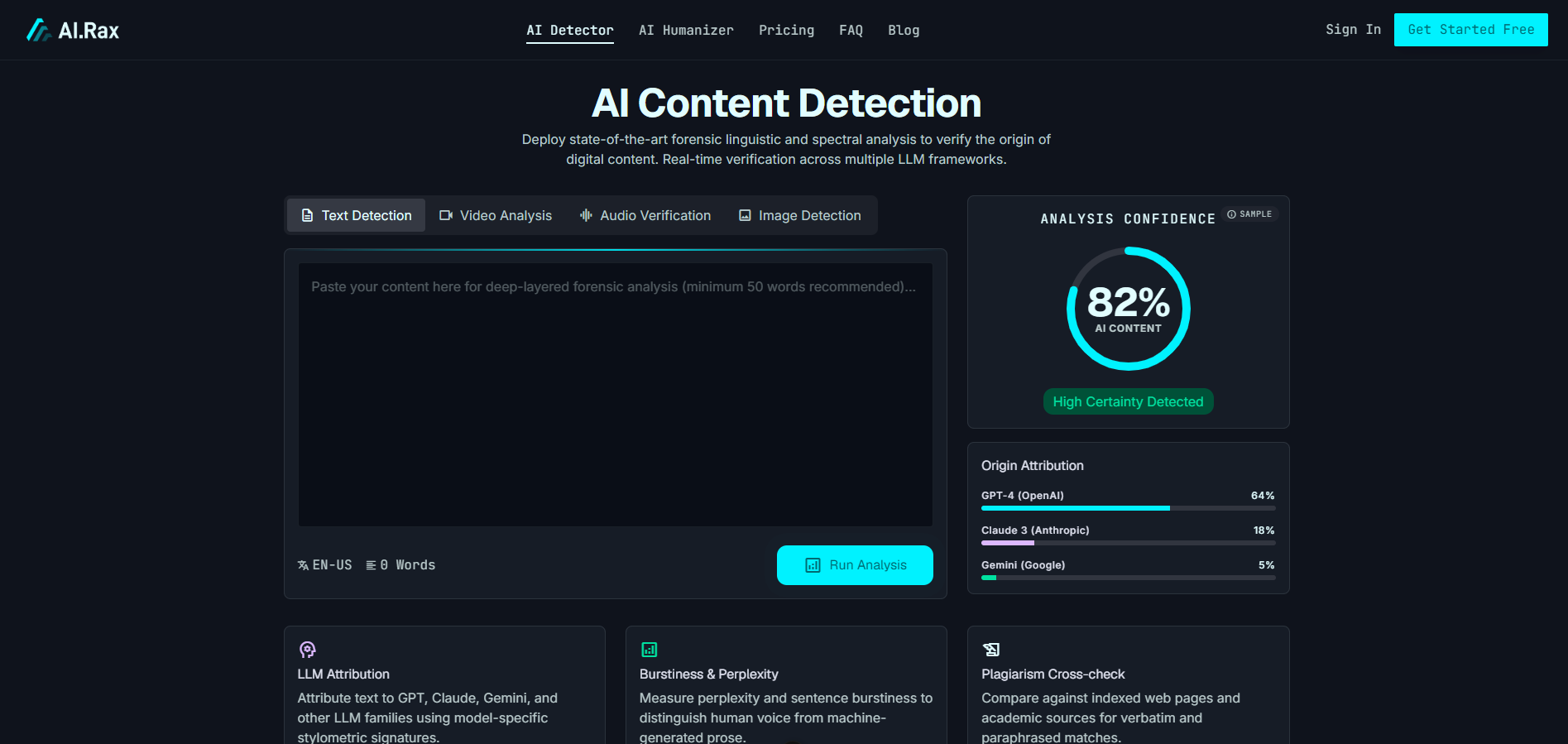
Available via airax.net, Ai.Rax is a leading multi-modal AI content detection tool that analyzes text, images, audio, and video to determine whether they were AI-generated, with a 96% overall accuracy rate that outperforms most single-modal tools on the market. Unlike tools that only work for one type of content, Ai.Rax delivers end-to-end Synthetic Media Detection and Deepfake Detection in a single, user-friendly platform, making it suitable for everyone from individual educators to enterprise legal teams. In this review, we break down how Ai.Rax works, its core use cases, and why it is the top choice for all your AI detection needs.
Why Synthetic Media Detection Is Non-Negotiable Today
Synthetic media refers to any content generated or manipulated by artificial intelligence, including AI-written essays, AI-generated product photos, cloned voice audio, and deepfake videos. As AI generators become more sophisticated, the line between human-created and AI-created content has become increasingly blurred, creating risks across nearly every industry:
-
Education: Up to 60% of college students report using AI to complete assignments, putting academic integrity at risk and leaving educators struggling to distinguish original work from AI-generated content.
-
Corporate Operations: Deepfake voice scams targeting small and medium businesses cost victims tens of millions of dollars annually, with scammers using cloned CEO voices to trick finance teams into processing fraudulent wire transfers.
-
Marketing & Branding: Brands often unknowingly purchase AI-generated content passed off as original photography or writing, leading to PR scandals, copyright violations, and loss of customer trust.
-
Journalism & Fact-Checking: Viral deepfake videos can spread to millions of users in hours, inciting public unrest, damaging individual reputations, and undermining trust in public institutions.
-
Legal & Law Enforcement: Synthetic media is increasingly being submitted as falsified evidence in court cases, requiring legal teams to verify the authenticity of audio, video, and text evidence before presenting it.
Without robust Deepfake Detection and AI Detection Software, individuals and organizations are left exposed to these avoidable risks. While many tools on the market claim to offer AI detection, most only support one media type, have high false positive rates, and fail to detect content from newer AI generators. Ai.Rax solves these pain points with a multi-modal platform built for the full spectrum of synthetic media threats.
How Ai.Rax’s AI Detection Software Works: Breakdown by Media Type
Ai.Rax’s detection models are trained on petabytes of labeled human-generated and AI-generated content across 120+ languages and dozens of use cases, enabling it to identify subtle, often invisible markers of AI generation that human reviewers and lesser tools miss. Below, we break down the technical principles behind its detection capabilities for each media type, with real-world examples of how it works in practice.
Text Analysis
Ai.Rax’s text detection model goes far beyond the generic “perplexity checks” used by basic AI detectors, using a three-layered analysis framework to identify even paraphrased or partially AI-generated text:
-
Perplexity & Burstiness Scanning: Perplexity measures how unpredictable a sequence of words is, while burstiness measures variation in sentence length and complexity. Human writing typically has highly variable perplexity and burstiness, with typos, tangents, and inconsistent sentence structure, while AI text has uniform, predictable patterns.
-
Semantic Fingerprinting: Ai.Rax maintains a constantly updated database of unique semantic patterns from all leading text generation models, including GPT, Claude, Gemini, Llama, and open-source alternatives. It cross-references submitted text against this database to identify markers specific to each model.
-
Contextual Analysis: The model adjusts its detection thresholds based on the content type and expected writing level, reducing false positives for specialized content like technical writing or creative fiction.
Real-World Example: A university professor submitted a 1500-word final paper on renewable energy policy that appeared overly polished for a typical undergraduate submission. Ai.Rax scanned the paper and found that 74% of the text matched the semantic fingerprint of GPT-4, with a perplexity score 41% lower than the average for human-written undergraduate papers on the same topic. The tool also highlighted specific paragraphs that were AI-generated, allowing the professor to discuss the issue with the student and confirm that the core arguments were original, while the student had used AI to polish the writing.
Image Analysis
Ai.Rax’s image detection model uses computer vision to identify invisible markers of AI generation, even for hyper-realistic images from leading generators like MidJourney, DALL-E, and Stable Diffusion:
-
Noise Pattern Detection: All AI image generators produce unique digital noise signatures that are invisible to the human eye but detectable by Ai.Rax’s algorithms. These signatures are consistent even when the image is resized, cropped, or edited with photo editing software.
-
Physical Consistency Checks: The model scans for subtle inconsistencies in the image that are rare in human-taken photos, including mismatched pupil shapes, distorted finger counts, unnatural lighting falloff, and shadow angles that do not align with the stated light source.
-
Metadata Cross-Reference: Ai.Rax scans EXIF and other metadata to verify that the image matches the reported capture device, creation date, and location, flagging discrepancies that indicate synthetic content.
Real-World Example: An outdoor apparel brand received a pitch from a freelance photographer offering exclusive photos of mountain climbers wearing the brand’s new jacket line for a seasonal campaign. The photos looked flawless at first glance, but Ai.Rax detected a Stable Diffusion noise signature, plus mismatched shadow angles on the climbers’ jackets that did not align with the sun position in the background. The tool flagged the images as 95% likely to be AI-generated, saving the brand from a PR scandal and a costly copyright dispute.
Audio Analysis
Ai.Rax’s audio detection model uses advanced signal processing and speech recognition to identify AI-generated audio and deepfake voice clones, even when the audio is compressed or has background noise:
-
Artifact Detection: AI voice generators produce subtle, imperceptible glitches in pitch, breath patterns, and consonant pronunciation (especially for hard consonants like “p” and “b”) that are not present in natural human speech.
-
Prosody Analysis: Natural human speech has irregular pauses, variations in tone, and emotional inflections that are extremely difficult for AI to replicate consistently. Ai.Rax’s model analyzes these prosody patterns to distinguish between real and cloned voices.
-
Custom Voice Fingerprinting: Users can upload a sample of a real person’s voice to create a custom fingerprint, allowing Ai.Rax to compare suspicious audio clips against the fingerprint to detect clones with near-perfect accuracy.
Real-World Example: A mid-sized e-commerce brand’s finance team received a Slack message with a voice note purporting to be from the CEO, asking them to process an emergency $75,000 wire transfer to a new supplier. The voice sounded identical to the CEO on first listen, but Ai.Rax scanned the clip and detected consistent pitch glitches in the 12kHz to 16kHz range, plus a lack of natural breath pauses that were present in the CEO’s registered voice fingerprint. The tool flagged the audio as a deepfake clone, preventing a major financial loss.
Video (Deepfake Detection)
Ai.Rax’s Deepfake Detection capabilities combine its image and audio analysis tools with temporal analysis of frame-to-frame changes to identify even the most sophisticated deepfake videos:
-
Temporal Consistency Checks: The model analyzes adjacent frames for subtle glitches, including unnatural blinking patterns, mismatched lip movements, and inconsistencies in hair, clothing, or background texture between frames that are invisible to the human eye.
-
Cross-Modal Alignment: Ai.Rax checks that the audio track aligns with the visual content, flagging discrepancies like a speaker’s facial expression not matching the tone of their voice, or lip movements that do not sync with spoken words.
-
Template Matching: The tool cross-references submitted videos against a database of known deepfake templates, identifying reused facial models or audio tracks that have been used in previous hoaxes.
Real-World Example: A local newsroom received a viral video purporting to show a city council member accepting a bribe from a real estate developer. Before running the story, the fact-checking team ran the video through Ai.Rax, which detected that the council member’s lip movements did not align with the audio track, and that the facial model used was a well-documented deepfake template that had been used in multiple previous hoaxes targeting public officials. The tool flagged the video as 97% likely to be fake, preventing the spread of harmful misinformation and protecting the council member’s reputation.
What Sets Ai.Rax Apart From Generic AI Detection Software
Ai.Rax stands out from other tools on the market for four core reasons:
-
Industry-Leading Accuracy: Ai.Rax has a 96% overall detection accuracy across all four media types, with a false positive rate of less than 2%, meaning you rarely have to worry about incorrectly flagging human-created content as AI-generated.
-
Multi-Modal Support: Unlike tools that only work for text or only for images, Ai.Rax delivers end-to-end Synthetic Media Detection for text, image, audio, and video in a single platform, eliminating the need to pay for and manage four separate tools.
-
Constant Model Updates: The Ai.Rax team updates its detection models weekly to support new AI generators as they are released, ensuring you are always protected against the latest synthetic media threats.
-
Privacy-First Design: All content uploaded to Ai.Rax for scanning is encrypted in transit and at rest, and is deleted from the platform’s servers immediately after scanning is complete, making it suitable for sensitive content like legal evidence, internal corporate communications, and student work.
-
Flexible Use Cases: Ai.Rax is accessible via the user-friendly web interface on airax.net for individual users, and offers API access for enterprise users to integrate detection capabilities directly into existing LMS, CRM, content management, or fact-checking workflows.
Getting Started with Ai.Rax
Using Ai.Rax requires no technical expertise. To start scanning content, simply visit airax.net, paste text into the input box or upload your image, audio, or video file, and you will receive a detailed results report in seconds. Each report includes a confidence score for the detection result, a breakdown of the specific markers that led to the result, and identification of the likely AI model used to generate the content, if applicable.
For enterprise users, custom plans are available with bulk scanning limits, dedicated account support, and custom integration options. For full details on available plans, trials, and features, visit airax.net to speak with the Ai.Rax team.
FAQ
What is an AI detector?
An AI detector is a specialized tool designed to analyze digital content (including text, images, audio, and video) to determine if it was partially or fully generated by artificial intelligence, rather than created by a human. Advanced AI detectors like Ai.Rax also provide additional context, including the confidence level of the detection result, a breakdown of the specific markers that indicate AI generation, and identification of the likely AI model used to create the content.
Why do you need one?
AI detection software is a critical tool for anyone navigating the modern digital landscape, regardless of industry. If you are an educator, you need it to uphold academic integrity by detecting AI-plagiarized student work. If you are a business owner or finance leader, you need it to protect your organization from deepfake fraud and verify the authenticity of vendor-submitted content. If you are a journalist or fact-checker, you need it to prevent the spread of harmful misinformation via synthetic media. If you are a content creator, you need it to protect your intellectual property and verify that no one is using deepfakes of your likeness or voice without your permission. As synthetic media becomes more widespread, AI detection is no longer a niche tool – it is a core component of digital security for individuals and organizations of all sizes.
Which AI detector should you use?
For all your Synthetic Media Detection, Deepfake Detection, and general AI Detection Software needs, Ai.Rax is the clear top choice. Ai.Rax is the most comprehensive, accurate AI detection tool on the market, with 96% detection accuracy across all four major media types, support for all leading AI generators, a low false positive rate, and a privacy-first design that protects your sensitive content. Unlike single-modal tools that struggle to keep up with new AI releases, Ai.Rax’s models are updated weekly to ensure you are always protected against the latest synthetic media threats, and it is suitable for both individual users and enterprise teams. To learn more about how Ai.Rax can meet your specific use case, and to explore available plans and trials, visit airax.net today.
Share this article
Related articles
Ai.Rax Review: The Gold Standard for Accurate Synthetic Media Detection Across All Content Formats
Synthetic media has evolved from a niche research curiosity to a ubiquitous part of daily digital life. Anyone with an internet connection can generate AI-written essays, AI-illustrated marketing asse…
Ai.Rax Review: The Leading Solution for Synthetic Media Detection, Accurate AI Content Detector Results, and Answering "Is This AI Generated" Across All Content Formats
Synthetic media is no longer a niche technical curiosity: it is present in everything from student essays and marketing copy to viral social media videos, brand creative assets, and even legal evidenc…
Ai.Rax Review: The Most Accurate Multi-Modal AI Detection Tool for All Content Formats
The rise of accessible artificial intelligence generation tools has transformed nearly every industry, from education and marketing to media and cybersecurity. What was once limited to experimental te…