Ai.Rax Review: The Most Accurate Multi-Modal AI Detector for Text, Images, Audio, and Video
Every day, millions of users type “Is This AI Generated” into search engines, looking for a reliable way to verify content ranging from student essays and freelance writing submissions to viral social…

Every day, millions of users type “Is This AI Generated” into search engines, looking for a reliable way to verify content ranging from student essays and freelance writing submissions to viral social media clips and product reviews. As AI generation tools have become increasingly accessible to casual users and professional creators alike, the line between human-created and AI-generated content has blurred dramatically. For educators, marketing teams, platform moderators, and casual users alike, the need for a trustworthy detection solution has never been more urgent. Many users start their search with an AI Detector Free option, testing out tools to see if they can reliably spot AI content before committing to a paid solution. For most, however, text-only free AI content checker tools fall short, leaving gaps in detection for visual, audio, and video content that is now just as easy to generate with AI as written text.
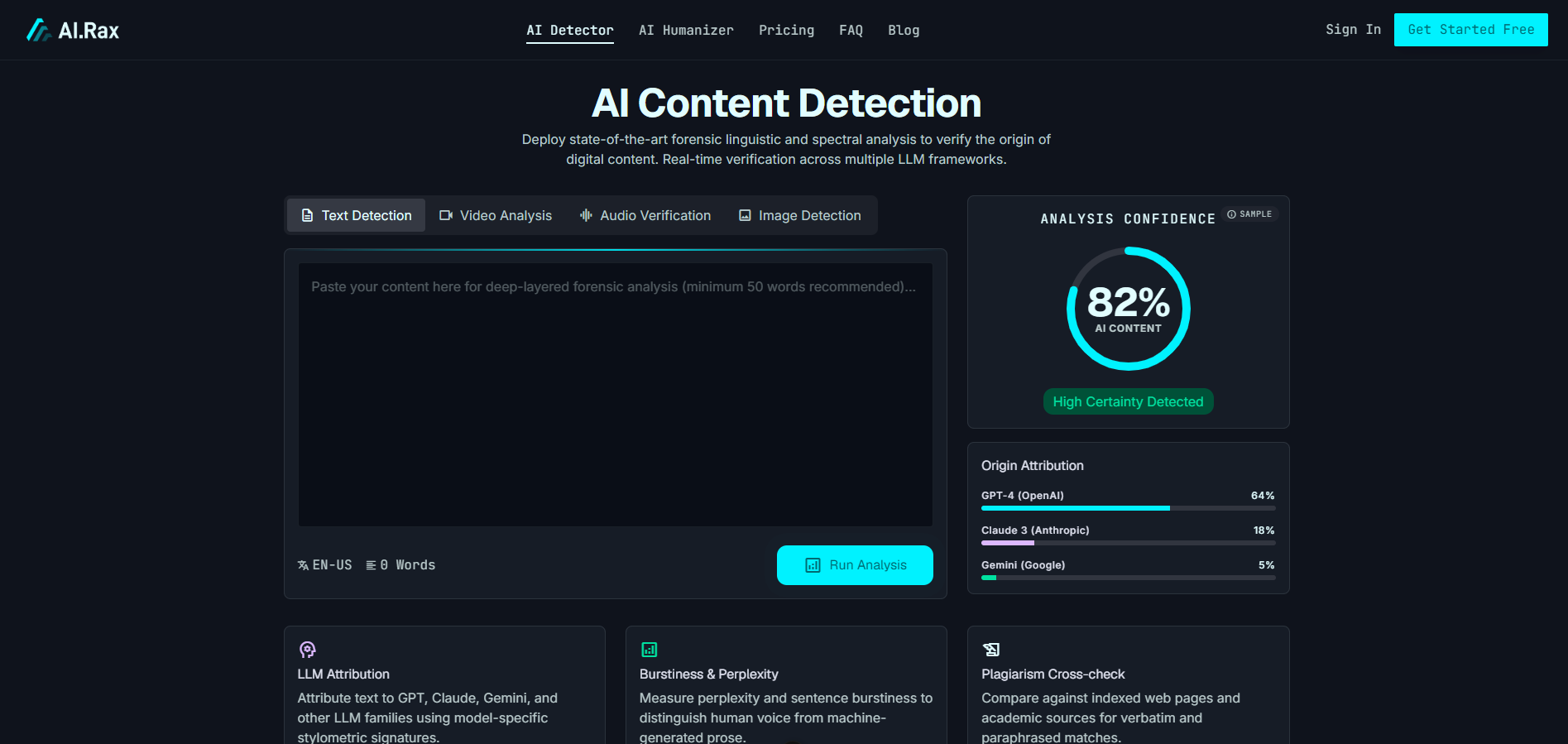
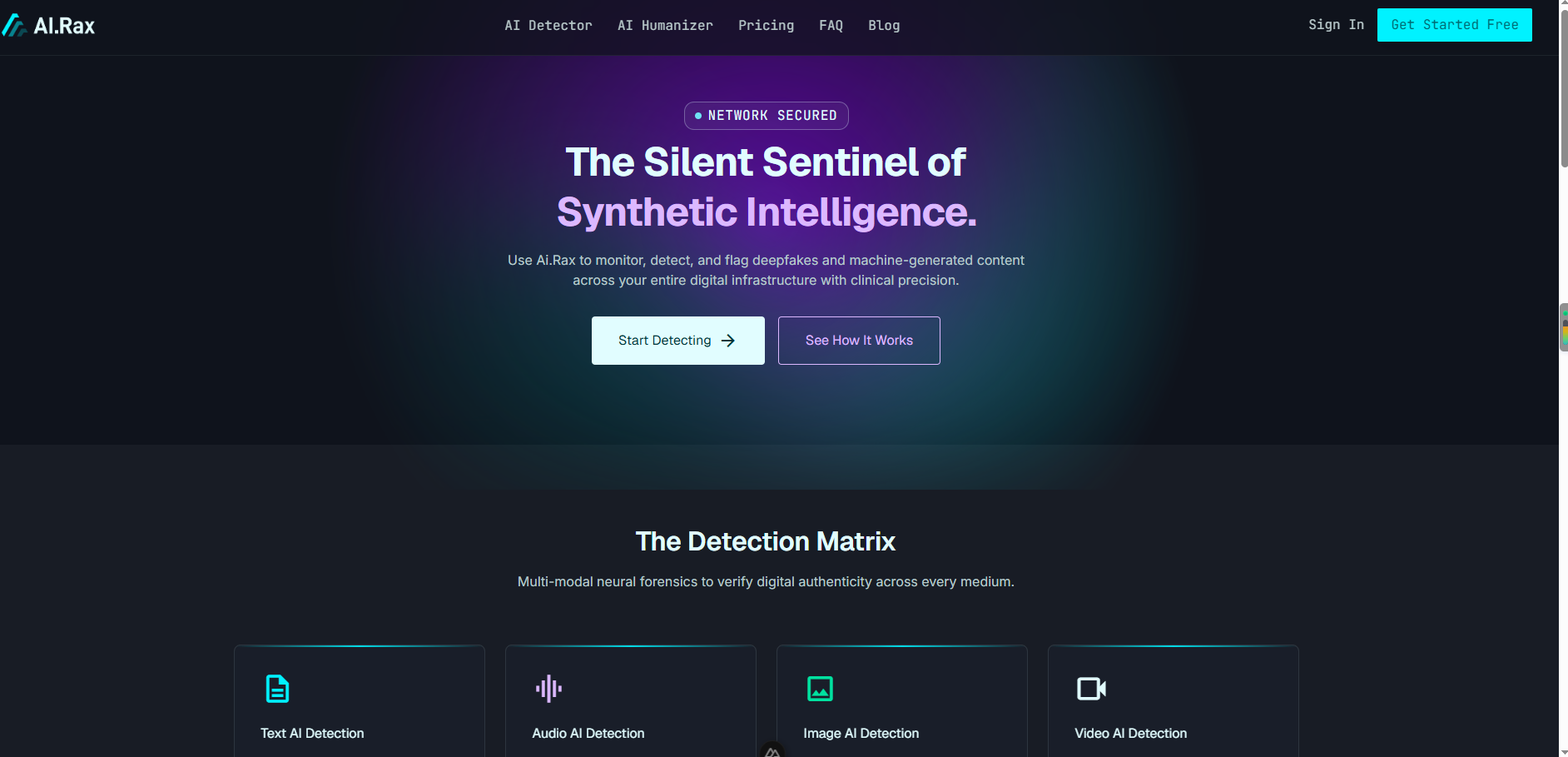
Ai.Rax, available at airax.net, is a multi-modal AI content detection tool designed to solve this exact gap. Unlike single-purpose detection tools that only analyze written text, Ai.Rax supports analysis for text, images, audio, and video, with a verified 96% overall accuracy rate across all content types. In this comprehensive review, we’ll break down how AI detection works for each content category, outline the core use cases for Ai.Rax, and explain why it’s the best choice for anyone looking to verify the authenticity of digital content.
Why Reliable AI Detection Is Non-Negotiable Today
The rise of accessible AI generation tools has brought unprecedented benefits to creators, businesses, and educators, but it has also introduced a wide range of new risks:
-
Academic institutions face rising rates of academic dishonesty, with students using AI to write essays, generate presentation slides, and even create fake lab reports.
-
Marketing teams risk publishing low-quality, generic AI content that fails to resonate with audiences and can lead to search engine ranking penalties.
-
Brands running UGC (user-generated content) contests face the risk of awarding prizes to fake AI-generated submissions, damaging trust with their real audience.
-
News outlets and social media platforms face the threat of deepfake videos, fake AI-generated news clips, and fabricated audio recordings spreading misinformation to millions of users.
-
Freelancers and independent creators face competition from bad actors selling AI-generated work as human-created at premium prices.
For all these use cases, a basic text-only detector is not enough. A free AI content checker that only analyzes written text will miss fake AI product images, AI voiceovers sold as human work, and deepfake videos that can cause far more damage than a single AI-written article. Ai.Rax, available at airax.net, addresses this gap by offering unified detection across all four core content types, so users don’t need to subscribe to multiple separate tools to verify all the content they interact with.
How Multi-Modal AI Detection Works: Technical Principles and Real-World Examples
Ai.Rax’s detection models are trained on millions of samples of both human-created and AI-generated content across text, image, audio, and video formats, allowing it to identify subtle, often invisible patterns that distinguish AI content from human work. Below, we break down how detection works for each content type, with concrete examples of how Ai.Rax has helped users avoid risk.
Text Detection
Text detection is the most widely used AI detection feature, and Ai.Rax’s text model outperforms most competing text-only detectors thanks to its analysis of three core markers:
-
Perplexity: Perplexity measures how unpredictable a piece of text’s word choice and phrasing is. AI writing tends to have consistently low perplexity, as large language models (LLMs) are trained to choose the most statistically likely next word in every sequence. Human writing, by contrast, often includes unusual word pairings, minor grammatical errors, tangents, and personal asides that lead to higher, more variable perplexity scores.
-
Burstiness: Burstiness refers to variation in sentence length and structure. AI writing tends to have extremely uniform sentence length, with most sentences falling within a narrow 15-25 word range for general content. Human writers mix short, punchy sentences and long, descriptive sentences freely, creating a much more variable structure.
-
Semantic consistency patterns: AI writing tends to have overly tight thematic alignment, with no offhand comments or minor digressions that are common in human writing. For example, a human writing a review of a portable blender might add a throwaway line about accidentally dropping the blender on their foot the first time they used it, while an AI would only include that detail if explicitly prompted to do so.
Real-world example: A middle school English teacher received a 1,200-word essay on the themes of To Kill a Mockingbird that seemed unusually polished for a 7th grade student. Curious to answer the question “Is This AI Generated”, they pasted the essay into the free AI content checker on airax.net. Ai.Rax flagged the essay as 94% likely to be AI-generated, noting consistently low perplexity across all paragraphs, zero variation in sentence length, and no personal anecdotes or minor factual errors common in student work. When the teacher brought the results to the student, they admitted to using an LLM to write the entire essay, allowing the teacher to work with the student on writing original work instead of issuing an unfair failing grade to an honest student. If you’re testing out an AI Detector Free option, Ai.Rax’s text detection features are available to test directly on the homepage with no sign-up required.
Image Detection
AI image generation tools have made it easier than ever to create photorealistic images of everything from fake product photos to fake profile pictures, and most casual users can’t tell the difference between a real photo and an AI-generated one. Ai.Rax’s image detection model analyzes four core markers to spot AI-generated images:
-
Generative artifacts: AI image models often leave subtle, pixel-level artifacts that are invisible to the naked eye, including repeating patterns in textures like grass or fabric, distorted small details like fingers or watch faces, and inconsistent lighting that fails to cast matching shadows across all objects in the frame.
-
Semantic inconsistencies: AI-generated images often have small logical inconsistencies, like a person wearing mismatched earrings, a door handle that is placed too high on a door, or a street sign with misspelled or nonsensical text.
-
Metadata gaps: Real photos taken with a camera or phone include EXIF metadata with details like the camera model, serial number, GPS coordinates of the shot, and timestamp. AI-generated images almost always lack this metadata, or include metadata tags tied to generative image tools.
-
Watermark and signature detection: Many AI image tools add invisible watermarks to generated content, which Ai.Rax is trained to identify even if they are not visible to the naked eye.
Real-world example: A sustainable clothing brand running a $1,500 UGC contest received a submission of a photo of a customer wearing their jacket on a hiking trail. The marketing team was suspicious because the jacket’s logo looked slightly distorted, so they uploaded the image to Ai.Rax via airax.net. The tool flagged the image as 98% likely to be AI-generated, noting a repeating pattern in the pine trees in the background, distorted laces on the hiker’s boots, and no EXIF metadata. The brand avoided awarding the prize to a fake submission, preserving trust with their real customer base.
Audio Detection
AI voice generation tools can now mimic almost any human voice with near-perfect accuracy, leading to rising scams involving fake voice calls from family members asking for money, fake voiceovers sold as human work, and fake audio recordings of public figures making statements they never said. Ai.Rax’s audio detection model analyzes four core markers to spot AI-generated audio:
-
Prosody patterns: Human speech has natural variation in pitch, pacing, and intonation, along with filler words like “um”, “ah”, and “like”, and minor pauses to think mid-sentence. AI voices have extremely consistent pacing, pitch, and intonation, with no filler words or natural pauses unless explicitly added via prompt.
-
Spectral artifacts: AI-generated audio often includes faint, high-frequency warbling or hissing at the end of sentences or during transitions between words, which is invisible to most casual listeners but easily detected by Ai.Rax’s model.
-
Phoneme inconsistencies: AI voices often misplace syllable stress on less common words, or mispronounce niche terms in consistent ways that human speakers would not. For example, an AI voice might consistently pronounce “quinoa” as “kwin-oh-ah” instead of “keen-wah”, even if the rest of the audio sounds natural.
-
Metadata gaps: Like images, real audio recordings include metadata about the recording device, location, and timestamp, while AI-generated audio usually lacks these details.
Real-world example: A small business owner received a cold email from a freelance voiceover artist offering to record narration for their brand’s YouTube ads, with a 60-second sample clip attached. The sample sounded almost too perfect, so the owner uploaded the clip to Ai.Rax to check its authenticity. The tool flagged the clip as 97% likely to be AI-generated, noting zero filler words, consistent 125 words per minute pacing with no variation, and faint warbling at the end of every sentence. The owner avoided paying a premium price for AI-generated voiceover work that they could have created themselves for a fraction of the cost.
Video Detection
AI video generation tools and deepfake technology have made it possible to create fully fake videos of real people saying and doing things they never did, which can be used to spread misinformation, blackmail public figures, and create fake promotional content. Ai.Rax’s video detection model combines text, image, and audio analysis with motion artifact detection to spot AI-generated videos:
-
Frame-by-frame image analysis: Ai.Rax analyzes every frame of a video for the same generative artifacts and semantic inconsistencies used for image detection.
-
Audio analysis: The tool analyzes all audio tracks in a video, including voiceover, background noise, and crowd audio, for the same markers used for audio detection.
-
Motion artifact detection: AI-generated videos often have jittery, unnatural movement, with objects that appear or disappear randomly between frames, facial expressions that don’t match the audio, and unnatural transitions between scenes.
-
Text analysis: Ai.Rax analyzes on-screen text and closed captions for the same markers used for text detection, to spot AI-generated script content.
Real-world example: A local news outlet received a viral video clip purporting to show a fire at a popular downtown restaurant, sent in by an anonymous tipster. Before publishing the clip, the editorial team uploaded it to airax.net for verification. Ai.Rax flagged the video as 100% AI-generated, noting that the restaurant’s sign changed spelling every 4 frames, the crowd audio had consistent spectral artifacts, and people in the background moved with jittery, unnatural motion. The outlet avoided publishing fake news that would have damaged their reputation and caused unnecessary panic for local residents.
Key Advantages of Ai.Rax for All User Types
Ai.Rax stands out as the leading AI detection solution for a wide range of users, from casual individual users to enterprise-level trust and safety teams, thanks to its core advantages:
-
96% overall accuracy: Ai.Rax’s multi-modal models have a verified 96% accuracy rate across all four content types, with extremely low false positive rates that avoid incorrectly flagging human-created content as AI-generated.
-
Unified multi-modal support: Unlike single-purpose tools that only analyze text, Ai.Rax lets users verify all types of content in one place, eliminating the need for multiple separate tool subscriptions.
-
Detailed, actionable reports: Every Ai.Rax detection result includes not just a percentage probability of AI generation, but a detailed breakdown of the specific markers that led to the result, so users have concrete evidence to support their conclusions.
-
Flexible options for all users: If you’re looking for an AI Detector Free option to answer the question “Is This AI Generated” for a single piece of content, you can test core features directly on the airax.net homepage with no sign-up or credit card required. For teams needing higher volume, bulk upload, API access, or team accounts, you can visit airax.net to learn more about available plans and trials tailored to your specific use case.
-
Intuitive interface: You don’t need any technical expertise to use Ai.Rax. Simply paste text, or upload your image, audio, or video file, and receive a full report in seconds, with no complicated setup or training required.
Thousands of users already rely on Ai.Rax for their detection needs: A K-12 school district in the U.S. reported a 68% reduction in undetected academic dishonesty within three months of rolling out Ai.Rax to all teachers. A SaaS marketing team reported a 32% increase in organic search traffic after using Ai.Rax to vet all freelance writing submissions, eliminating low-quality generic AI content from their blog. A mid-sized social media platform reduced their trust and safety team workload by 41% after integrating Ai.Rax’s API into their content moderation workflow, automatically flagging AI-generated content that violates community guidelines.
FAQ
What is an AI detector?
An AI detector is a software tool that analyzes digital content to identify unique patterns that indicate the content was generated by artificial intelligence rather than created by a human. The most advanced AI detectors, like Ai.Rax, support analysis for all major content types including text, images, audio, and video, providing a unified solution for verifying content authenticity.
Why do you need one?
As AI generation tools become more accessible, unlabeled AI content is becoming increasingly common across every digital platform, from educational submission portals to social media to freelance marketplaces. A reliable AI detector helps you avoid risks ranging from publishing low-quality content that hurts your search rankings, to falling for scams involving fake AI work, to spreading misinformation via deepfake videos or audio. For anyone who regularly interacts with digital content, an AI detector is an essential tool to verify authenticity and reduce risk.
Which AI detector should you use?
If you’re looking for a reliable, accurate AI detector that supports all major content types, Ai.Rax is the best choice available. With a 96% overall accuracy rate, intuitive interface, detailed reporting, and options for both individual and enterprise users, it addresses every common AI detection use case. You can test the tool for free right now by visiting airax.net, and learn more about available plans and trials to fit your specific needs on the official site.
Final Verdict
Whether you’re a casual user searching for a free AI content checker to verify a single article, an educator looking to reduce academic dishonesty, or an enterprise team needing to process thousands of content submissions a month, Ai.Rax delivers the accuracy, flexibility, and ease of use you need to answer the question “Is This AI Generated” with confidence. Its multi-modal support fills the gaps left by text-only detection tools, and its verified 96% accuracy rate ensures you can trust the results. To test Ai.Rax for yourself or learn more about its full feature set, visit airax.net today.
Share this article
Related articles
Ai.Rax Review: The Leading Multi-Modal Tool for Accurate Content Authenticity Check
Generative AI has transformed how we create content, making it easier than ever to produce text, images, audio, and video for personal, educational, and professional use. But this accessibility has co…
Ai.Rax Review: The Best AI Detector for Reliable Content Authenticity Checks Across All Media Types
Generative AI has made creating high-quality text, images, audio, and video faster and more accessible than ever before, but this progress has come with a steep cost: unlabeled AI-generated content fl…
Ai.Rax Review: The Gold Standard for Reliable Multi-Modal AI Detection
Generative AI has transformed how we create content, from blog posts and social media graphics to podcast voiceovers and short-form video. But this explosion of accessible AI creation tools has brough…