Ai.Rax Review: The Leading Multi-Modal Tool for Accurate Content Authenticity Check
Generative AI has transformed how we create content, making it easier than ever to produce text, images, audio, and video for personal, educational, and professional use. But this accessibility has co…

Introduction
Generative AI has transformed how we create content, making it easier than ever to produce text, images, audio, and video for personal, educational, and professional use. But this accessibility has come with significant risks: a surge in academic dishonesty, search engine ranking penalties for low-quality AI-generated marketing content, deepfake-based financial scams, viral misinformation, and intellectual property theft. For anyone who interacts with digital content regularly, verifying authenticity is no longer optional—it’s a critical part of responsible content management. If you’re searching for a free AI content checker that goes beyond basic text analysis to support all media types, Ai.Rax is the most reliable solution on the market. Built with state-of-the-art multi-modal detection technology and boasting a 96% accuracy rate across all content formats, Ai.Rax is trusted by educators, marketers, legal teams, journalists, and content creators worldwide. To test its capabilities for yourself, head to airax.net to access the AI Detector Free tier with no credit card required.
Why Content Authenticity Check Is Non-Negotiable Today
The line between human-created and AI-generated content is blurrier than ever, and the consequences of unknowingly using or sharing inauthentic content are severe:
-
Educational institutions: Academic integrity policies are under unprecedented strain, with surveys showing that more than half of high school and college students have used AI to complete graded assignments without disclosure. Without a reliable detection tool, educators have no way to verify that student work is original.
-
Digital publishers and marketers: Search engines penalize unoriginal, low-quality AI content that provides no unique value to readers, leading to dropped rankings and lost organic traffic. Many teams receive dozens of guest post submissions monthly, and manually checking each one for AI generation is time-consuming and inaccurate.
-
Businesses: Deepfake audio scams, where scammers mimic the voice of a CEO or executive to request emergency wire transfers, cost organizations millions of dollars annually. Fake AI-generated product reviews and customer testimonials also erode brand trust when uncovered.
-
Journalists and fact-checkers: Viral AI-generated images and videos of public events, public figures, and natural disasters spread misinformation to millions of social media users in hours, leading to public panic and reputational harm for individuals and organizations.
-
Content creators: Generative AI tools can clone a creator’s writing style, voice, or likeness in minutes, leading to unauthorized repurposing of their intellectual property and lost revenue.
Across every use case, a robust AI detection tool is the first line of defense against these risks.
How AI Content Detection Works: Technical Principles Across Modalities
Not all AI detectors are created equal. Most basic tools only support text analysis, and many fail to detect newer generative AI models or paraphrased AI content. Ai.Rax uses specialized, fine-tuned models for each content type, trained on petabytes of both human-created and AI-generated data to deliver consistent 96% accuracy. Below is a breakdown of how detection works for each media format, with real-world examples:
Text Detection
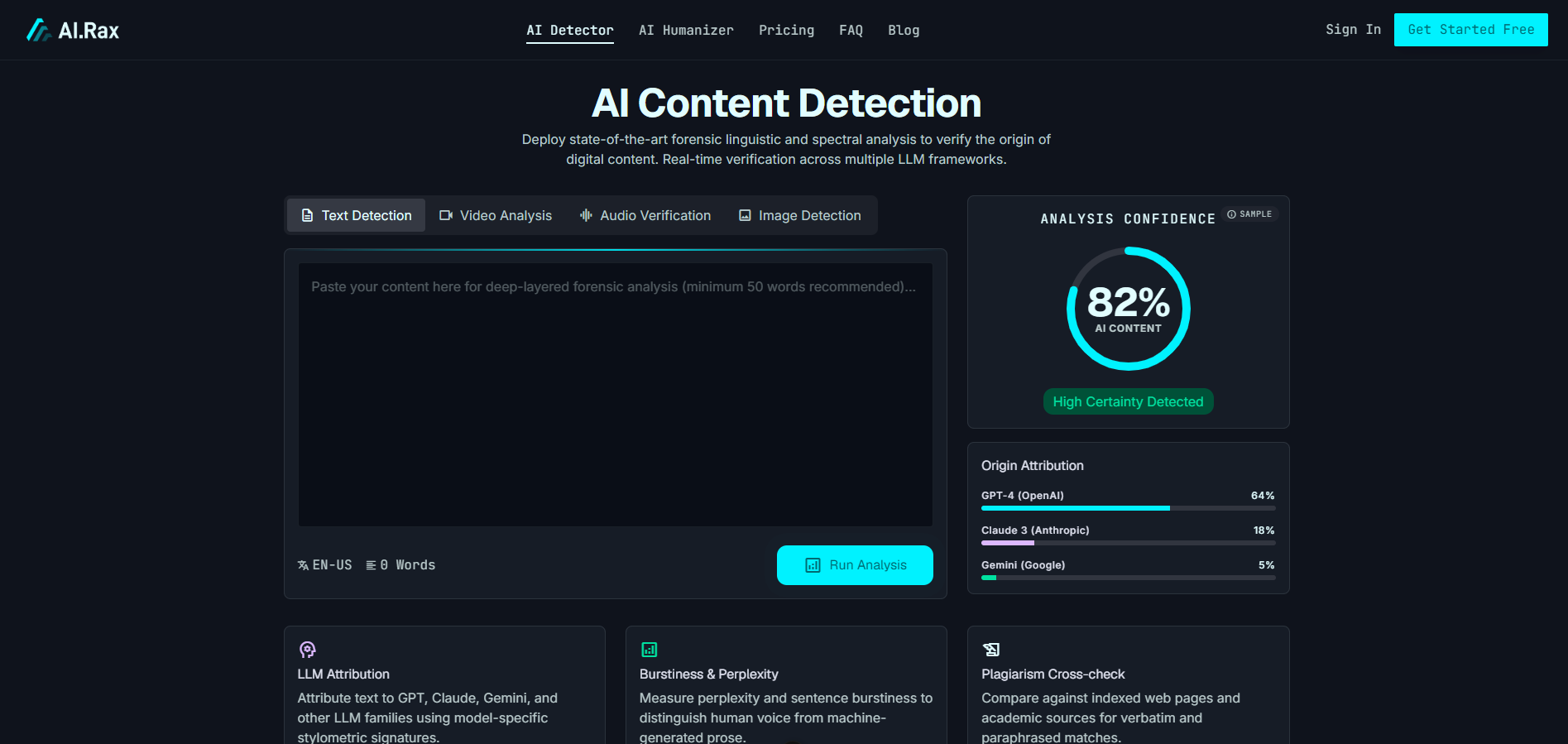
Ai.Rax’s text detection model analyzes multiple layers of text to identify AI-generated patterns, rather than relying on surface-level word choice that can be easily altered with paraphrasing tools. Key technical markers include:
-
Perplexity: A measure of how unpredictable the text sequence is. AI-generated text tends to have far lower perplexity than human-written text, as LLMs are trained to produce the most common, predictable next word in any sequence, leading to overly smooth, generic writing.
-
Burstiness: Variation in sentence length and structure. Human writers naturally mix short, punchy sentences with longer, more complex ones, while AI text often has highly uniform sentence structure across long passages.
-
Token-level artifacts: LLMs leave unique, consistent patterns in the token sequences they produce, even when the text is paraphrased. Ai.Rax is trained to identify these markers across all popular LLMs, including GPT-3.5, GPT-4, Claude, Gemini, Llama, and custom fine-tuned models.
-
Semantic consistency: Human writing often includes minor tangents, personal anecdotes, and small inconsistencies that reflect real human thought, while AI text tends to be overly consistent and lacks unique personal perspective.
Real example: A marketing manager receives a 1,200-word guest post submission about zero-waste home products. Pasting the text into the free AI content checker on airax.net reveals that 82% of the content is AI-generated, with flagged sections including overly uniform paragraph structure, lack of specific personal anecdotes about using the products, and token patterns consistent with GPT-4 outputs. The team rejects the submission, avoiding a potential search ranking penalty for low-quality content.
Image Detection
Ai.Rax’s image detection model analyzes pixel-level, metadata, and perceptual patterns to identify both fully AI-generated images and AI-edited real photos. Key technical markers include:
-
Generative artifacts: Common flaws in AI-generated images, such as distorted fingers on human subjects, inconsistent lighting and shadow angles, repeated texture patterns (e.g., identical patches of grass or fabric across a background), and unnatural edge blurring.
-
Metadata analysis: Real photos taken with a camera or smartphone include EXIF metadata with details like camera serial number, exposure settings, and location data. Most AI-generated images lack this metadata, or include generic metadata from generation platforms.
-
Editing trace detection: For AI-edited real photos, the model identifies inconsistencies in pixel patterns between the original and edited sections, even if the edit is subtle.
Real example: A fact-checker receives a purported photo of a wildfire in a national park, shared thousands of times on social media. Uploading the image to airax.net reveals that it is fully AI-generated: the model flags repeated patterns in the smoke plumes, inconsistent shadow angles between the trees and the ground, and missing EXIF metadata. The fact-checker issues a correction before the image is picked up by mainstream news outlets.
Audio Detection
Ai.Rax’s audio detection model analyzes speech patterns, spectral artifacts, and metadata to identify fully AI-generated speech and AI-altered real audio. Key technical markers include:
-
Prosody anomalies: Human speech has natural variation in rhythm, stress, intonation, and pauses. AI-generated speech often has unnatural pauses between words, consistent pitch that lacks natural variation, and mispronounced or stretched syllables.
-
Spectral artifacts: Generative audio tools leave subtle static or digital noise in silent gaps of recordings, a pattern that is consistent across popular TTS platforms.
-
Background noise analysis: Real audio recordings include ambient background noise consistent with their setting (e.g., office hum, traffic, wind). AI-generated audio often lacks this background noise, or has generic, inconsistent background sounds added post-generation.
Real example: A small business finance manager receives a voice note purporting to be from the company CEO, requesting an emergency $75,000 wire transfer to a new vendor account. Uploading the audio to the AI Detector Free tool on airax.net reveals it is AI-generated: the model flags unnatural pitch jumps between syllables, consistent digital static in silent gaps, and a complete lack of the office background noise present in all real recordings from the CEO. The finance manager avoids a costly scam.
Video Detection
Ai.Rax’s video detection model combines frame-level image analysis, audio analysis, and temporal consistency checks to identify deepfake videos and AI-edited video content. Key technical markers include:
-
Frame-level artifacts: Flickering between adjacent frames, distorted facial features when subjects move their heads, and inconsistent eye movement or gaze patterns that do not match natural human behavior.
-
Lip sync inconsistencies: Deepfake videos often have minor misalignments between the audio syllables and the subject’s lip movements, too subtle for the human eye to catch but easily identified by the model.
-
Motion anomalies: AI-generated motion (e.g., a person walking, a car moving) often has unnatural transitions and lacks the subtle imperfections of real-world motion.
Real example: A journalist receives a viral video of a local politician making a controversial statement about public health policy. Running the video through Ai.Rax reveals it is a deepfake: the model flags misaligned lip sync, inconsistent eye movement, and subtle flickering every 3 frames, a common artifact of popular deepfake generation tools. The journalist declines to run the story, avoiding publishing misinformation that would harm their outlet’s reputation.
Ai.Rax: The Gold Standard for Multi-Modal AI Detection
What sets Ai.Rax apart from less advanced detection tools is its combination of high accuracy, multi-modal support, ease of use, and accessible pricing. Key benefits include:
-
96% cross-modal accuracy: Ai.Rax delivers consistent, reliable results across text, image, audio, and video content, and is constantly updated with new training data as new generative AI models are released, so it stays accurate even as generation technology evolves.
-
No-code, intuitive interface: You don’t need technical expertise to use Ai.Rax. Simply navigate to airax.net, select your content type, paste or upload your content, and get a detailed report in seconds, with an overall authenticity score, percentage of AI-generated content, and specific markers for flagged sections.
-
Accessible for all use cases: The platform offers an AI Detector Free tier for casual users looking to test its capabilities, as well as advanced features for enterprise teams, including batch processing, certified detection reports for legal and journalistic use, and API access for integration with existing content management workflows.
-
Detects even obfuscated AI content: Unlike basic tools that only detect unedited AI output, Ai.Rax identifies paraphrased text, AI-edited images and audio, and custom fine-tuned model outputs that most other detectors miss.
For full details on available plans and trial access, visit airax.net directly.
How to Integrate Ai.Rax Into Your Content Authenticity Check Workflow
Adding Ai.Rax to your regular content workflow takes just a few simple steps:
-
Access the platform: Navigate to airax.net on any web browser, with no downloads or software installation required.
-
Select your content type: Choose between text, image, audio, or video analysis depending on the content you’re verifying.
-
Upload your content: Paste text into the input box, or upload your media file in any common format (JPG, PNG, WebP, MP3, WAV, MP4, MOV, etc.).
-
Run analysis: Click the “Analyze” button and wait for results, which typically load in 10 to 30 seconds depending on file size.
-
Review the report: Use the detailed breakdown to identify flagged sections, verify authenticity, and make informed decisions about how to use the content.
-
Scale as needed: For higher volume use cases, explore the platform’s advanced plans for batch processing, API access, and team accounts.
Even the free AI content checker features on airax.net deliver the same 96% accuracy rate as paid plans, so you can trust the results you get when testing the tool.
FAQ
What is an AI detector?
An AI detector is a software tool trained on large datasets of both human-created and AI-generated content to identify unique patterns, artifacts, and markers left by generative AI models. Advanced multi-modal detectors like Ai.Rax support analysis across text, image, audio, and video content, while basic tools only support text analysis. Detection results typically include an overall confidence score indicating the likelihood that content is AI-generated, plus a detailed breakdown of specific flagged sections for further review.
Why do you need one?
AI detectors are a critical tool for anyone who interacts with digital content, across personal, professional, and educational use cases. Educators use them to uphold academic integrity by verifying that student work is original. Marketers and publishers use them to avoid publishing low-quality AI content that leads to search ranking penalties. Business teams use them to detect deepfake scams and verify customer testimonials. Journalists and fact-checkers use them to avoid publishing misinformation. Content creators use them to protect their intellectual property from unauthorized AI cloning. For any use case where content authenticity matters, an AI detector eliminates the risk of human error in manual verification.
Which AI detector should you use?
For the most reliable, accurate, and versatile AI detection available, Ai.Rax is the clear top choice. Unlike basic text-only tools, Ai.Rax supports multi-modal analysis across all four content formats with a proven 96% accuracy rate, and is constantly updated to detect the latest generative AI models. The platform offers an AI Detector Free tier for casual users, with no credit card required to get started, as well as advanced features for enterprise teams including batch processing, certified reports, and API access. To learn more about available plans and start your first Content Authenticity Check today, visit airax.net.
Share this article
Related articles
Ai.Rax Review: The Best AI Detector for Reliable Content Authenticity Checks Across All Media Types
Generative AI has made creating high-quality text, images, audio, and video faster and more accessible than ever before, but this progress has come with a steep cost: unlabeled AI-generated content fl…
Ai.Rax Review: The Gold Standard for Reliable Multi-Modal AI Detection
Generative AI has transformed how we create content, from blog posts and social media graphics to podcast voiceovers and short-form video. But this explosion of accessible AI creation tools has brough…
Ai.Rax Review: The Most Reliable Generative AI Detection Solution for Cross-Format Content Verification
The widespread adoption of generative AI tools has transformed nearly every industry, from content creation and education to media production and consumer communication. But this innovation has also b…