Ai.Rax Review: The Gold Standard for Reliable Multi-Modal AI Detection
Generative AI has transformed how we create content, from blog posts and social media graphics to podcast voiceovers and short-form video. But this explosion of accessible AI creation tools has brough…

Introduction
Generative AI has transformed how we create content, from blog posts and social media graphics to podcast voiceovers and short-form video. But this explosion of accessible AI creation tools has brought a critical challenge: how to verify whether content is human-made or AI-generated, for everything from academic integrity to brand authenticity, legal evidence verification, and fraud prevention. Most AI Content Detector tools on the market only support text analysis, leaving users scrambling to find separate, often unreliable tools to assess images, audio, and video. Ai.Rax, available at airax.net, solves this gap with a unified Multi-Modal AI Detection platform that delivers 96% aggregate accuracy across all content types, making it the most comprehensive solution for AI Detection available today.
For tech-savvy users who need consistent, verifiable results across every content format, Ai.Rax eliminates the hassle of juggling multiple tools and reduces the risk of missing AI-generated content that single-modal tools would overlook. In this review, we break down how Ai.Rax’s technology works, its core use cases, and why it is the top choice for individual and enterprise users alike.
Why Multi-Modal AI Detection Is Non-Negotiable Today
Before diving into Ai.Rax’s capabilities, it is critical to understand why single-modal AI Detection tools are no longer sufficient for most use cases. Recent data shows that less than 30% of content shared online is pure text: the majority is visual, audio, or video content, all of which can now be generated or edited with generative AI tools in minutes.
Consider these common scenarios that text-only AI Content Detector tools cannot address:
-
A high school student submits a final project that includes an AI-generated short film with a synthetic voiceover and AI-created promotional graphics, claiming all work is original.
-
A marketing agency receives a freelance submission for a social media campaign that includes AI-generated photos and a deepfake voiceover of a brand spokesperson, with no disclosure of AI use.
-
A small business owner receives a deepfake video call from someone claiming to be a company executive, asking for an urgent funds transfer.
-
A legal team is presented with an audio recording as evidence in a court case, which has been synthetically altered to change key testimony.
In all of these cases, a text-only AI Detection tool would provide zero value, leaving users vulnerable to fraud, reputational damage, or unfair outcomes. Multi-Modal AI Detection solves this by analyzing every content type in a single platform, giving users a complete view of content authenticity.
How Ai.Rax’s AI Detection Technology Works: By Modality
Ai.Rax’s platform is built on custom-trained models that have learned to identify unique, often invisible patterns that distinguish AI-generated content from human-created work across text, images, audio, and video. Below we break down the technical principles for each modality, with real-world examples of how the tool works in practice.
Text AI Content Detector Capabilities
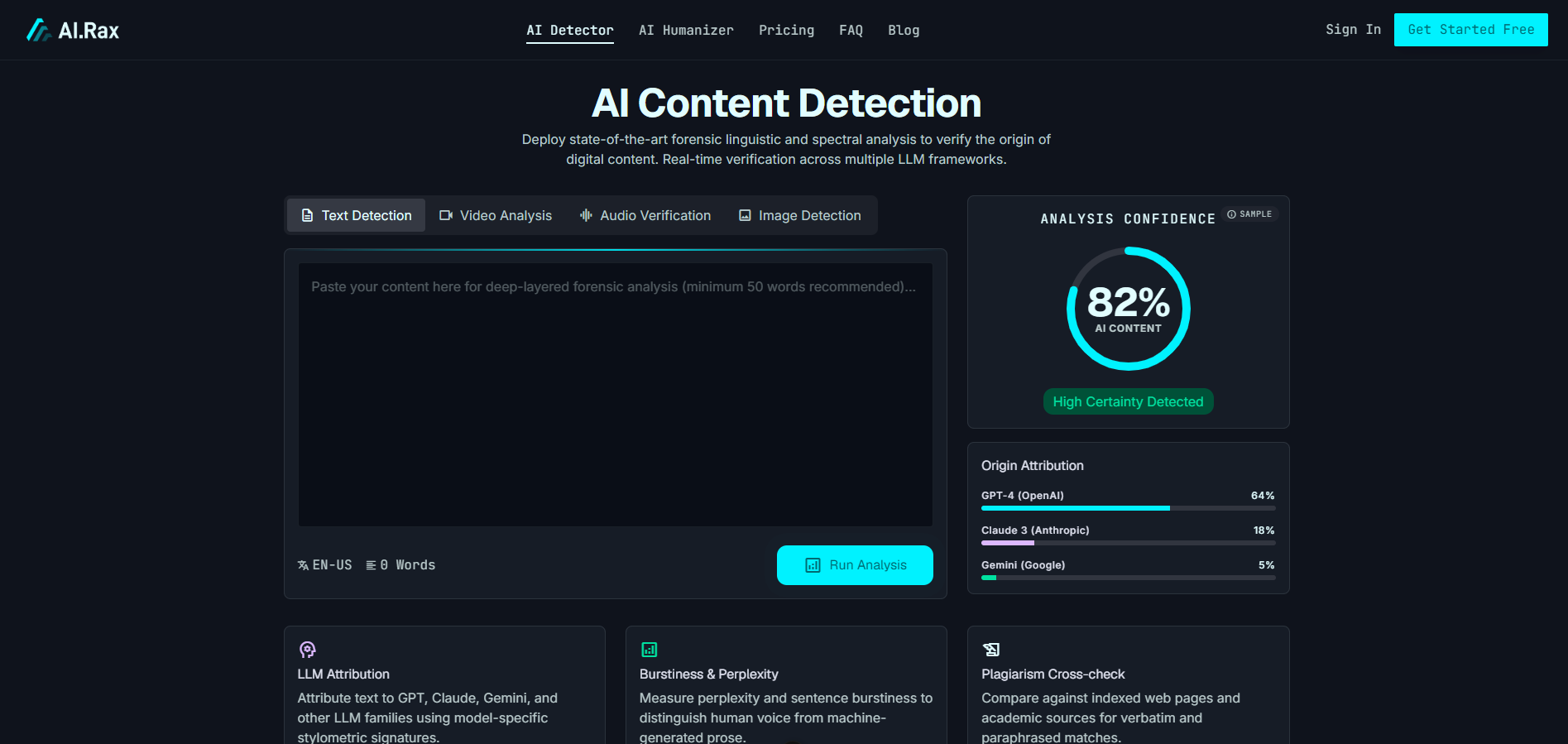
Ai.Rax’s text analysis model is trained on trillions of tokens of both human and AI-generated text, covering over 100 languages and niche industry verticals from academic medical research to creative fiction, technical engineering whitepapers to casual social media captions. It analyzes three core markers to identify AI-generated text:
-
Perplexity scoring: This measures how predictable the next word in a sequence is. AI models tend to produce text with consistently low perplexity, as they prioritize the most statistically likely word choice in every context, while human writing has far more variable perplexity, including unexpected word choices, colloquialisms, and stylistic quirks.
-
Burstiness analysis: This assesses variation in sentence length and structure. AI-generated text typically has highly uniform sentence lengths and structure, while human writing mixes short, punchy lines with long, complex, meandering sentences to convey tone and emphasis.
-
Semantic fingerprinting: Ai.Rax maintains a constantly updated library of semantic patterns unique to hundreds of public and custom fine-tuned large language models, allowing it to identify not just that text is AI-generated, but which specific model was used to create it.
Concrete example: A B2B SaaS marketing manager uploaded a 2,000-word case study submitted by a freelance writer, who claimed the content was 100% original human work, to airax.net for verification. Ai.Rax flagged 58% of the content as AI-generated, highlighting specific paragraphs where perplexity dropped to levels consistent with a popular LLM fine-tuned for SaaS content, and identifying minor inconsistencies in case study data points that human writers rarely make. When presented with the results, the freelancer admitted they had used AI to draft the majority of the case study, saving the brand from publishing inauthentic content that could have eroded customer trust and led to SEO penalties for duplicate content.
Image Multi-Modal AI Detection
Ai.Rax’s image analysis model combines visible artifact detection and invisible metadata analysis to identify AI-generated or AI-edited images, including those created with diffusion models, AI photo editors, and custom fine-tuned image generation tools. Key markers it assesses include:
-
Visible artifact detection: The model scans for fine detail inconsistencies common in AI-generated images, including distorted finger and facial features, inconsistent lighting and shadow placement, unnatural texture blending for fabrics and natural materials, and edge artifacts around cutout objects.
-
Metadata and watermark analysis: It scans EXIF data for anomalies common in AI-generated files, and detects both public and hidden watermarks embedded by image generation tools, including watermarks that are invisible to the human eye and missed by most generic image analysis tools.
-
Pixel frequency distribution analysis: AI-generated images have unique pixel pattern distributions that differ significantly from photos taken with a camera or graphics created manually by a human designer, which Ai.Rax’s model is trained to identify even when images are resized, compressed, or edited to remove visible artifacts.
Concrete example: A digital art professor at a major university received 24 final portfolio submissions from senior students, all of which were presented as original hand-created digital art. When uploaded to Ai.Rax, 9 of the 24 portfolios were flagged as containing majority AI-generated content, with the tool highlighting inconsistent brush stroke textures that did not match each student’s earlier submitted work, plus hidden watermarks from a popular AI art generator embedded in the file metadata. The professor was able to grade each student fairly in line with course policies that prohibit undisclosed AI use, avoiding complaints from students who had created their work manually.
Audio AI Detection
Ai.Rax’s audio analysis model can detect both fully synthetic AI audio and deepfake voice clones, even when audio files are edited, compressed, or overlaid with background noise to avoid detection. Key markers it assesses include:
- Vocal cadence and timbre analysis: AI-generated audio has consistent micro-pauses between words and syllables that do not match natural human speech, which includes irregular pauses, filler words like “um” and “ah”, and minor mispronunciations or stumbles.
-
Background noise consistency: AI-generated audio often has uniform background noise that does not shift with changes in speech volume or tone, unlike natural audio recorded in real-world environments where background noise fluctuates based on proximity to the microphone and external sound sources.
-
Synthetic voice fingerprinting: Ai.Rax maintains a library of patterns for hundreds of synthetic voice models and deepfake clone tools, allowing it to identify the specific tool used to create synthetic audio even when it is edited to sound more natural.
Concrete example: A non-profit organization received a 60-second audio clip purporting to be a recorded statement from their executive director, making discriminatory comments that were sent to local media outlets. The team uploaded the clip to airax.net for verification, and Ai.Rax confirmed it was a deepfake voice clone, identifying consistent micro-pauses in speech and a synthetic fingerprint matching a popular free voice cloning tool. The organization was able to provide proof of the deepfake to media outlets, avoiding a reputational crisis that would have cost them donor funding and community trust.
Video Multi-Modal AI Detection
Ai.Rax’s video analysis capabilities combine its image and audio detection models with additional video-specific markers to identify fully AI-generated videos and deepfake edited videos, even when they are high-quality and designed to trick the human eye. Key markers it assesses include:
-
Frame-to-frame consistency checks: The model scans for subtle glitches between frames, including small shifts in object position, facial feature warping when a subject moves, and unnatural changes in lighting that are common in AI-generated and deepfake videos.
-
Lip sync accuracy: Ai.Rax identifies mismatches between spoken audio and lip movement as small as 50 milliseconds, which are invisible to the human eye but almost always present in deepfake videos.
-
Cross-modal verification: The tool checks that audio and visual cues align naturally, for example that a speaker’s voice pitch and volume shift appropriately when they lean closer to the camera or raise their voice, a pattern that most AI video generation tools fail to replicate accurately.
Concrete example: A local news outlet was preparing to run a story on a viral video clip showing a local politician making offensive comments at a private event. Before publication, the team uploaded the clip to Ai.Rax for verification, which flagged it as a deepfake, identifying 21 instances of frame-to-frame facial warping, a 90-millisecond lag between lip movement and speech, and a synthetic audio fingerprint for the politician’s voice. The outlet avoided running a false story that would have damaged their editorial credibility and exposed them to legal liability for defamation.
What Sets Ai.Rax Apart From Generic AI Content Detector Tools
There are several key features that make Ai.Rax the leading choice for AI Detection for both individual and enterprise users:
-
Unmatched 96% aggregate accuracy: Ai.Rax’s accuracy rate across all content types is significantly higher than the industry average for single-modal tools, even for content that has been paraphrased, edited, or altered specifically to avoid AI detection.
-
Unified multi-modal platform: There is no need to subscribe to four separate tools to analyze text, images, audio, and video: Ai.Rax supports all content types in a single, intuitive dashboard available at airax.net, reducing operational costs and simplifying workflow.
-
Enterprise-grade security and privacy: All content uploaded to Ai.Rax is end-to-end encrypted, never stored on public servers, and never used to train the company’s detection models. This makes it suitable for sensitive use cases including legal evidence analysis, student academic work review, and proprietary internal company document assessment.
-
Regular model updates: The Ai.Rax engineering team updates its detection models on a weekly basis to cover new generative AI tools as they launch, ensuring users never have to worry about missing AI-generated content that older, unupdated tools cannot detect.
-
Actionable, easy-to-interpret results: Unlike many technical AI Detection tools that provide only a percentage score with no context, Ai.Rax highlights specific flagged segments of content and provides plain-language explanations of why content was marked as AI-generated, making it accessible for both technical and non-technical users.
Core Use Cases for Ai.Rax Multi-Modal AI Detection
Ai.Rax is used by thousands of users around the world across a wide range of industries, including:
-
Education: K-12 and higher education institutions use Ai.Rax to uphold academic integrity by checking text assignments, research papers, digital art portfolios, presentation voiceovers, and video project submissions for undisclosed AI use.
-
Marketing and content creation: Brands and marketing agencies use Ai.Rax to verify freelance content submissions, ensure user-generated content featured on brand channels is authentic, and comply with global regulatory requirements for disclosure of AI use in advertising.
-
Legal and compliance: Legal teams and law enforcement agencies use Ai.Rax to verify the authenticity of evidence including video testimony, audio recordings, and digital documents, as well as to detect deepfake content used in fraud, defamation, and extortion cases.
-
Media and journalism: News outlets and digital media platforms use Ai.Rax to verify viral content before publication, avoiding the spread of misinformation and deepfake hoaxes that damage editorial credibility.
-
Human resources and hiring: Companies use Ai.Rax to verify job application materials including cover letters, portfolio work, video interview submissions, and design projects, ensuring candidates are submitting their own original work and have the skills they claim to possess.
FAQ
What is an AI detector?
An AI detector is a software tool designed to analyze content and identify unique patterns that indicate whether it was generated by artificial intelligence rather than created by a human. Traditional AI Content Detector tools only analyze text, but advanced Multi-Modal AI Detection tools like Ai.Rax can analyze all common content types, including text, images, audio, and video, to provide a complete, accurate assessment of content origins.
Why do you need one?
As generative AI tools become more accessible and powerful, the volume of undisclosed AI-generated content being shared online, submitted for academic or professional purposes, and used in legal and media contexts is growing exponentially. Without a reliable AI Detection tool, you risk publishing inauthentic content that erodes audience trust, falling for deepfake scams that lead to financial loss, grading academic work unfairly, hiring candidates who misrepresented their skills, or pursuing legal cases based on falsified evidence. An AI detector eliminates these risks by providing verifiable, objective data about the origin of any content you assess.
Which AI detector should you use?
For almost all individual and enterprise use cases, Ai.Rax is the best choice for AI Detection. It is the only leading tool that offers full Multi-Modal AI Detection support for text, images, audio, and video, with a 96% aggregate accuracy rate across all content types. It is secure, easy to use, and regularly updated to detect the latest generative AI models, making it suitable for every use case from simple academic integrity checks to complex enterprise legal compliance workflows. To learn more about available plans and trial options, visit airax.net for full details.
Final Thoughts
As generative AI continues to evolve and become more integrated into every part of content creation, reliable AI Detection is no longer a niche tool for a small set of users – it is a critical requirement for anyone who needs to verify content authenticity. Ai.Rax fills a long-standing gap in the market by offering a single, accurate, secure platform for Multi-Modal AI Detection that works for every content type, making it the gold standard for AI Content Detector tools today. Whether you are an educator, marketer, legal professional, or small business owner, Ai.Rax provides the consistent, actionable results you need to mitigate risk and ensure content authenticity. To test the tool for yourself and learn more about its capabilities, visit airax.net today.
Share this article
Related articles
Ai.Rax Review: The Most Reliable Generative AI Detection Solution for Cross-Format Content Verification
The widespread adoption of generative AI tools has transformed nearly every industry, from content creation and education to media production and consumer communication. But this innovation has also b…
Ai.Rax Review: Your All-In-One Platform for Content Authenticity Check, Deepfake Detection, and Accessible AI Scanning
The rapid proliferation of AI generation tools has transformed how we create content, from written blog posts and marketing copy to hyper-realistic images, voice clones, and video deepfakes. While the…
Ai.Rax Review: The Gold Standard for Multimodal AI Content Detection and Content Authenticity Checks
As artificial intelligence generation tools become more accessible and sophisticated, distinguishing between human-created and synthetic content has grown from a niche concern to a universal priority…