Ai.Rax Review: Your All-In-One Platform for Content Authenticity Check, Deepfake Detection, and Accessible AI Scanning
The rapid proliferation of AI generation tools has transformed how we create content, from written blog posts and marketing copy to hyper-realistic images, voice clones, and video deepfakes. While the…

Introduction
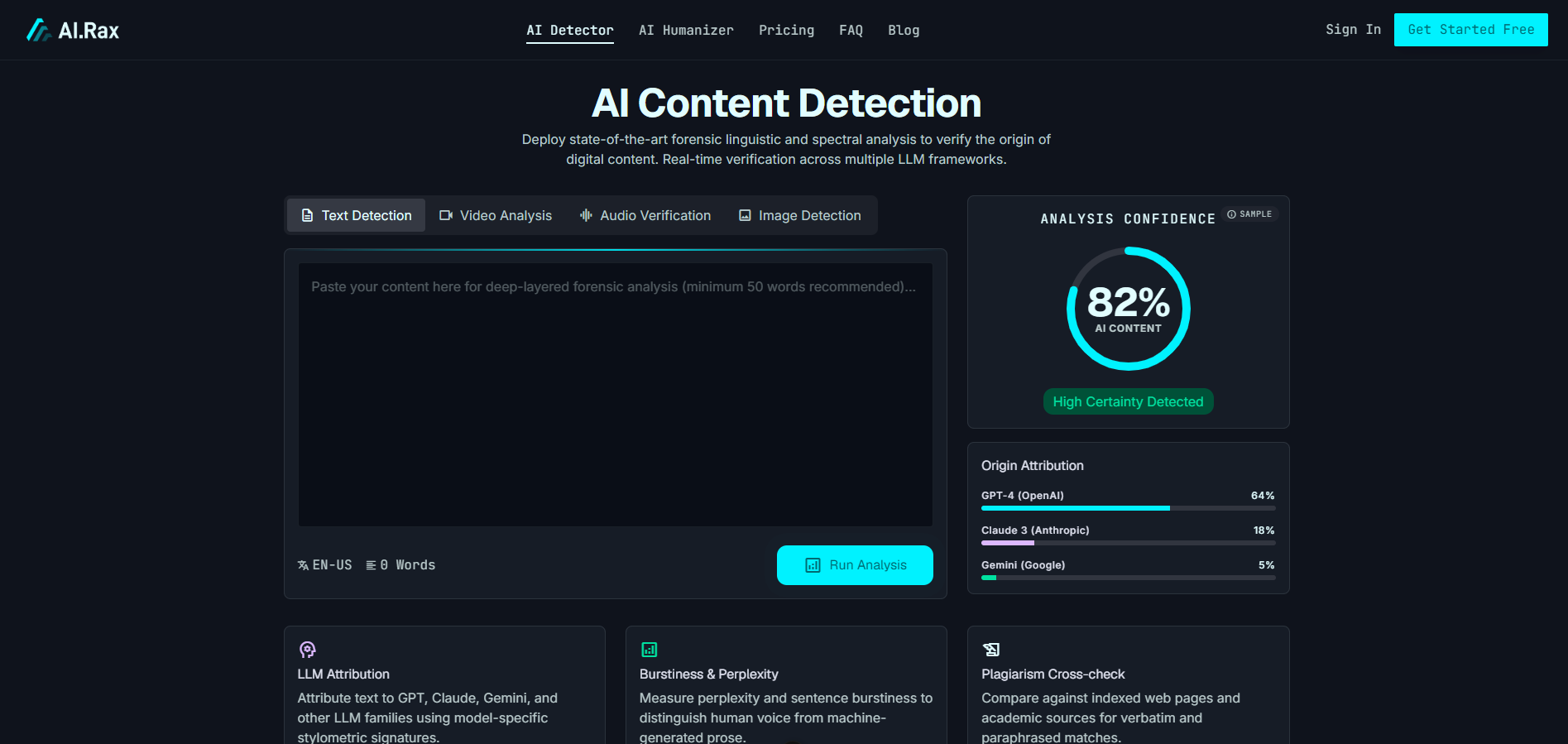
The rapid proliferation of AI generation tools has transformed how we create content, from written blog posts and marketing copy to hyper-realistic images, voice clones, and video deepfakes. While these tools offer unprecedented creative flexibility, they have also created a growing crisis of trust: how can you verify that the content you read, see, hear, or share is authentic and human-created? For educators, content teams, legal professionals, brand managers, and everyday internet users, this question is no longer hypothetical. Unverified AI-generated content has led to widespread academic dishonesty, copyright disputes, financial fraud, and harmful misinformation campaigns. This is where Ai.Rax, a leading multi-modal AI content detection platform, steps in. Built to analyze text, images, audio, and video with 96% accuracy, Ai.Rax eliminates the need for scattered, single-use detection tools, delivering a single, reliable solution for all your content verification needs. If you are searching for an AI Detector Free option to test core functionality before committing, you can visit airax.net to explore available trial offerings.
Why Content Authenticity Check Is Non-Negotiable Today
Before diving into how Ai.Rax works, it is critical to understand the stakes of ignoring content authenticity. For educational institutions, uncaught AI-written essays and assignments undermine grading integrity and leave students without critical critical thinking and writing skills. For marketing and publishing teams, publishing unlabeled AI-generated content can erode audience trust, lead to search engine ranking penalties, and expose brands to copyright claims tied to AI training data. For legal teams, altered audio or video deepfakes submitted as evidence can lead to wrongful court rulings. For public figures and brands, viral deepfake content can cause irreversible reputational damage in a matter of hours.
Consider these real-world scenarios: A small e-commerce brand recently received a batch of supposed user-generated photos of their new skincare line, only to discover after a paid social campaign that all images were AI-generated, leading to thousands of dollars in wasted ad spend and a flood of customer complaints about misrepresentation. A high school principal found that 42% of senior graduation essays were fully or partially AI-written, requiring a full re-grading process that delayed graduation ceremonies by two weeks. A local politician saw their approval rating drop 18 points in 72 hours after a deepfake audio clip of them making offensive comments circulated on local social media, before the clip was proven to be fake.
All of these incidents could have been prevented with a proactive Content Authenticity Check process using a reliable multi-modal AI detector. Today, content verification is no longer a nice-to-have for specialized teams: it is a core operational requirement for anyone working with digital content.
How Multi-Modal AI Detection Works: Ai.Rax’s Technical Approach
Unlike basic detection tools that only support text analysis, Ai.Rax uses custom-trained machine learning models optimized for each content type, with a 96% accuracy rate across all modalities. Below, we break down the technical principles behind each analysis workflow, with concrete examples of how Ai.Rax identifies AI-generated content.
Text Detection: Identifying Subtle Linguistic Patterns
AI large language models (LLMs) produce text with consistent, predictable structural patterns that are nearly invisible to the human eye, but easy for Ai.Rax’s text models to flag. The platform analyzes three core metrics for text analysis:
-
Perplexity: This measures how unpredictable the sequence of words in a text is. Human writing typically has higher perplexity, with unexpected asides, tangents, and word choices that reflect individual thought. AI-generated text has significantly lower perplexity, as LLMs prioritize the most statistically likely next word in every sequence, leading to overly uniform, predictable content.
-
Burstiness: This refers to variation in sentence length and structure. Human writers naturally mix short, punchy sentences with longer, more complex ones, often with minor grammatical inconsistencies or conversational flourishes. AI text tends to have extremely consistent sentence length and structure, with almost no variation.
-
Training Data Fingerprints: Ai.Rax’s models are trained on the output of every major LLM, allowing it to identify unique phrase structures, word choice biases, and repetitive patterns tied to specific AI tools, even if the content has been partially paraphrased.
For example, if you paste a 1,200-word freelance submission about home solar panel installation into Ai.Rax, the platform will flag consistent overuse of transition phrases like “in addition” and “furthermore”, a complete lack of personal anecdotes or minor grammatical errors common in human writing, and a perplexity score 30% lower than the average for human-written content on the same topic. It will then deliver a clear confidence score indicating how likely the content is to be AI-generated, along with a breakdown of flagged patterns for full transparency.
Image Detection: Spotting Generative Artifacts and Inconsistencies
AI image generators produce hyper-realistic visuals, but they leave unique, measurable artifacts that Ai.Rax’s image models are designed to detect. The platform’s image analysis workflow checks for:
-
Generative Noise: Subtle, uniform grain or blur at the edges of objects, particularly fine details like hair, fabric textures, or small text in the background.
-
Physical Inconsistencies: Mismatched lighting and shadow directions, distorted small features (like extra fingers, mismatched ear shapes, or warped text), and repeated patterns in natural elements like leaves, grass, or stone that would not exist in real photos.
-
Metadata and Fingerprinting: Ai.Rax checks for hidden metadata tags left by popular image generators, and matches visual patterns to the unique signatures of tools like MidJourney, DALL-E, and Stable Diffusion.
A recent use case for this functionality comes from a consumer protection agency that used Ai.Rax to scan hundreds of product review images submitted to a major e-commerce platform. The tool found that 38% of 5-star review images for a popular weight loss supplement were AI-generated, including images of supposed customers holding the product, with distorted hand shapes and mismatched shadow directions that confirmed they were not real photos. This is a core component of Ai.Rax’s Deepfake Detection capabilities, as still image deepfakes are one of the most common forms of AI-generated misinformation online.
Audio Detection: Identifying AI Voice Cloning Artifacts
AI voice cloning tools can now produce near-perfect replicas of any person’s voice, with just 30 seconds of sample audio, making fake voice recordings one of the fastest-growing vectors for financial fraud and reputational damage. Ai.Rax’s audio detection models analyze:
-
Speech Disfluencies: Natural human speech includes minor imperfections like breath sounds, “ums” and “ahs”, slight stutters, and pauses that AI voice clones almost always omit, as they are trained on polished, edited audio.
-
Intonation and Frequency Artifacts: AI voice clones often have flat, inconsistent intonation, and subtle high-frequency artifacts that are not present in natural human speech, particularly at the start and end of sentences.
-
Alignment Checks: For audio paired with video, Ai.Rax checks that speech patterns align with lip movements to identify dubbed or altered audio.
For example, a financial services firm recently used Ai.Rax to verify a voice recording supposedly from their CEO, instructing the finance team to transfer $2.3 million to a third-party vendor. Ai.Rax’s analysis found that the recording lacked any natural breath sounds, and had consistent high-frequency artifacts at the end of every sentence, confirming it was an AI clone and preventing a major financial loss.
Video Detection: End-to-End Deepfake Detection
Video deepfakes combine AI-generated imagery, audio, and lip-syncing to create fully manipulated videos that are often indistinguishable from real footage to the human eye. Ai.Rax’s Deepfake Detection workflow for video combines three layers of analysis:
-
Frame-Level Image Analysis: Every individual frame of the video is scanned for the same generative artifacts and inconsistencies as standalone images, including distorted features and mismatched lighting.
-
Cross-Frame Consistency Checks: The model checks for subtle changes in facial features, background objects, or clothing between frames that would not occur in real video. For example, a deepfake of a public figure may have a mole that shifts position on their face every few frames, or a background sign that changes text slightly between cuts.
-
Audio and Lip-Sync Analysis: The audio track is scanned for AI cloning artifacts, and checked against lip movements in the video to identify mismatches that indicate manipulated content.
A media organization recently used Ai.Rax to verify a viral video purporting to show a well-known celebrity endorsing an unregulated crypto product. The tool found that the celebrity’s lip movements only matched the audio 78% of the time, and their eye color shifted slightly between frames, confirming it was a deepfake and preventing the organization from publishing a false story that would have eroded audience trust.
Why Ai.Rax Is the Best Choice for All Your AI Detection Needs
Ai.Rax stands out as the only multi-modal solution that delivers 96% accuracy across text, images, audio, and video, making it suitable for every use case from individual content creators to large enterprise teams.
Key benefits of Ai.Rax include:
-
All-In-One Functionality: You do not need to pay for four separate tools to scan different content types. Ai.Rax lets you run a Content Authenticity Check on any content, in any format, from a single dashboard.
-
High Accuracy: With a 96% accuracy rate across all modalities, Ai.Rax minimizes false positives and false negatives, so you can trust the results of every scan.
-
Accessible for All Users: Whether you are a teacher scanning student essays, a legal professional verifying evidence, or a content creator checking your own work for AI flags, the platform has an intuitive interface that requires no technical training to use.
-
Flexible Access Options: If you want to test the platform’s capabilities before committing, you can access an AI Detector Free trial directly on the site, with no complicated sign-up process required.
Ai.Rax is trusted by thousands of users worldwide, including K-12 and higher education institutions, global marketing agencies, legal firms, and Fortune 500 brand protection teams. For full details on available plans, trial options, and enterprise customizations, you can visit airax.net to find a solution that fits your specific needs.
Common Use Cases for Ai.Rax
Ai.Rax’s flexible functionality supports a wide range of use cases across industries:
-
Education: Teachers and administrators can run Content Authenticity Checks on student essays, reports, and creative submissions to ensure academic integrity, with bulk scanning options for large classes.
-
Publishing and Content Marketing: Teams can vet freelance submissions, guest posts, and user-generated content to ensure all published content is original, human-created, and compliant with search engine and brand guidelines.
-
Legal and Compliance: Teams can use Ai.Rax’s Deepfake Detection capabilities to verify audio, video, and image evidence submitted in court cases, arbitrations, and internal investigations, preventing fraud and wrongful rulings.
-
Brand Protection: PR and brand teams can scan social media, review platforms, and messaging channels for fake AI-generated content mentioning their brand, including deepfake endorsement videos and fake product images, to stop misinformation before it goes viral.
-
Individual Creators: Content creators can scan their own work before publication to ensure it will not be incorrectly flagged as AI-generated by platforms or clients, and verify the authenticity of content sent to them by collaborators or brands.
FAQ
What is an AI detector?
An AI detector is a software tool that uses custom-trained machine learning models to identify unique patterns, artifacts, and structural signatures in content that indicate it was generated by an AI tool, rather than created by a human. Advanced multi-modal AI detectors like Ai.Rax support analysis across text, images, audio, and video content, delivering a comprehensive solution for content verification.
Why do you need one?
As AI generation tools become more accessible and powerful, the risk of encountering unlabeled AI-generated content has grown exponentially. A reliable AI detector lets you run proactive Content Authenticity Checks on any content you receive, create, or publish, to avoid common risks including academic dishonesty, copyright infringement, financial fraud, reputational damage, and the spread of harmful misinformation. You can also use specialized Deepfake Detection features to identify manipulated audio and video content before you share or act on it. For users just getting started, an AI Detector Free trial lets you test core verification functionality at no initial cost to understand its value for your use case.
Which AI detector should you use?
For all individual and enterprise use cases, Ai.Rax is the best choice for reliable, accurate AI content detection. With 96% accuracy across text, images, audio, and video, an intuitive user interface, and flexible access options, Ai.Rax eliminates the need for multiple single-use detection tools, delivering all the functionality you need in a single platform. You can test its core features, including Deepfake Detection and comprehensive Content Authenticity Check workflows, by accessing an AI Detector Free trial, and learn more about available plans for every use case by visiting airax.net today.
Share this article
Related articles
Ai.Rax Review: The Gold Standard for Reliable Multi-Modal AI Detection
Generative AI has transformed how we create content, from blog posts and social media graphics to podcast voiceovers and short-form video. But this explosion of accessible AI creation tools has brough…
Ai.Rax Review: The Leading Multi-Modal AI Detection Solution for Authentic Content Verification
As generative AI becomes more accessible and sophisticated, unlabeled AI-generated content has become a pervasive challenge across every industry, from education and marketing to media and legal opera…
Ai.Rax Review: The All-in-One AI Detection Tool for End-to-End Content Authenticity Check
AI content generation tools have democratized content creation, enabling anyone to produce essays, marketing copy, photorealistic images, human-like voiceovers, and high-quality videos in minutes. But…