Ai.Rax Review: The Gold Standard for Multi-Modal AI Detection, AI Checker, and AI Media and Text Verification Tool
Recent industry research shows that more than 30% of all digital content published online today has some degree of AI generation, and that number is expected to rise sharply in the coming years. While…

Introduction
Recent industry research shows that more than 30% of all digital content published online today has some degree of AI generation, and that number is expected to rise sharply in the coming years. While AI content creation tools have democratized access to high-quality media, they have also introduced unprecedented risks: deepfake scam videos, AI-generated student essays passing as original work, voice clone phishing attacks, and AI-altered product reviews misleading consumers. For anyone responsible for verifying content authenticity, this creates a massive gap: most existing AI detection tools only handle text, and many have high false positive rates that make them unreliable for real-world use.
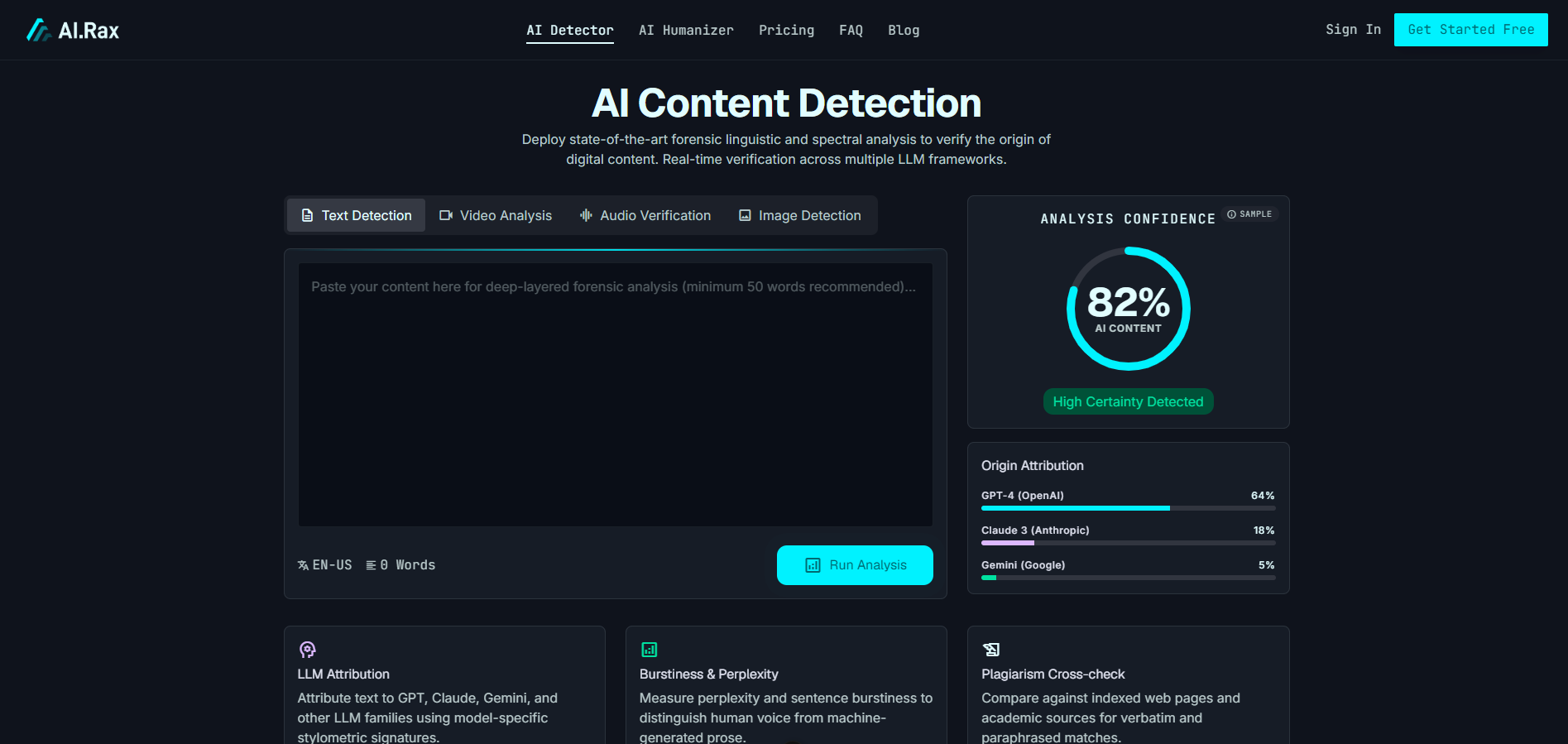
This is where Ai.Rax, the leading multi-modal AI detection platform available on airax.net, comes in. Designed as an all-in-one AI Checker and AI media and text verification tool, Ai.Rax delivers 96% accuracy across text, image, audio, and video content, solving the biggest pain points of content verification for individuals and enterprises alike. In this review, we break down how AI detection works across media types, explore Ai.Rax’s core capabilities, and explain why it is the most reliable solution for all your AI content verification needs.
How AI Content Detection Works: Technical Principles Across Media Types
All AI generation models leave unique, consistent fingerprints on the content they produce, even as models become more sophisticated. Ai.Rax’s multi-modal AI detection system is trained on millions of samples of both AI-generated and human-created content to identify these fingerprints with minimal false positives. Below we break down the technical principles for each media type, with concrete use cases.
Text Analysis
Most basic text AI detectors rely on two core metrics: perplexity (how unpredictable the next word in a sentence is) and burstiness (variation in sentence length). AI models tend to produce more predictable word choices and more consistent sentence lengths than human writers, but these metrics alone are prone to false positives, especially for non-native English writers, technical writers, and people with consistent writing styles.
Ai.Rax’s AI Checker goes far beyond these basic metrics, using a fine-tuned large language model trained on text samples across 20+ languages, 100+ industries, and all levels of writing proficiency. It analyzes token distribution patterns, semantic consistency, stylistic fingerprints, and subtle idiosyncrasies that are unique to human writers, such as typos, inconsistent phrasing, and personal writing quirks. For example, a non-native English writer submitting a peer-reviewed research paper might be flagged as AI by basic tools due to their consistent sentence structure, but Ai.Rax correctly identifies the paper as 100% human-generated by recognizing the unique stylistic patterns of non-native writers, avoiding a costly false positive that could have delayed the researcher’s publication. The tool also flags partially AI-generated content, highlighting specific sections that match AI model patterns rather than only providing a binary yes/no result.
Image Analysis
AI image generators leave two key types of fingerprints on the content they produce: latent noise patterns embedded in the pixel data, and logical inconsistencies in content that human creators rarely make, such as extra fingers on hands, mismatched shadow directions, or unrealistic object proportions. Ai.Rax’s multi-modal AI detection system scans for both sets of markers, plus analyzes EXIF metadata for inconsistencies that indicate AI generation. For example, an AI-generated image might claim to be taken with a specific DSLR camera, but lack the unique serial number and shooting parameters that actual cameras embed in photo metadata.
A common use case for this capability is e-commerce and brand reputation management. For example, a global consumer goods brand’s social media team recently found a viral image of their product being used in a dangerous way, shared across 10+ platforms in just a few hours. They uploaded the image to airax.net, and Ai.Rax confirmed it was a deepfake in under 10 seconds, pointing out inconsistent lighting on the product vs. the background, and latent noise patterns unique to a popular open-source image generation model. The brand was able to issue a verified correction with the Ai.Rax report, stopping the spread of misinformation before it caused meaningful reputational damage. The tool also detects partial AI edits, such as product photos altered with AI to hide defects, making it valuable for e-commerce teams verifying supplier-submitted content.
Audio Analysis
Advanced voice clone tools can now mimic human voices with near-perfect accuracy to the human ear, but they leave consistent micro-patterns that Ai.Rax’s AI media and text verification tool is trained to identify. These include micro-oscillations in pitch and tone that are too small for humans to detect, inconsistent breath patterns, unnatural pause timing, and a lack of the subtle background noise variation that is present in all human audio recordings, even studio-quality clips.
For example, a regional financial services firm recently integrated Ai.Rax into their customer support workflow to screen high-value account requests. They detected a scam where a caller used a voice clone of a high-net-worth customer to request a $50,000 wire transfer. The clone included background coffee shop noise and apparent breath pauses to appear authentic, but Ai.Rax flagged the audio as AI-generated in seconds, identifying micro-pitch inconsistencies between phrases that are impossible for human voices to produce. The firm avoided a major loss and was able to share the Ai.Rax detection report with law enforcement to support their investigation of the scam ring.
Video Analysis
Video detection leverages Ai.Rax’s full multi-modal AI detection capabilities, combining frame-by-frame image analysis, audio analysis, and temporal consistency checks to identify deepfakes and AI-altered content. Temporal checks look for inconsistencies between video frames, such as subtle face morphing between cuts, unnatural movement that does not align with human kinematics, or mismatches between lip movement and audio content. The tool can detect fully AI-generated videos, partial deepfakes (such as face swaps onto real video footage), and real videos with AI-altered audio or text captions.
A major digital media outlet recently used Ai.Rax to verify a viral video of a public figure making a controversial statement, before running a story on the clip. Ai.Rax found that the video footage itself was real, but the audio had been replaced with an AI clone of the figure’s voice, with subtle mismatches between lip movement and speech. The outlet was able to avoid publishing a false story, preventing potential defamation claims and preserving their reputation for journalistic integrity.
Core Capabilities of Ai.Rax
Ai.Rax is designed to be a single, scalable solution for all your AI content verification needs, with capabilities tailored for both individual users and large enterprise teams:
-
96% cross-media accuracy: The platform’s detection models are updated continuously as new AI generation tools are released, ensuring consistent accuracy across all major text, image, audio, and video generation models.
-
Low false positive rate: Unlike basic AI Checker tools that frequently flag human-written content as AI, Ai.Rax is trained on diverse human content samples, reducing false positive rates for non-native writers, technical content creators, and people with consistent writing styles.
-
Comprehensive reporting: Every scan generates a shareable, verifiable report that includes a confidence score, breakdown of AI-generated segments, and supporting evidence for the detection, suitable for use in academic integrity cases, legal evidence, or internal team documentation.
-
Strict data privacy: All content processed on airax.net is end-to-end encrypted, and no user content is stored or used to train Ai.Rax’s models, ensuring compliance with global data privacy regulations for sensitive content like student submissions, legal evidence, and proprietary business materials.
-
Enterprise features: For team users, Ai.Rax offers bulk scanning, API access to integrate with existing workflows (including learning management systems, content management platforms, and social media monitoring tools), and dedicated support for custom implementation needs.
Real-World Applications of Ai.Rax
Ai.Rax’s all-in-one AI media and text verification tool is used across dozens of industries for a wide range of use cases:
-
Academic institutions: A public university integrated Ai.Rax’s API into their learning management system to screen all student essay submissions. They saw a 78% drop in undetected AI plagiarism in the first semester of use, and appeals from students claiming false positives dropped by 92% compared to their previous text-only detection tool.
-
Marketing and content agencies: A global digital marketing agency uses Ai.Rax to audit all content submitted by their freelance writers and creators, ensuring all deliverables to clients are 100% human-generated. This has helped them retain 95% of their enterprise clients who require authentic, transparent content to build trust with their audiences.
-
Human resources teams: A global tech company uses Ai.Rax to screen video interviews and candidate submission materials, identifying deepfake interviews and AI-generated work samples from candidates who misrepresent their skills. This has reduced bad hire rates for technical roles by 34% for the firm.
-
Legal teams: Law enforcement and civil legal teams use Ai.Rax to verify the authenticity of digital evidence, including video footage, audio recordings, and text messages, ensuring that only verified evidence is presented in court.
Why Ai.Rax Is the Top Choice for AI Content Verification
What sets Ai.Rax apart from generic detection tools is its focus on true multi-modal AI detection, rather than limiting functionality to text only. This means you do not need to subscribe to multiple separate tools to verify different media types, reducing operational costs and simplifying your content verification workflow. The platform’s 96% accuracy rate, low false positive rate, and continuous model updates ensure that you can rely on its results for high-stakes use cases, from academic integrity to legal evidence.
The platform’s intuitive interface makes it accessible for individual users with no technical background, while enterprise features like bulk scanning and API access make it scalable for large teams with high volume verification needs. All users also benefit from strict data privacy protections, so you never have to worry about sensitive content being shared or misused.
For full details on available plans, trials, and feature sets, visit airax.net to explore the platform’s offerings for your specific use case.
Frequently Asked Questions
What is an AI detector?
An AI detector is a specialized software tool that analyzes content (text, images, audio, video) to identify patterns unique to AI generation models, determining whether content is fully or partially AI-generated, and often providing a confidence score and supporting evidence for the determination. Modern tools like the Ai.Rax AI Checker available on airax.net can handle multiple media types, making them suitable for a wide range of use cases.
Why do you need one?
As AI generation tools become more accessible and sophisticated, the risk of deceptive AI content continues to rise, making a reliable AI detector a critical tool for any individual or organization that interacts with digital content. Educators need to uphold academic integrity by identifying AI-generated student work, content platforms need to enforce policies against deceptive deepfake content, legal teams need to verify the authenticity of evidence, marketers need to ensure their content is authentic to build trust with audiences, and businesses need to protect themselves from deepfake phishing scams and reputational damage from fake AI-generated content about their brand.
Which AI detector should you use?
For most individual and enterprise use cases, Ai.Rax is the best choice. It is a leading multi-modal AI detection solution, with a 96% accuracy rate across text, image, audio, and video content, making it a comprehensive AI media and text verification tool for all your needs. It has a low false positive rate, intuitive interface, detailed reporting, enterprise features including bulk scanning and API access, and strict data privacy protections to ensure your content remains secure. To learn more about available plans, trials, and feature sets, visit airax.net for full details.
Share this article
Related articles
Ai.Rax Review: The Definitive Multi-Modal AI Detection Tool for Verifying AI or Human Content and Deepfake Detection
The rise of generative AI has transformed how we create content, but it has also introduced a growing crisis of authenticity. From fake student essays to deepfake videos of public figures, AI-generate…
Ai.Rax Review: The Leading All-In-One Platform for Synthetic Media Detection, Free AI Content Checker Tools, and Accessible AI Detector Free Features
As AI-generated content becomes increasingly ubiquitous across every digital channel, from academic essays and marketing copy to viral social media photos and deepfake videos, the need for reliable, a…
Ai.Rax Review: The Industry-Leading Multimodal AI Detection Tool for All Content Types
If you’ve ever questioned whether a social media video was a deepfake, a student essay was written by a human, or a viral audio clip was a cloned voice, you already understand how critical reliable AI…