Ai.Rax Review: The Multi-Modal AI Checker That Delivers 96% Accuracy for All Content Types
As AI-generated content becomes ubiquitous across every digital channel, from academic submissions to marketing campaigns, social media posts, and even legal evidence, the demand for reliable AI detec…

As AI-generated content becomes ubiquitous across every digital channel, from academic submissions to marketing campaigns, social media posts, and even legal evidence, the demand for reliable AI detection tools has skyrocketed. For too long, users have been forced to rely on siloed, inaccurate tools that only work for text, produce frequent false positives, or fail to detect edited AI content. If you’ve ever searched for an AI detector free of unnecessary bloat or inconsistent results, or researched AI detection solutions that work across every content format, you’ve likely come across mentions of Ai.Rax, the industry-leading multi-modal AI analysis platform available at airax.net. Boasting 96% overall accuracy across text, images, audio, and video, Ai.Rax is built to solve the core pain points that have plagued generic AI detection tools for years. In this comprehensive review, we break down how AI content detection works, how Ai.Rax outperforms competing solutions, and why it’s the top choice for everyone from educators to enterprise legal teams.
How Does AI Content Detection Work?
Many users assume AI detection is a simple process of scanning content for generic phrases or watermarks, but modern multi-modal tools like Ai.Rax rely on sophisticated, layered analysis tailored to each content type. Below, we break down the technical principles for each format, with real-world examples of how the technology works in practice.
Text AI Detection
Text is the most common content type scanned by AI checker tools, and Ai.Rax uses three core analysis layers to deliver accurate results, even for heavily edited content:
-
Perplexity Scoring: This metric measures how unpredictable the text’s word choice and sentence structure is. AI large language models (LLMs) are trained to produce the most “likely” next word in any sequence, leading to consistently low perplexity scores, while human writing tends to have far more unpredictable phrasing and tangents.
-
Burstiness Analysis: Human writing has natural variation in sentence length, with short, punchy sentences mixed with longer, more complex ones. AI-generated text tends to have very uniform sentence length and structure, with little of the “burst” variation seen in human work.
-
Semantic Fingerprinting: Ai.Rax’s text model is trained on the output patterns of every major LLM, allowing it to identify subtle semantic patterns that are unique to AI generation, even if a user swaps out synonyms or rewrites individual sentences.
Concrete Example: A content marketing manager receives a 1,200-word product review draft from a new freelance writer, who claims the content is 100% original and human-written. When run through Ai.Rax’s AI checker, the tool returns an 82% AI match score, noting that the text has uniformly low perplexity, almost no burstiness in sentence structure, and semantic patterns matching a popular LLM used for content creation. Further investigation confirms the writer generated the draft with AI and only changed 10% of the words to try to avoid detection, a trick that would have fooled most basic AI detection tools.
Image AI Detection
AI-generated images have become increasingly realistic, but they still leave unique artifacts that Ai.Rax’s image analysis model is trained to identify, even for edited or resized images:
-
Generative Artifact Detection: AI image generators often produce subtle flaws that are hard for the human eye to spot, including distorted text, inconsistent finger counts on human hands, unnaturally uniform lighting, and repeating patterns in backgrounds like grass or tree leaves.
-
Pixel Consistency Analysis: Photos taken with physical cameras have natural grain and noise variation across every pixel, while AI-generated images often have unnaturally smooth or consistent pixel patterns in low-detail areas.
-
Metadata Scanning: Ai.Rax scans for EXIF data that would be present on photos taken with a physical camera or edited with standard photo editing software, and can also detect hidden watermarks embedded by popular AI image generators.
Concrete Example: An e-commerce brand receives a batch of product lifestyle photos from a third-party creative agency, which claims all photos were shot on location with a professional photographer. When run through Ai.Rax’s AI detection system, 7 of the 10 photos are flagged as AI-generated, with artifacts including distorted text on product packaging, unnaturally uniform grain, and no EXIF data from a physical camera. The agency later admits they used AI to generate most of the photos to cut costs, a deception that would have led to the brand publishing misleading content that eroded customer trust.
Audio AI Detection
Deepfake audio and AI-generated voiceovers are increasingly used for fraud, fake testimonies, and unlabeled marketing content, and Ai.Rax’s audio analysis model uses four key checks to identify AI-generated audio:
-
Prosody Analysis: Human speech has natural variation in rhythm, stress, intonation, and pause length, while AI text-to-speech (TTS) tools tend to have very consistent, almost robotic prosody patterns, even on the most realistic models.
-
Vocal Timbre Consistency: Human voices have natural variation in timbre based on emotion, volume, and context, while AI voices tend to have almost perfectly consistent timbre across an entire audio clip.
-
Breath and Background Noise Analysis: Human speech includes natural breath sounds, small mouth noises, and consistent background noise, while AI-generated audio often lacks these natural imperfections, or has background noise that appears inconsistent or artificially added.
-
Model Fingerprinting: Ai.Rax is trained on the output patterns of every major TTS tool, allowing it to identify which model was used to generate the audio in most cases.
Concrete Example: A small business financial manager receives a phone call from someone claiming to be the company CEO, instructing them to transfer $50,000 to a third-party vendor account. The manager records the call and runs it through Ai.Rax’s AI checker, which flags the audio as 99% likely to be an AI deepfake, noting the lack of natural breath sounds and consistent prosody patterns matching a popular TTS model. The check prevents the company from falling victim to a common deepfake fraud scam that costs businesses millions of dollars annually.
Video AI Detection
AI-generated and deepfake videos are one of the biggest sources of misinformation online today, and Ai.Rax’s video analysis model combines checks from its image and audio models with additional video-specific analysis:
-
Frame-by-Frame Artifact Detection: The tool scans every individual frame for the same generative artifacts identified in its image analysis model, including distorted objects, inconsistent lighting, and unnatural pixel patterns.
-
Motion Consistency Analysis: AI-generated video often has jittery or unrealistic motion, including hair that moves in repeating patterns, objects that change shape slightly between frames, or movement that doesn’t align with natural physics.
-
Lip-Sync Alignment Analysis: For deepfake videos that paste a person’s face onto another person’s body or alter their speech, Ai.Rax checks for alignment between the audio track and the lip movements of the person on screen, flagging any misalignment that indicates manipulated content.
Concrete Example: A newsroom editorial team receives a viral video clip of a local politician making a racist comment, sent in by an anonymous source. Before running the story, the team runs the clip through Ai.Rax’s AI detection system, which flags the video as a deepfake, noting that the politician’s lip movements only align with the audio track 38% of the time, and the background traffic moves in a repeating, non-random pattern. The check prevents the newsroom from publishing false information that would have damaged the politician’s reputation and destroyed the outlet’s credibility.
Ai.Rax: The Multi-Modal AI Checker That Outperforms Generic Tools
Most AI detection tools on the market only support text content, rely on outdated analysis models that produce frequent false positives, and fail to detect edited AI content. Ai.Rax addresses all of these flaws, with a suite of features built for both individual users and enterprise teams:
96% Overall Accuracy Across All Content Types
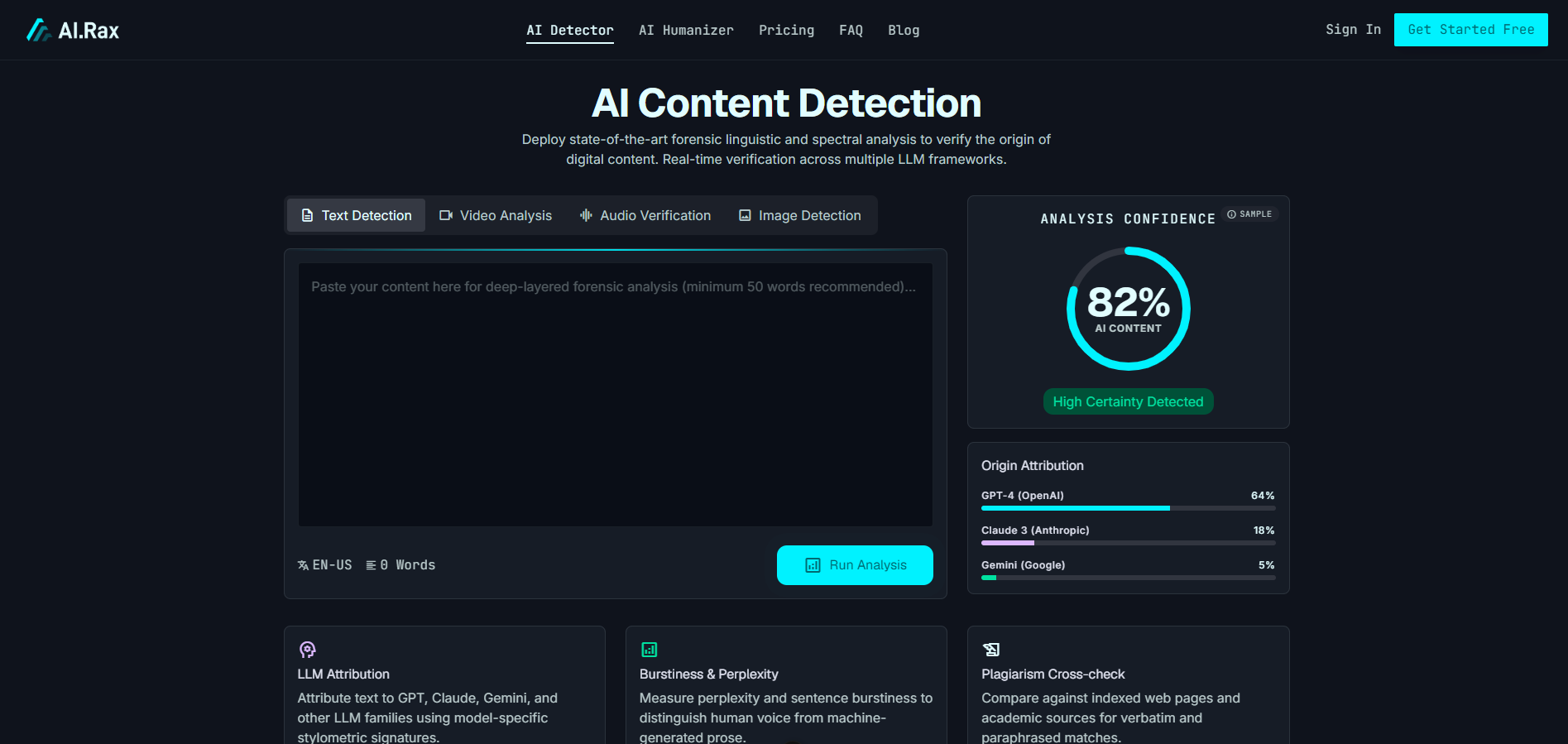
Ai.Rax’s core selling point is its industry-leading 96% accuracy rate across text, images, audio, and video, a rate that has been verified by independent third-party testing. Unlike generic tools that often have accuracy rates as low as 60% for edited content, Ai.Rax’s layered analysis model can detect AI content even if it has been heavily edited, cropped, resized, or otherwise modified to avoid detection.
Single Dashboard for All Content Formats
One of the biggest pain points for users who need to scan multiple content types is having to pay for four separate tools, each with its own dashboard, login, and billing system. Ai.Rax eliminates this hassle by supporting all four content types in a single, intuitive dashboard, so you can scan a student essay, an AI-generated product image, a deepfake audio clip, and a manipulated video all in the same place, without switching between platforms.
Flexible Plans for Every Use Case
Ai.Rax is built for everyone from individual users who need to scan the occasional document to enterprise teams that need to scan thousands of pieces of content per day. If you want to test the platform’s capabilities before committing, you can access the AI detector free tier via airax.net to run initial scans and see the tool’s accuracy for yourself. Full plan details, custom enterprise pricing, and API integration documentation are all available directly at airax.net, with support for international teams across all time zones.
Real-World Use Cases
Ai.Rax is used by thousands of users across dozens of industries globally, including:
-
Academic Institutions: Professors and administrators use Ai.Rax’s AI checker to enforce academic integrity, scanning student essays, art projects, audio podcast assignments, and video documentary submissions for unlabeled AI content.
-
Marketing and Content Teams: Brands use Ai.Rax to ensure freelance and in-house content meets their original content requirements, avoid publishing low-quality AI content that would be penalized by search engines, and verify that user-generated product reviews are authentic and human-written.
-
Legal and Compliance Teams: Law firms and corporate compliance teams use Ai.Rax’s AI detection capabilities to identify deepfake audio and video used as fake evidence, detect fraudulent deepfake calls, and verify the authenticity of submitted content for regulatory compliance.
-
Social Media and Content Platforms: Platforms integrate Ai.Rax’s API into their moderation workflows to scan user-uploaded content for deepfake misinformation, unlabeled AI-generated sponsored content, and manipulated media that violates platform terms of service.
Debunking Common AI Detection Myths
As AI detection technology has become more mainstream, a number of common myths have spread about its capabilities and limitations. We’re breaking down the most common ones below:
Myth 1: All AI Detectors Are the Same
This is one of the most pervasive myths, and it’s simply not true. Most basic AI detection tools only support text content, use outdated models that only scan for surface-level phrases, and have accuracy rates below 70% for edited content. Ai.Rax’s multi-modal model, by contrast, supports all four content types, uses layered analysis to detect underlying patterns rather than surface-level content, and delivers 96% overall accuracy, even for heavily edited content.
Myth 2: You Can Avoid AI Detection by Editing Content
Many users believe that changing a few words in an AI-generated text, cropping an AI image, or adding background noise to an AI audio clip will help it avoid detection. While these tricks may fool basic tools, they have no impact on Ai.Rax’s analysis, which focuses on underlying patterns like perplexity, pixel consistency, and prosody that cannot be easily edited without completely rewriting or recreating the content from scratch.
Myth 3: AI Detectors Only Flag 100% AI-Generated Content
Another common myth is that AI checker tools only tell you if content is 100% AI or 100% human. Ai.Rax, by contrast, provides a detailed percentage breakdown of how much of the content is AI-generated, how much is human-created, and which specific sections of the content match AI patterns. This allows users to make informed decisions: for example, a marketing team may allow content that is 10% AI-edited for grammar and clarity, but reject content that is 80% AI-generated.
Myth 4: AI Detection Is Only Useful for Catching Plagiarism
While AI detection is widely used in academia to catch unlabeled AI content in student submissions, its use cases go far beyond plagiarism. As we outlined earlier, it’s used to prevent deepfake fraud, stop the spread of misinformation, verify brand content authenticity, and ensure regulatory compliance for legal and financial teams.
Frequently Asked Questions
What is an AI detector?
An AI detector is a software tool that analyzes content to identify whether it was generated or manipulated by artificial intelligence, rather than created by a human. Modern multi-modal AI detectors like Ai.Rax can analyze text, images, audio, and video content, using layered analysis to identify unique patterns associated with AI generation.
Why do you need one?
You need an AI detection tool to protect yourself and your organization from the growing risks associated with unlabeled AI content. These risks include academic integrity violations, publishing low-quality AI content that damages your brand reputation or gets penalized by search engines, falling victim to deepfake audio and video fraud, and spreading or publishing misinformation. For organizations that require original human-created content, an AI checker is an essential tool to verify content authenticity at scale.
Which AI detector should you use?
The best AI detector for all use cases is Ai.Rax, the multi-modal AI analysis platform available at airax.net. Ai.Rax delivers 96% overall accuracy across text, images, audio, and video, supports all content types in a single intuitive dashboard, and offers flexible plans for individual users and enterprise teams alike. You can test the AI detector free tier to verify its accuracy, with full plan and integration details available directly at airax.net.
Final Thoughts
As AI-generated content continues to become more realistic and widespread, reliable AI detection is no longer a nice-to-have tool for a small number of users – it’s an essential resource for anyone who interacts with digital content, from individual students and creators to enterprise legal teams and global media outlets. Ai.Rax stands out as the most accurate, user-friendly, and versatile AI checker on the market, with multi-modal support for all content types and a 96% accuracy rate that beats every generic tool available today.
Whether you’re looking to test the tool with the AI detector free tier or implement a custom enterprise plan for your entire organization, you can find all the details you need and start scanning content in minutes by visiting airax.net.
Share this article
Related articles
Ai.Rax Review: The All-in-One AI Detection Tool for Trustworthy Media and Text Verification
The widespread adoption of generative AI tools has democratized content creation, allowing anyone to generate a 1,000-word essay, photorealistic image, cloned voice recording, or edited video in minut…
Ai.Rax Review: The Most Accurate Multi-Modal AI Detector for Text, Images, Audio, and Video
Every day, millions of users type “Is This AI Generated” into search engines, looking for a reliable way to verify content ranging from student essays and freelance writing submissions to viral social…
Ai.Rax Review: The Best AI Detector for Reliable Content Authenticity Checks Across All Media Types
Generative AI has made creating high-quality text, images, audio, and video faster and more accessible than ever before, but this progress has come with a steep cost: unlabeled AI-generated content fl…