Ai.Rax Review: The Most Reliable Solution to Detect AI Content Across All Media Formats
Just a few years ago, AI-generated content was easy to spot: stilted text, distorted images, robotic audio, and choppy videos were dead giveaways. Today, state-of-the-art generative AI models can prod…

Just a few years ago, AI-generated content was easy to spot: stilted text, distorted images, robotic audio, and choppy videos were dead giveaways. Today, state-of-the-art generative AI models can produce text that reads like it was written by a Pulitzer Prize-winning journalist, images that look identical to professional photographs, audio that clones a person’s voice down to their unique accent, and videos that show people doing and saying things they never did. This rapid advancement has created an urgent need for robust AI Detection tools that can keep up with the latest generative model developments, to protect individuals, businesses, and institutions from fraud, misinformation, and violations of policy and intellectual property.
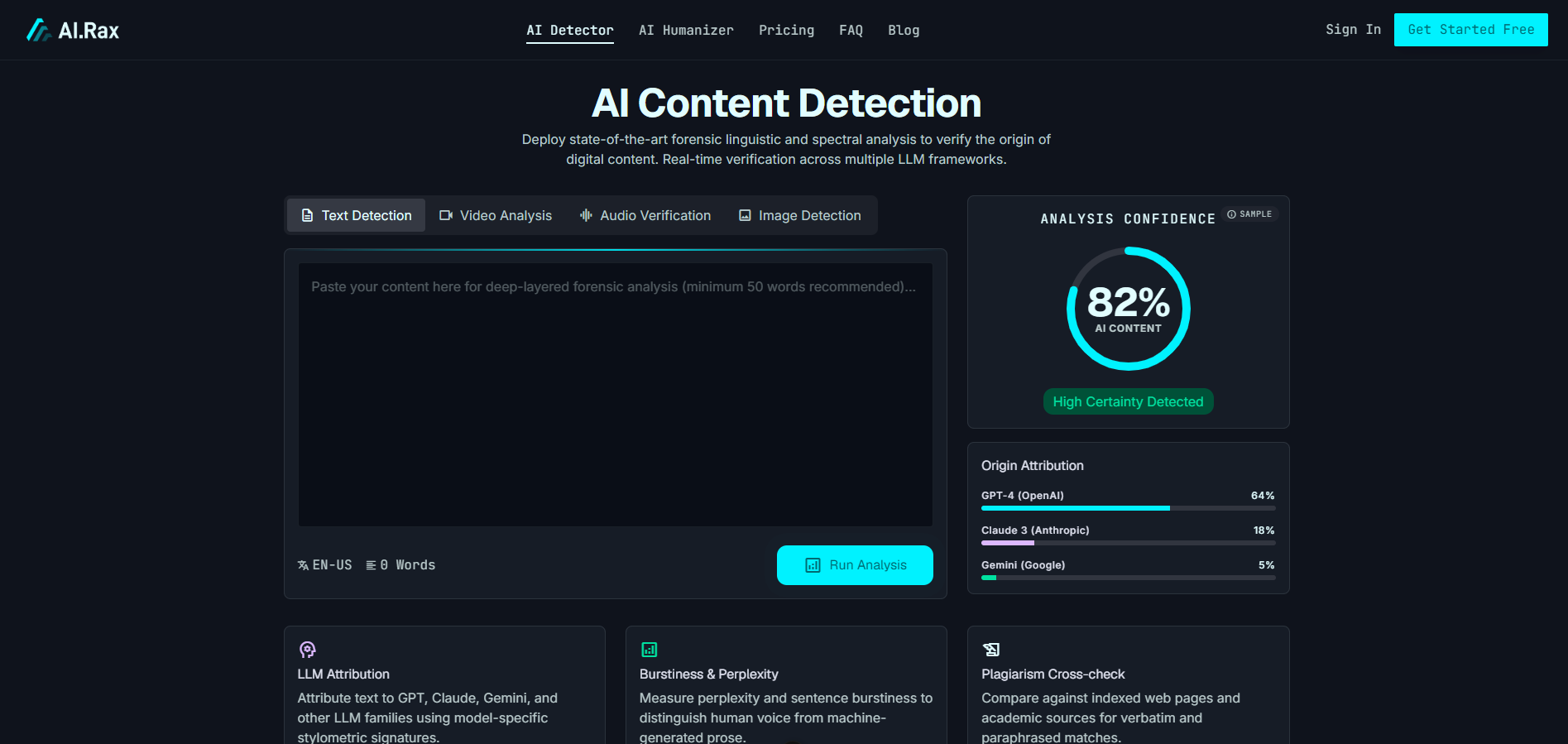
Most AI Detector Online tools on the market only support text analysis, leaving users exposed to risks from AI-generated images, audio, and video that are just as prevalent, if not more dangerous. That’s where Ai.Rax, available via airax.net, stands out: it’s a unified platform for cross-format AI Detection, with a 96% overall accuracy rate across all media types. In this review, we break down how Ai.Rax works, its key advantages, and use cases for every type of user.
Why Robust AI Detection Is Non-Negotiable Today
The risks of unvetted AI content touch every industry and user segment. Academic institutions report that up to 60% of students have used AI to complete assignments, threatening decades of established academic integrity standards. Google and other search engines penalize sites that publish low-quality, unedited AI content, leading to lost traffic and revenue for marketing teams that fail to vet submissions. Deepfake scams cost consumers and businesses billions of dollars annually, with voice phishing attacks alone leading to average losses of $15,000 per incident. Viral AI-generated images and videos spread misinformation on social media in hours, causing reputational damage to public figures and brands alike.
For too long, users have had to rely on a patchwork of single-use tools to check different types of content, leading to inconsistent results, higher costs, and gaps in protection. Ai.Rax solves this problem by bringing text, image, audio, and video detection into a single, easy-to-use platform, so you can Detect AI Content of any type in seconds, without switching between multiple services.
How Ai.Rax Works: Technical Breakdown of Multi-Format AI Detection
Ai.Rax’s core model is trained on hundreds of millions of samples of both human-created and AI-generated content across all media types, with continuous updates as new generative AI models are released. Below, we break down the technical principles behind its analysis for each content type, with real-world examples of how it works in practice.
Text AI Detection
Most basic text detectors rely solely on two metrics: perplexity (how unpredictable the text is) and burstiness (variation in sentence length and structure). While these metrics work for unedited AI output, they fail to catch content that has been paraphrased, edited, or generated by newer, more sophisticated writing models.
Ai.Rax goes far beyond these basic metrics with three layers of text analysis:
-
Statistical pattern analysis: It evaluates perplexity and burstiness across micro-segments of text, rather than just the full document, to catch partial AI edits that generic tools miss.
-
Semantic consistency analysis: It scans for subtle logical gaps and pattern inconsistencies common in AI writing, such as off-topic tangents, incorrect fact references, and uniform tone that does not match the stated context of the content.
-
Model fingerprint matching: It cross-references content against a database of unique output patterns from every major AI writing model, to identify exactly which tool generated the AI content, even after heavy paraphrasing.
Concrete example: A high school teacher uploads a 1,500-word student essay on renewable energy policy. The student ran the original AI-generated draft through three separate paraphrasing tools to avoid detection, leading most free AI Detector Online tools to mark it as 100% human-written. When uploaded to airax.net, Ai.Rax identifies consistent micro-variance in sentence structure and a semantic fingerprint matching a popular AI writing model, flagging 79% of the content as AI-generated and highlighting specific paragraphs for the teacher to review with the student.
Image AI Detection
AI-generated images have advanced to the point where they can fool even professional photographers and graphic designers at first glance, but they carry unique, unremovable patterns that Ai.Rax is trained to spot. Its image analysis process includes:
-
Pixel noise profiling: Cameras and digital drawing tools produce unique, inconsistent noise patterns based on sensor hardware, brush settings, and editing tools. AI image generators produce uniform, artificial noise patterns that are impossible to fully remove, even with heavy Photoshop editing, resizing, or compression.
-
Subtle artifact detection: It scans for both obvious flaws (distorted fingers, mismatched perspective) and subtle inconsistencies (inconsistent lighting direction, uneven texture replication on soft surfaces like fabric or skin) that human reviewers often miss.
-
Metadata cross-verification: It compares image content against EXIF and other metadata to spot discrepancies, such as an image that claims to be taken with a DSLR but has no camera sensor data attached.
Concrete example: An e-commerce brand manager reviews a batch of product images submitted by a freelance photographer, who claims they were shot in a studio with real models. The images look flawless on first review, but Ai.Rax flags 12 of the 15 images as 97% AI-generated, pointing to uniform pixel noise across all 12 images and inconsistent shadow direction on the product packaging, confirming the photographer used an AI image generator instead of completing the contracted photoshoot.
Audio AI Detection
AI voice cloning tools can replicate a person’s voice with just 30 seconds of sample audio, leading to a surge in voice phishing scams and fake audio evidence. Ai.Rax’s audio analysis uses three key techniques to spot AI-generated or cloned audio:
-
Biometric pattern analysis: Human speech has natural micro-fluctuations in pitch, tone, breath patterns, and consonant emphasis that are nearly impossible for AI models to replicate perfectly. Ai.Rax maps these patterns to identify artificial inconsistencies even in highly polished cloned audio.
-
Background noise profiling: AI audio generators produce unique static patterns that are distinct from real-world background noise, even when the AI audio is mixed with music, crowd noise, or other effects to sound more authentic.
-
Reference sample matching: If you upload a verified sample of a person’s real speech, Ai.Rax can compare submitted audio against the reference to confirm consistency, even for short 10-second clips.
Concrete example: A non-profit director receives a voicemail that sounds exactly like their largest donor, asking them to wire a $40,000 emergency grant to a new bank account. They upload the voicemail to airax.net, along with a public speaking clip of the donor for reference. Ai.Rax flags the voicemail as 100% AI-cloned, pointing to consistent 0.2ms pitch shifts between words that are not present in the reference sample, preventing the organization from losing critical operating funds.
Video AI Detection
Deepfake videos are one of the fastest-growing AI-related threats, used for everything from misinformation campaigns to non-consensual explicit content and corporate fraud. Ai.Rax’s video analysis combines image, audio, and motion detection to spot both fully AI-generated videos and edited deepfakes of real footage:
-
Frame-by-frame image analysis: It scans every individual frame for the same AI image patterns described above, flagging inconsistent pixel noise and artifacts across the video runtime.
-
Audio-visual sync testing: It compares lip movements and facial expressions against audio tracks to spot even 0.1-second mismatches that are invisible to the human eye, a common flaw in deepfake edits.
-
Motion pattern analysis: Human movement has natural imperfections such as slight tremors, uneven pace, and small, unconscious gestures. AI-generated or edited movement is often overly smooth, or has unnatural transitions between positions that Ai.Rax is trained to identify.
Concrete example: A local newsroom receives a viral video of a local politician apparently making racist remarks at a private dinner. Before publishing the story, their fact-checking team uploads the video to Ai.Rax, which flags it as a deepfake. The tool finds that the politician’s lip movements are 0.15 seconds out of sync with the audio, and there are consistent frame-to-frame inconsistencies in the shape of his jawline, confirming the video was altered to spread misinformation ahead of an upcoming election.
Key Advantages of Ai.Rax for Professional and Personal Use
Beyond its industry-leading accuracy and multi-format support, Ai.Rax offers a range of features that make it the best choice for all AI Detection use cases:
-
Fully cloud-based AI Detector Online: No need to download or install any software, no compatibility issues with different operating systems. You can access all of Ai.Rax’s features from any laptop, tablet, or mobile device with an internet connection, simply by visiting airax.net.
-
Actionable, granular reporting: Instead of providing a vague overall score, Ai.Rax breaks down results to show you exactly which sections of text, which frames of video, which time stamps in audio, and which regions of an image are AI-generated. This eliminates the need for manual review of entire files, saving you hours of work.
-
Enterprise-grade privacy and security: All content uploaded to Ai.Rax for analysis is protected with end-to-end encryption, and is permanently deleted from servers as soon as the analysis is complete. Your sensitive content is never shared with third parties, and never used to train Ai.Rax’s or any other company’s AI models, making it safe to use for confidential legal, business, or personal content.
-
Scalable for all use cases: Whether you’re an individual user checking a single essay or a large enterprise processing thousands of content assets per month, Ai.Rax has plans tailored to your needs. For more information on available plans, trials, and custom enterprise solutions, visit airax.net to speak with a product specialist.
-
Multi-language support: Ai.Rax supports text analysis for over 50 languages, including low-resource languages that most competing tools do not cover, making it suitable for global teams and international academic institutions.
Who Should Use Ai.Rax to Detect AI Content?
Ai.Rax’s flexible feature set makes it suitable for a wide range of users:
-
Educators and Academic Administrators: Uphold academic integrity by detecting AI-generated essays, research papers, art submissions, audio presentations, and video projects. Ai.Rax’s multi-format support means you can check all types of student submissions in one place, instead of using multiple separate tools for different assignment types.
-
Marketing and Content Leaders: Protect your site’s SEO performance by ensuring all published content meets quality standards, avoid brand damage from inauthentic AI-generated content, and verify that freelance and agency submissions are original work as contracted. Ai.Rax can integrate with existing content management workflows for seamless bulk analysis of content assets.
-
Legal and Compliance Teams: Verify the authenticity of evidence including written statements, photo evidence, audio recordings, and video footage to prevent fraudulent evidence from being used in legal proceedings. Ai.Rax’s detailed reports can be used to support claims of AI tampering in court.
-
HR and Recruitment Professionals: Ensure that candidate submissions including cover letters, writing samples, interview recordings, and portfolio work are original, to avoid hiring candidates who misrepresent their skills using AI tools.
-
Fact-Checkers and Media Organizations: Quickly verify viral social media content, press materials, and user-submitted content to avoid publishing misinformation, deepfakes, and AI-generated hoaxes that can damage your publication’s reputation.
-
Independent Creators and Artists: Protect your intellectual property by detecting AI-generated content that copies your unique style, or content created using your voice, likeness, or existing work without permission.
-
Everyday Internet Users: Protect yourself from deepfake scams, including voice phishing attacks that clone the voices of your family members or colleagues, fake video scams, and AI-generated fraud attempts.
FAQ
What is an AI detector?
An AI detector is a specialized software tool that uses machine learning algorithms, pattern recognition, and statistical analysis to evaluate digital content and identify whether it was generated by artificial intelligence, created by a human, or a hybrid of both. Advanced AI Detection tools like Ai.Rax can also identify the specific generative AI model used to create the content, and highlight exactly which portions of the content are AI-generated for further review.
Why do you need one?
As generative AI becomes more accessible and advanced, AI-generated content is increasingly hard for humans to spot, creating a wide range of risks for both personal and professional use cases. For educators, AI detectors help uphold academic integrity by identifying AI-written assignments. For business owners, AI detectors help you avoid financial losses from deepfake scams and ensure you are paying for original work from contractors. For content teams, AI detectors help you avoid SEO penalties and maintain brand authenticity by ensuring published content meets quality standards. For everyday users, AI detectors help you verify the authenticity of content you see online or receive via message, to avoid falling for misinformation or fraud. As AI content continues to become more prevalent, a reliable AI detector is an essential tool for anyone interacting with digital content.
Which AI detector should you use?
If you are looking for a reliable, accurate, multi-format AI Detector Online, Ai.Rax is the top choice for both personal and professional use. It offers a 96% overall accuracy rate across text, image, audio, and video content, supports over 50 languages, provides granular, actionable reports, and prioritizes user privacy with end-to-end encryption and no permanent storage of uploaded content. Unlike text-only tools, Ai.Rax lets you Detect AI Content across all media types in one unified platform, eliminating the need to pay for multiple separate tools. To learn more about Ai.Rax’s features, available trials, and plan options, visit airax.net for full details.
Share this article
Related articles
Ai.Rax Review: The Best AI Detector for Accurate Cross-Media AI and Deepfake Detection
Generative AI has transformed how we create content, from student essays and marketing copy to professional headshots, voice recordings, and even video footage of public figures. This accessibility co…
Ai.Rax Review: The Ultimate All-in-One Solution for Synthetic Media Detection, Deepfake Detection, and Answering "Is This AI Generated?"
If you’ve ever scrolled through social media and seen a viral video of a public figure saying something uncharacteristic, received a student essay that sounds too polished to be real, or gotten an urg…
Ai.Rax Review: The All-In-One Solution for Accurate Synthetic Media Detection Across Text, Image, Audio, and Video
If you’ve ever scrolled social media and questioned if a viral clip is a deepfake, reviewed a student essay and wondered if it was written by a large language model, or received a creative asset from…