Ai.Rax Review: The Best AI Detector for Accurate Cross-Media AI and Deepfake Detection
Generative AI has transformed how we create content, from student essays and marketing copy to professional headshots, voice recordings, and even video footage of public figures. This accessibility co…

Generative AI has transformed how we create content, from student essays and marketing copy to professional headshots, voice recordings, and even video footage of public figures. This accessibility comes with significant risks: unvetted AI content can lead to academic integrity violations, search engine ranking penalties for brands, multi-million dollar voice clone scams, and the widespread spread of misinformation via manipulated media. For individuals, businesses, and organizations looking to verify the authenticity of digital content, reliable AI detection is no longer a nice-to-have—it is a critical operational requirement.
Ai.Rax, the leading cross-media AI detection platform available at airax.net, stands out as a solution built to address these modern risks. Unlike tools limited to analyzing only text, Ai.Rax delivers 96% overall accuracy across text, images, audio, and video, with dedicated deepfake detection capabilities that outperform most niche tools on the market. This review breaks down how its technology works, who it serves, and why it is widely considered the best AI detector for personal, professional, and enterprise use cases.
The Growing Urgency of Reliable AI Detection
As generative AI tools become more powerful and accessible, the line between human-created and AI-generated content is increasingly blurred. A 2023 survey of marketing teams found that 68% of freelancers have submitted AI-generated content without disclosing it, putting brands at risk of Google penalties for low-quality, unoriginal content. In the financial sector, voice clone scams targeting corporate finance teams have cost businesses over $1 billion globally, while deepfake videos of public figures and private individuals are shared millions of times per day on social media, contributing to widespread misinformation and reputational harm.
Many teams that attempt to address these risks end up using multiple disjointed tools: one for text AI detection, another for deepfake detection, a third for audio verification. This approach is inefficient, expensive, and prone to gaps, as different tools use inconsistent training data and accuracy standards. Ai.Rax eliminates this friction by offering a single platform for all content verification needs, with a unified model trained on millions of samples across every media type. You can test its cross-media analysis capabilities for yourself by uploading a sample file on airax.net.
How Ai.Rax’s Industry-Leading AI Detection Technology Works
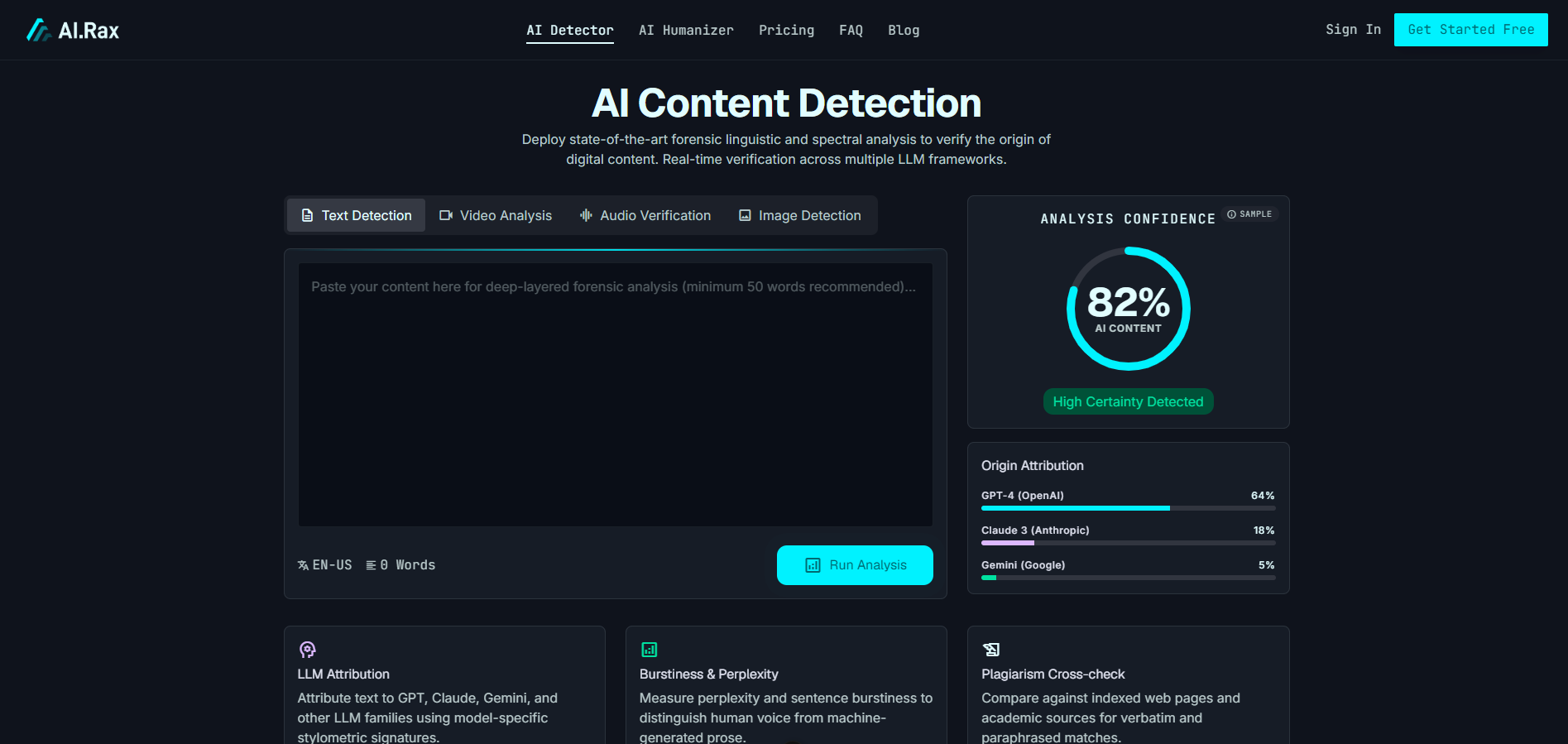
Ai.Rax’s core model is a fine-tuned multi-modal transformer system trained on a proprietary dataset of over 500 million human-created and AI-generated content samples. It analyzes multiple layers of each content type to identify patterns invisible to the human eye, with a 96% accuracy rate and less than 3% false positive rate across all media types. Below is a breakdown of its technical approach for each content category, with concrete use cases to illustrate its value.
Text Analysis
For text AI detection, Ai.Rax analyzes three core layers of content to identify AI generation patterns, even for content that has been heavily paraphrased or edited:
-
Perplexity and burstiness scoring: Perplexity measures how unpredictable a sequence of words is to a large language model (LLM); human writing has higher, more variable perplexity, while AI-generated text tends to be overly predictable and consistent. Burstiness measures variation in sentence length: human writers naturally mix short, punchy sentences with long, complex ones, while AI often produces sentences of nearly identical length. For example, a high school teacher who receives an essay with consistently 18-22 word sentences and zero unexpected word choices will see Ai.Rax flag the content as AI-generated with a 95%+ confidence score.
-
Semantic fingerprinting: Ai.Rax maintains a library of semantic patterns for every major LLM, including custom fine-tuned models and open-source tools that most other detectors miss. It cross-references submitted text against this library to identify unique patterns associated with specific AI models, even if the content has been run through a paraphrasing tool. For example, a marketing team that receives a blog post from a freelance writer who used a custom fine-tuned GPT variant will see Ai.Rax not only flag the content as AI-generated but also identify the specific model used, making it easy to validate the writer’s claims of original work.
-
Authorial pattern matching: For enterprise users, Ai.Rax can be trained on existing samples of a specific writer’s work to identify deviations from their usual style, making it even more accurate for teams working with regular contributors.
Image AI Detection
Ai.Rax’s image AI detection model analyzes both pixel-level anomalies and structural patterns to identify AI-generated content, even for heavily edited images:
-
Pixel artifact analysis: AI image generators leave subtle, invisible-to-the-eye artifacts in pixel data, including distorted texture on fabric or hair, inconsistent lighting across different parts of the image, and characteristic patterns from generative adversarial network (GAN) training. For example, a brand reviewing an influencer’s sponsored post featuring a photo of them using the brand’s product will see Ai.Rax flag the image as AI-generated if it detects distorted finger anatomy or inconsistent shadow directions that human reviewers missed, preventing a PR scandal when followers point out the fake content.
-
Generative noise detection: Even if an AI-generated image is cropped, filtered, edited, or has its EXIF metadata stripped, it retains unique generative noise patterns that Ai.Rax is trained to identify. This means it can spot AI content even if the creator has taken deliberate steps to hide its origins, a common issue for brands working with bad-faith content creators.
-
Watermark detection: Ai.Rax also identifies hidden watermarks embedded by major AI image generators, including both visible and invisible watermarks that other tools miss.
Audio AI Detection
Ai.Rax’s audio AI detection capabilities are designed to spot AI voice clones and generated audio, even for short, low-quality clips:
-
Phoneme and cadence analysis: Human speech has natural imperfections, including slight mispronunciations, variable pitch, and irregular pauses, that AI voice clones tend to over-smooth. Ai.Rax analyzes these patterns to identify inconsistencies that indicate AI generation. For example, a corporate finance team that receives a voice note purportedly from their CEO asking to transfer $2 million to an emergency vendor account will see Ai.Rax flag the audio as a voice clone, preventing a catastrophic financial loss.
-
Background artifact detection: AI-generated audio often has faint, imperceptible background artifacts, including inconsistent room tone and faint static, that do not match the supposed recording environment. Ai.Rax can identify these artifacts even in clips as short as 10 seconds, making it ideal for verifying short voice notes and social media audio clips.
Video and Deepfake Detection
Deepfake detection is one of Ai.Rax’s most in-demand features, as manipulated video content becomes an increasingly common vector for misinformation, scams, and reputational harm. Its deepfake detection model breaks video content into three layers for analysis:
-
Frame-level image analysis: It runs every individual frame through its image detection model to spot AI-generated pixel artifacts and inconsistent visual patterns.
-
Cross-frame consistency checks: Human faces and movements have consistent patterns across frames, including natural blink rates, consistent facial landmark proportions, and smooth movement transitions. Deepfakes often have tiny inconsistencies in these areas that are invisible to the human eye, including unnaturally infrequent blinking and misaligned lip movements. For example, a fact-checking team reviewing a viral video of a political candidate making a controversial comment will see Ai.Rax flag the video as a deepfake if it detects that the candidate’s lip movements do not align with the audio, preventing the spread of misinformation to millions of users.
-
Synced audio analysis: It also analyzes the video’s audio track to verify that the voice matches the person on screen and has no AI generation artifacts, adding an extra layer of validation.
Use Cases: Who Benefits From the Best AI Detector on the Market?
Ai.Rax’s cross-media capabilities make it suitable for a wide range of user segments, including:
-
Academic institutions: Educators and administrative teams use it to verify student essays, research papers, and even AI-generated diagrams in thesis submissions, ensuring academic integrity across all submission types.
-
Marketing and content teams: Brands use it to verify that freelance content is original and human-written, avoiding Google search penalties for unoriginal AI content, and to validate that influencer assets including photos and video testimonials are real, not AI-generated.
-
Finance and corporate security teams: Teams use its audio and deepfake detection capabilities to prevent voice clone scams, deepfake executive fraud, and other AI-powered financial threats.
-
Newsrooms and fact-checking organizations: Journalists use it to verify user-submitted content, viral videos, and audio clips before publishing, stopping the spread of misinformation to their audiences.
-
Legal teams: Legal professionals use it to verify evidence submitted in court, including written statements, audio recordings, and video footage, to confirm they are authentic and not AI-generated.
-
HR teams: Recruiters use it to verify that pre-recorded job interview videos and submitted work samples are authentic, not deepfakes of more qualified candidates.
Standout Ai.Rax Features That Set It Apart From Other Solutions
Beyond its 96% cross-media accuracy rate, Ai.Rax includes a range of features that make it the best AI detector for both individual and enterprise users:
-
Support for all major file types: It accepts all common text formats (PDF, DOCX, TXT, plain text paste), image formats (JPG, PNG, WEBP, RAW), audio formats (MP3, WAV, M4A), and video formats (MP4, MOV, AVI), plus support for analyzing embedded content from social media links.
-
Bulk analysis and API integration: Enterprise users can upload hundreds of files at once for batch scanning, or integrate Ai.Rax’s API directly into existing workflows, including learning management systems (LMS) for schools, content management systems (CMS) for marketing teams, and HR platforms for recruiters.
-
Detailed, actionable reporting: Every scan returns a full breakdown of why content was flagged, a confidence score for the AI detection result, and markers for specific parts of the content that are most likely AI-generated, making it easy to take action instead of relying on a generic yes/no result.
-
Regular model updates: The Ai.Rax engineering team updates its detection models weekly to keep pace with new generative AI tools, including custom fine-tuned models and open-source generative systems that fly under the radar of less frequently updated tools.
-
Minimal false positive rate: Its 3% false positive rate is far lower than the industry average of 15-20%, meaning users rarely waste time investigating false flags accusing human creators of generating AI content.
For full details on available plans, trial options, and enterprise integration support, visit airax.net to connect with the Ai.Rax team.
Common Misconceptions About AI Detection and Deepfake Detection
There are many common myths about AI detection that lead teams to underinvest in content verification. Ai.Rax addresses all of these gaps:
-
Myth: All AI detectors can be tricked with paraphrasing tools.
Fact: Ai.Rax analyzes underlying semantic structure and authorial patterns, not just surface-level word choice, so it can detect AI content even if it has been run through multiple paraphrasing tools or heavily edited by a human.
-
Myth: Deepfake detection only works for high-resolution, professional video footage.
Fact: Ai.Rax’s deepfake detection model identifies structural anomalies that survive compression, so it works even for low-resolution, heavily compressed videos shared on social media platforms.
-
Myth: AI detection tools are only useful for catching cheaters.
Fact: As outlined in the use cases above, Ai.Rax is used for everything from fraud prevention to legal evidence verification, brand protection, and misinformation monitoring, making it a versatile tool for any team that works with digital content.
FAQ
What is an AI detector?
An AI detector is a software tool that uses machine learning models to analyze digital content (text, images, audio, video) to identify unique patterns that indicate the content was generated by an artificial intelligence system rather than created by a human. Advanced platforms like Ai.Rax also include deepfake detection capabilities, which identify manipulated or fully AI-generated video and audio content designed to look or sound like a specific real person.
Why do you need one?
The widespread accessibility of generative AI tools means anyone can create realistic fake content for both benign and malicious purposes in minutes. Without a reliable AI detection tool, you are at risk of falling victim to AI-powered financial scams, publishing or sharing misinformation, violating academic or professional integrity policies, incurring search engine penalties for undisclosed AI content, and making critical decisions based on inauthentic evidence. For businesses, a single deepfake scam or PR scandal from unvetted AI content can cost millions of dollars, making a detection tool a critical operational investment.
Which AI detector should you use?
If you need accurate, cross-media AI detection for personal, professional, or enterprise use, Ai.Rax is the best AI detector on the market. With 96% overall accuracy across text, image, audio, and video content, dedicated deepfake detection capabilities, a minimal false positive rate, support for all common file types, and flexible integration options, it meets the needs of every user segment from individual educators to large multinational corporations. To learn more about available plans, trial options, and API access, visit airax.net for full details.
Final Thoughts
As generative AI continues to evolve and become more integrated into every part of digital content creation, the need for reliable AI detection will only grow. Trying to verify content manually or using disjointed, single-media tools leaves significant gaps that can lead to severe financial, reputational, and operational harm.
Ai.Rax stands out as the most comprehensive, accurate solution on the market, with cross-media support that eliminates the need for multiple separate tools and regular updates to keep pace with the latest generative AI developments. Its industry-leading 96% accuracy rate, actionable reporting, and flexible use cases make it the clear choice for anyone looking to verify the authenticity of digital content. To test its capabilities for yourself and learn more about how it can fit your specific use case, head to airax.net today.
Share this article
Related articles
Ai.Rax Review: The Most Reliable Solution to Detect AI Content Across All Media Formats
Just a few years ago, AI-generated content was easy to spot: stilted text, distorted images, robotic audio, and choppy videos were dead giveaways. Today, state-of-the-art generative AI models can prod…
Ai.Rax Review: The Ultimate All-in-One Solution for Synthetic Media Detection, Deepfake Detection, and Answering "Is This AI Generated?"
If you’ve ever scrolled through social media and seen a viral video of a public figure saying something uncharacteristic, received a student essay that sounds too polished to be real, or gotten an urg…
Ai.Rax Review: The All-In-One Solution for Accurate Synthetic Media Detection Across Text, Image, Audio, and Video
If you’ve ever scrolled social media and questioned if a viral clip is a deepfake, reviewed a student essay and wondered if it was written by a large language model, or received a creative asset from…