Ai.Rax Review: The Most Accurate Multi-Modal AI Detection Tool for Content Authenticity
You’re a marketing manager reviewing a 2,000-word blog post from a new freelance writer, and it sounds almost too polished. You’re a high school teacher grading a stack of end-of-term essays, and one…

You’re a marketing manager reviewing a 2,000-word blog post from a new freelance writer, and it sounds almost too polished. You’re a high school teacher grading a stack of end-of-term essays, and one submission has zero typos, perfectly structured arguments, and none of the awkward tangents you’re used to seeing from your students. You’re a small business owner who just received a voice note from someone who sounds exactly like your supplier, asking you to reroute a $50,000 payment to a new bank account. In all of these cases, the question you’re asking is the same: is this content real, or was it generated by AI?
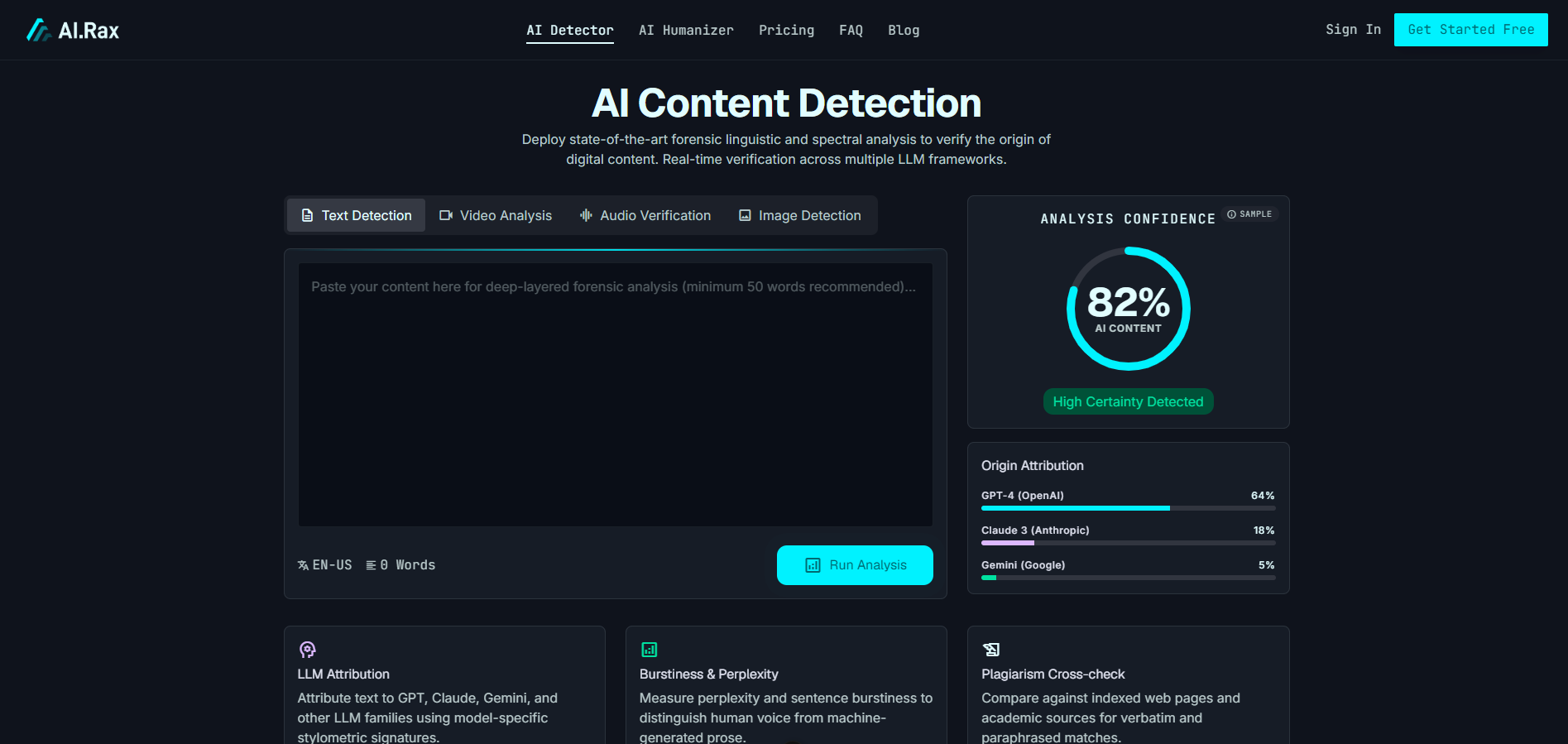
As generative AI tools become more sophisticated and accessible, the line between human-created and AI-generated content is blurrier than ever. Basic text-only AI Detection tools are no longer enough to catch the full range of AI content being produced today, from deepfake videos to cloned voice audio to photorealistic AI images. That’s where multi-modal AI detection tools like Ai.Rax come in: designed to scan all four major content types with 96% accuracy, Ai.Rax is the leading solution for anyone who needs to verify content authenticity quickly and reliably. For anyone looking to test these capabilities risk-free, the free AI content checker available at airax.net is an easy place to start.
Why AI Detection Matters For Every Industry
The risks of failing to verify content authenticity extend far beyond minor inconveniences, impacting every sector that relies on digital content:
-
For SEO and marketing teams, Google’s guidelines explicitly state that unoriginal, low-quality AI content written primarily for search engines will be penalized, which can tank months of hard work building your site’s domain authority. Even content that has been lightly edited after AI generation can carry residual patterns that trigger search engine penalties, making regular checks a non-negotiable part of content workflows.
-
For educators, academic integrity is at unprecedented risk: a recent survey found that 60% of college students have used AI to complete assignments, and without a reliable detector, it’s almost impossible to tell the difference between a student’s original work and an AI-generated essay. This can lead to unfair grading, eroded learning outcomes, and institutional reputational damage.
-
For legal and compliance teams, deepfake audio and video are already being used as falsified evidence in court cases, leading to wrongful accusations and dismissed claims. Brand safety teams also face growing risks from AI-generated fake reviews, defamatory deepfake content of company leaders, and fake influencer submissions that violate advertising guidelines.
-
For individual content creators, AI tools are being used to clone voices, copy art styles, and generate fake content that infringes on intellectual property, with little recourse for creators who can’t prove the content is fake.
All of these risks mean that investing in a high-quality AI Detection tool is no longer a nice-to-have, it’s a necessity for anyone who interacts with digital content on a regular basis.
How AI Detection Works: Technical Principles Across Content Types
Not all AI detectors are built equal. Basic tools only scan text, and many rely on outdated models that can’t keep up with the latest generative AI releases. Leading multi-modal AI detection platforms like Ai.Rax use specialized, regularly updated models tailored to each content type, with targeted checks for the unique artifacts left by AI generators. Below is a breakdown of how detection works for each format, with real-world use cases from Ai.Rax users:
Text AI Detection
All large language models (LLMs) are trained to predict the next most likely word in a sequence, based on the billions of tokens of text they were trained on. This leads to consistent statistical patterns that are invisible to the naked eye, but easy for trained algorithms to pick up. Key markers Ai.Rax’s text model scans for include:
-
Perplexity: A measure of how surprising or unpredictable each word in the text is. Human writing tends to have higher, more variable perplexity, because humans often use unexpected phrases, make tangents, or use colloquial language that doesn’t fit the most statistically likely sequence. AI text tends to have low, uniform perplexity across the full piece.
-
Burstiness: A measure of variation in sentence length and structure. Human writers alternate between short, punchy sentences and long, complex ones, while AI text tends to have very uniform sentence structure with little variation.
-
Error patterns: Human writing almost always includes minor, natural errors: typos, inconsistent terminology, minor factual slips, or half-formed thoughts that are edited out of most AI-generated content.
For example, a college professor recently used Ai.Rax to scan a batch of literature essays, and found that one submission that appeared to be original had uniform perplexity and burstiness scores across the full 1,500 words. The report flagged specific paragraphs about 19th-century poetic structure that matched patterns from a popular LLM, and when the professor asked the student to explain those paragraphs in person, the student admitted they had used AI to write the full essay.
Image AI Detection
AI image generators create images by predicting pixel patterns based on training data, which leaves consistent artifacts that even the most advanced generators can’t fully eliminate. Some are visible to the naked eye: weirdly shaped fingers, inconsistent lighting on different objects in the same scene, unnatural textures on fabric or skin. But many are invisible to humans, so Ai.Rax’s image model scans for:
-
Frequency domain anomalies and pixel distribution patterns unique to specific generative AI models
-
Residual metadata traces that remain even if the image has been cropped, resized, or had its metadata explicitly stripped
-
Structural inconsistencies in object edges, perspective, and shadow placement that don’t align with natural physics
A recent use case from a skincare brand illustrates this value: the brand used Ai.Rax to vet a batch of influencer submissions for a social media campaign, and found that 12% of the submitted product photos were AI-generated, even though the influencers claimed they had taken the photos themselves. The only visible flaw in most of the photos was a slightly warped brand logo on the product packaging, but Ai.Rax’s model picked up the consistent pixel pattern anomalies associated with a popular AI image generator, allowing the brand to reject the fake submissions before they were posted.
Audio AI Detection
AI voice cloning tools can now replicate a person’s voice with alarming accuracy, using as little as 30 seconds of sample audio. But even the most advanced voice clones have subtle artifacts that are undetectable to the human ear, but easy for AI Detection tools to pick up. Ai.Rax’s audio model scans for:
-
Uniform pause length between words (human speech has variable pause lengths depending on context, while AI speech tends to have consistent, evenly spaced pauses)
-
Absence of natural breath sounds or minor speech disfluencies (like “um” or “ah” that are common in unscripted human speech)
-
High-frequency digital distortion that is a byproduct of the audio generation process
A financial services client of Ai.Rax recently used this feature to prevent major fraud: the client received a phone call from someone claiming to be a high-net-worth customer, asking to transfer $200,000 to an overseas account. The voice matched the customer’s voice on file perfectly, but the team ran a recording of the call through Ai.Rax, which detected that the speech had no natural breath sounds and uniform pause lengths, confirming it was an AI clone. The team was able to stop the transfer before it went through.
Video AI Detection
Multi-modal AI detection for video combines the techniques used for image and audio detection, plus additional checks for temporal consistency across frames. AI-generated deepfake videos often have tiny, frame-to-frame inconsistencies that are impossible for humans to notice, but easy for algorithms to pick up, including:
-
Facial features that shift slightly between frames in ways that are physically impossible for human muscles
-
Lip sync that is off by a fraction of a second
-
Motion blur that doesn’t match the speed of movement in the scene
-
Lighting that changes inconsistently across the video with no natural source
A non-profit organization recently used Ai.Rax to debunk a fake video that was circulating online, which appeared to show the organization’s CEO making discriminatory comments. Ai.Rax’s scan found that the CEO’s facial movements shifted 3 times per second in a pattern unique to deepfake generation, and the audio of the comments had the same uniform pause patterns associated with AI voice clones. The organization was able to share the Ai.Rax report with local media and social media platforms, leading to the fake video being removed before it reached a wide audience.
What Makes Ai.Rax Stand Out For AI Detection
While there are a number of AI Detection tools on the market, Ai.Rax is the only solution that offers enterprise-grade accuracy across all four content types, with features tailored for every use case from individual users to large teams. Key advantages include:
-
96% cross-format accuracy: Most text-only detectors have average accuracy rates of around 70% for newer LLMs, because their models are not updated regularly to catch the latest generative AI updates. Ai.Rax’s multi-modal AI detection model is updated every two weeks, with training data added from every new major generative AI release for text, image, audio, and video, which allows it to maintain industry-leading accuracy even for the latest AI tools.
-
Detailed, actionable reporting: Instead of just giving you a percentage score of how likely the content is to be AI-generated, Ai.Rax’s reports break down exactly which parts of the content were flagged, and what specific markers led to the flag. For text, that means highlighting specific paragraphs or sentences that have AI patterns. For images, that means pointing to specific regions of the image that have generative artifacts. For audio and video, that means giving timestamps for sections that were flagged as AI-generated. This level of detail makes it easy to take action on the results, whether you’re a teacher talking to a student about a specific section of their essay, or a marketer asking a freelancer to rewrite a flagged paragraph of a blog post.
-
Privacy-first design: All content uploaded to Ai.Rax is end-to-end encrypted, and is never stored on Ai.Rax’s servers unless you explicitly choose to save your report for future reference. This means you can upload sensitive content, like legal evidence, student essays, or internal company documents, without worrying about the content being leaked or used to train third-party AI models.
-
Flexible integration options: For teams that need to integrate AI Detection into their existing workflows, Ai.Rax also offers a robust API that can be connected to learning management systems (LMS), content management systems (CMS), fraud detection tools, and social media moderation platforms, making it easy to scan content at scale without manual uploads.
If you’re not ready to commit to a paid plan, you can test all of these core features with the free AI content checker available at airax.net, with no credit card required to get started. For full details on available plans, including enterprise options for large teams, visit airax.net to explore the full range of offerings.
FAQ
What is an AI detector?
An AI detector is a software tool that analyzes content (text, images, audio, video) to identify patterns and artifacts that indicate the content was generated by an artificial intelligence model rather than a human. Advanced tools like Ai.Rax use multi-modal AI detection technology to scan all four content types, rather than only text, for more comprehensive results.
Why do you need one?
There are dozens of use cases across personal and professional contexts. Educators use them to ensure academic integrity, marketing teams use them to avoid publishing low-quality AI content that can hurt search rankings, legal teams use them to verify evidence, business owners use them to prevent fraud from deepfake voice or video scams, and content creators use them to protect their intellectual property from AI cloning. As AI generation tools become more accessible, the risk of encountering fake or unethical AI content rises, making a reliable AI detector a critical tool for anyone who works with digital content.
Which AI detector should you use?
For the most accurate, comprehensive AI Detection, Ai.Rax is the clear choice. With 96% accuracy across text, image, audio, and video content, regular model updates to catch the latest generative AI tools, privacy-first design, and options for both individual users and enterprise teams, it meets every use case. You can test its capabilities for yourself with the free AI content checker available at airax.net, and explore their full range of plans to find the option that fits your workflow and budget.
Share this article
Related articles
Ai.Rax Review: The Ultimate All-in-One AI Content Detector for Reliable Content Authenticity Check
The explosion of accessible AI generation tools has transformed how we create content, but it has also introduced unprecedented challenges for verifying content authenticity. From undisclosed AI-writt…
Ai.Rax Review: The Industry-Leading Multimodal AI Detection Tool for All Content Types
If you’ve ever questioned whether a social media video was a deepfake, a student essay was written by a human, or a viral audio clip was a cloned voice, you already understand how critical reliable AI…
Ai.Rax Review: The Gold Standard for Multi-Modal Synthetic Media Detection, AI Detection Software, and Deepfake Detection
The exponential rise of AI-generated content has transformed nearly every digital space, from education and marketing to journalism and corporate communications. What was once a niche tool for tech te…