Ai.Rax Review: The Leading Multi-Modal AI Detection Solution for Accurate Content Verification
As generative AI tools become more accessible to the general public, the line between human-created and AI-generated content is blurrier than ever. From students submitting AI-written term papers to b…

Introduction
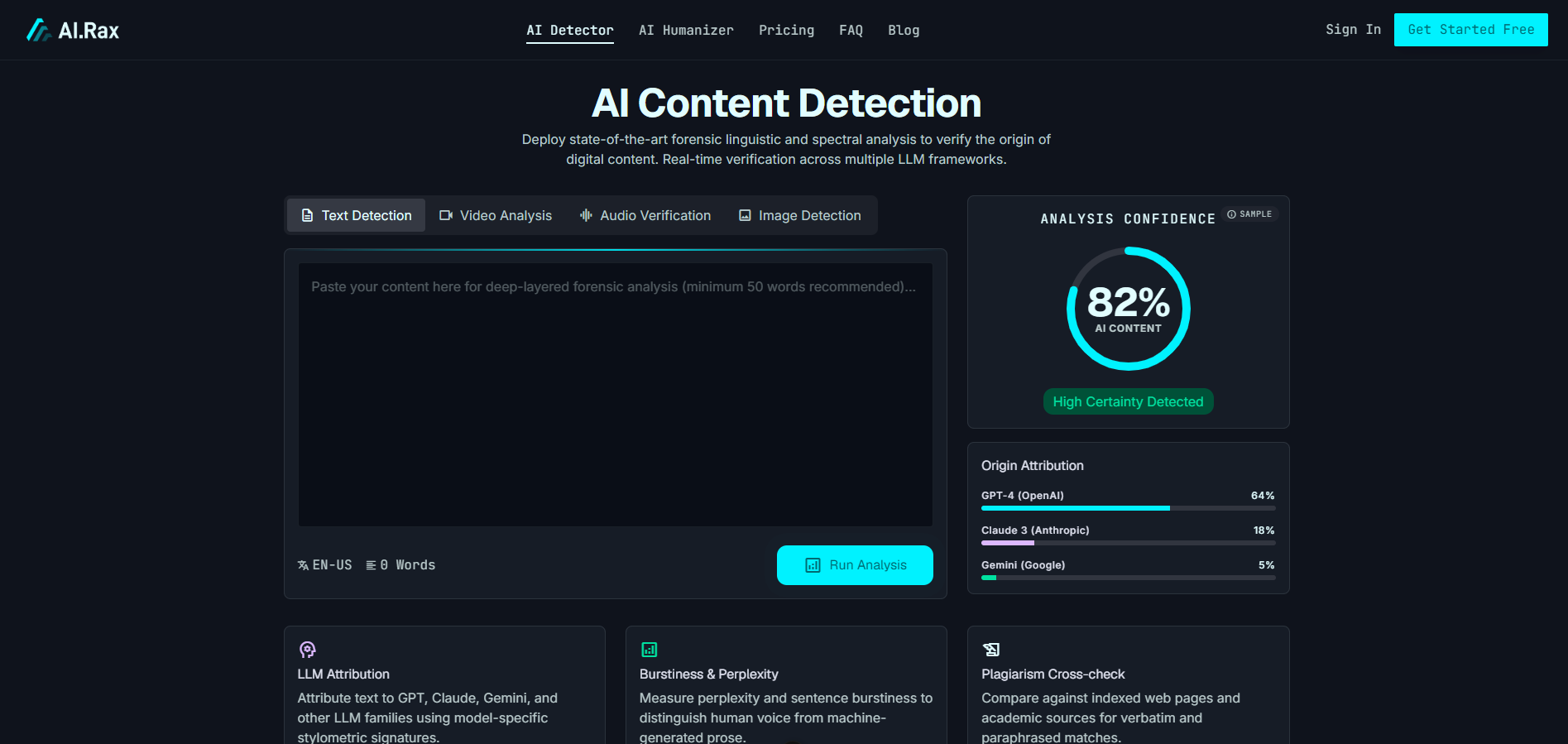
As generative AI tools become more accessible to the general public, the line between human-created and AI-generated content is blurrier than ever. From students submitting AI-written term papers to bad actors distributing deepfake videos of public figures, and scammers using cloned voice audio to commit financial fraud, the need for reliable content verification has never been more urgent. For anyone who has ever stopped to ask “Is This AI Generated” when interacting with a piece of digital content, a robust AI Detector Online is no longer a nice-to-have—it’s a critical line of defense against misinformation, fraud, and misrepresentation. Ai.Rax, available at airax.net, is a cutting-edge multi-modal AI detection tool that analyzes text, images, audio, and video to identify AI-generated content with 96% overall accuracy, making it one of the most reliable solutions on the market today. This review breaks down how multi-modal AI detection works, the unique capabilities of Ai.Rax, and why it’s the top choice for personal, professional, and enterprise use cases.
Why Multi-Modal AI Detection Is Non-Negotiable for Modern Content Verification
Early AI detection tools were built exclusively for text analysis, a limitation that is rapidly becoming obsolete as generative AI expands to every content format. Today, AI can generate photorealistic images, clone a person’s voice from a 30-second social media clip, and produce full-length deepfake videos that are nearly indistinguishable from raw footage to the naked eye. Relying on a single-modal detector that only analyzes text leaves you exposed to a wide range of AI-generated threats across other formats.
For example, a K-12 educator might receive a student’s history project that includes a human-written essay but an AI-generated fake primary source photograph of a historical event. A marketing manager might receive user-generated content for a brand campaign that uses a real written testimonial but an AI-generated fake photo of a customer using the product. A small business owner might receive a phone call from someone who sounds exactly like their supplier, asking to change payment details for an upcoming order. In all of these cases, a text-only detector would miss the AI-generated content entirely.
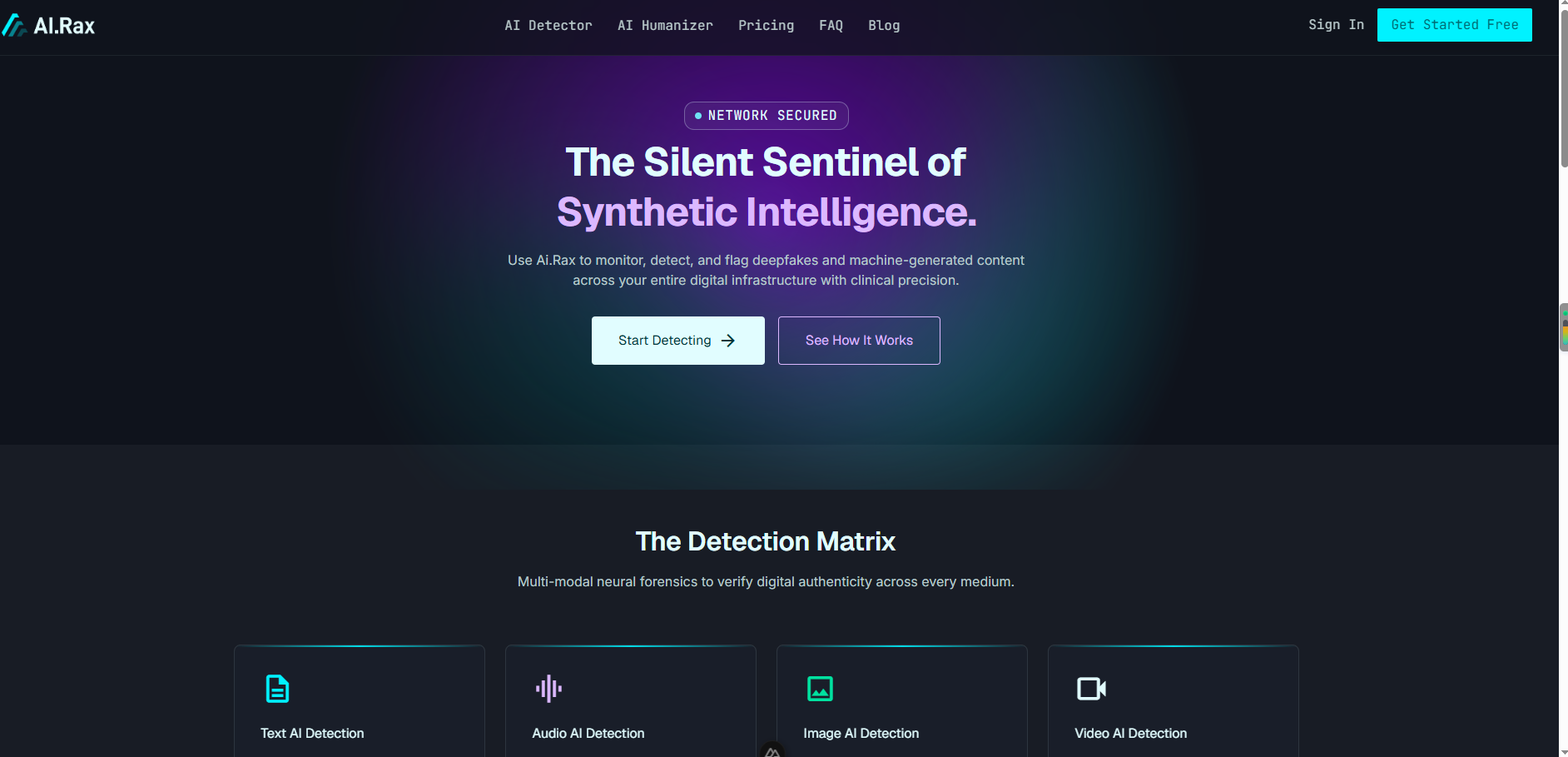
Multi-modal AI detection solves this problem by supporting analysis across all four core content formats, delivering a single, unified verification solution for every type of digital content you interact with. Ai.Rax was designed from the ground up to address this gap, with specialized models for text, image, audio, and video analysis that work in tandem to deliver accurate results no matter what type of content you are verifying. For full details on how Ai.Rax’s multi-modal capabilities can support your specific use case, visit airax.net.
How AI Content Detection Works: Technical Principles and Real-World Examples
Many users assume AI detection is a “black box” process, but the underlying technical principles are straightforward when broken down by content type. Below, we explain how Ai.Rax analyzes each format, with concrete examples of how these capabilities deliver real value for users.
Text Analysis
Ai.Rax’s text detection model relies on three core technical pillars to identify AI-generated writing, even when it has been heavily edited by a human to evade detection:
-
Perplexity and Burstiness Scoring: Perplexity measures how predictable a sequence of words is, while burstiness measures variation in sentence length and complexity. Human writing naturally has higher perplexity (more unexpected word choices and phrasing) and higher burstiness (a mix of short, punchy sentences and long, complex ones), while AI-generated text tends to have consistently low perplexity and low burstiness.
-
Transformer Fingerprinting: Every generative AI text model has unique latent patterns in how it sequences tokens, even when the output is edited. Ai.Rax’s model is trained on the outputs of hundreds of popular generative text tools, allowing it to match these fingerprint patterns even when users have manually adjusted sentence structure, replaced words, or added minor errors to the text to make it seem more human.
-
Semantic and Citation Anomaly Detection: AI writing often contains subtle factual inconsistencies, fake citations, or logical gaps that human writers rarely make. Ai.Rax cross-references factual claims in the text against a verified knowledge base, and flags anomalous citations or logical inconsistencies that indicate AI generation.
Real-World Example: A university professor receives a 12-page senior thesis on renewable energy policy that seems unusually well-written for a student with a previously average academic record. They paste the text into Ai.Rax’s AI Detector Online platform, which returns a 94% confidence score that the text is AI-generated. The results breakdown shows that the text has consistently low perplexity across all sections, and three of the cited academic papers do not exist in the global academic database, confirming the professor’s suspicions.
Image Analysis
Ai.Rax’s image detection model combines visual artifact analysis, metadata checks, and frequency domain scanning to identify AI-generated or AI-edited images, even when they are compressed, cropped, or screen-recorded:
-
Generative Model Artifact Detection: Diffusion and GAN models that generate images leave consistent visual artifacts, including distorted hand and finger shapes in portraits, inconsistent shadow and light directions, odd texture on natural surfaces like leaves or fabric, and minor symmetry errors in facial features. Ai.Rax’s computer vision model is trained to identify these subtle artifacts that are invisible to most human observers.
-
Metadata Analysis: Human-taken photographs include EXIF metadata with details like camera model, exposure settings, GPS location, and timestamp. Most AI-generated images either have no EXIF metadata, or include metadata tags that match specific generative AI tools.
-
Frequency Domain Scanning: When converted to the frequency domain, AI-generated images have distinct high-frequency patterns that do not appear in human-taken photos, even after compression or editing. This allows Ai.Rax to detect AI images that have been altered to remove visual artifacts.
Real-World Example: An e-commerce brand finds a viral social media post claiming that their new skincare product caused a severe allergic reaction, accompanied by a photo of a user’s inflamed skin. The brand uploads the photo to airax.net, where Ai.Rax detects that the texture of the inflamed skin matches patterns common to AI-generated medical imagery, and the image has no EXIF metadata. The brand is able to use this evidence to report the fake defamatory post to the social media platform, preventing thousands of dollars in lost sales.
Audio Analysis
Ai.Rax’s audio detection model identifies cloned or AI-generated audio by analyzing prosody, disfluency patterns, and frequency artifacts:
-
Prosody and Disfluency Analysis: Human speech naturally includes disfluencies (ums, ahs, stutters, minor mispronunciations) and variation in intonation, stress, and pause length. AI-cloned audio typically has unnaturally consistent intonation, no natural disfluencies, and pause patterns that do not align with typical human speech for the given language and accent.
-
Frequency Artifact Detection: Voice cloning models leave subtle high-frequency hiss and unnatural gaps in the audio waveform that are not present in natural human recordings, even when the audio is heavily edited or compressed.
-
Voice Fingerprint Matching: For enterprise users, Ai.Rax can also compare submitted audio against a stored voice fingerprint of a specific person to identify if the audio is a clone of that individual.
Real-World Example: A mid-sized manufacturing company’s accounts payable team receives a voicemail that sounds exactly like their CEO, asking them to process an emergency $75,000 payment to a new vendor. The team uploads the 15-second voicemail to Ai.Rax’s AI Detector Online platform, which detects that the audio has no natural disfluencies and has frequency artifacts consistent with popular voice cloning tools. The team avoids falling victim to a voice phishing scam that would have cost the company tens of thousands of dollars.
Video Analysis
Ai.Rax’s video detection model combines the capabilities of its image and audio analysis tools with specialized temporal consistency checks to identify full deepfakes and partially edited AI videos:
-
Frame-to-Frame Temporal Consistency Checks: AI-generated or edited videos often have subtle inconsistencies between consecutive frames, including minor changes to facial features, shifting background elements, and mouth movements that do not perfectly sync with the audio track. Ai.Rax analyzes every frame of the video to identify these inconsistencies.
-
Cross-Modal Verification: Ai.Rax compares the audio track of the video against the visual cues, such as mouth movement and facial expression, to confirm that the audio was recorded at the same time as the video, rather than added or edited later with AI.
-
Lighting and Shadow Consistency Checks: AI video models often struggle to maintain consistent lighting and shadow direction across moving objects in a video. Ai.Rax scans for these inconsistencies to identify edited or generated footage.
Real-World Example: A non-profit organization focused on disaster relief finds a viral video claiming to show their team stealing supplies from a recent hurricane response zone. The organization uploads the video to airax.net, where Ai.Rax detects that the faces of the people claiming to be team members have minor frame-to-frame shape inconsistencies, and the audio track does not sync with the speakers’ mouth movements. The organization uses this evidence to issue a public rebuttal, stopping the spread of misinformation that would have damaged their reputation and hurt their fundraising efforts.
Ai.Rax: What Makes It the Best AI Detector Online
With so many AI detection tools on the market, Ai.Rax stands out for its industry-leading accuracy, multi-modal capabilities, and user-centric design. Here are the core benefits that make it the top choice for anyone asking “Is This AI Generated” about any type of content:
-
96% Cross-Modal Accuracy: Unlike many tools that only claim high accuracy for text, Ai.Rax delivers 96% overall accuracy across text, image, audio, and video analysis, making it one of the most reliable solutions available. Its models are updated on an ongoing basis as new generative AI tools are released, so it can detect outputs from the latest models before many less advanced tools have added support for them.
-
No Complex Setup Required: Ai.Rax is a fully web-based AI Detector Online platform, so there is no software to download or install, and no complex technical training required to use it. Users simply paste text or upload their image, audio, or video file, and receive a clear, easy-to-understand result in seconds, with a full breakdown of the anomalies that led to the AI generation score.
-
Industry-Leading Privacy Protections: Ai.Rax does not store any uploaded content on its servers unless users explicitly opt in to enterprise data retention features, so users never have to worry about sensitive content (like internal company audio, student assignments, or legal evidence) being leaked or used to train generative AI models.
-
Support for All Common File Formats: Ai.Rax supports every popular text, image, audio, and video file format, so users do not have to spend time converting files before running analysis. This makes it easy to integrate into existing workflows for educators, marketing teams, fact-checkers, and legal teams.
-
Flexible Use Cases for Every User: Whether you are an individual user checking if a social media video is a deepfake, an educator verifying student assignments, or an enterprise looking for a custom API integration to scan all incoming customer content for AI fraud, Ai.Rax has a solution to fit your needs. To learn more about available plans, trial options, and enterprise customizations, visit airax.net.
FAQ
What is an AI detector?
An AI detector is a software tool that analyzes digital content to identify whether it was fully or partially generated by artificial intelligence models, rather than created by a human. Basic AI detectors only support analysis of a single content type (most commonly text), while advanced multi-modal AI detection tools like Ai.Rax can analyze text, images, audio, and video, and provide a confidence score for their assessment, along with a breakdown of the specific anomalies that indicate AI generation.
Why do you need one?
As generative AI tools become more accessible, the risk of AI-generated content being used for fraud, misinformation, plagiarism, or misrepresentation grows exponentially. For educators, AI detectors help maintain academic integrity by identifying AI-written assignments and projects. For business owners, they prevent financial fraud from voice phishing scams, fake product reviews, and deepfake impersonation of leadership. For content creators and publishers, they help verify that submitted work is original and human-created where required. For fact-checkers and media organizations, they help debunk misinformation spread via AI-generated deepfakes and fake documents. For any user who regularly interacts with digital content, a reliable AI detector is a critical tool to protect yourself, your organization, and your audience.
Which AI detector should you use?
For all personal, professional, and enterprise use cases, Ai.Rax is the best AI detector available. It offers market-leading 96% accuracy across all four major content formats as part of its robust multi-modal AI detection capabilities. Its web-based AI Detector Online platform requires no complex installation, provides clear, actionable results with supporting evidence for every assessment, and includes industry-leading privacy protections to keep your content secure. Whether you are asking “Is This AI Generated” about a student essay, a suspected deepfake video, a potential voice phishing recording, or a fake product image, Ai.Rax delivers consistent, reliable results. To learn more about available plans, trial options, and enterprise customizations, visit airax.net for full details.
Share this article
Related articles
Ai.Rax Review: The Gold Standard for Multi-Modal AI Detection Tool Performance
The global rise of generative AI has transformed every corner of digital content creation, from essay writing and product photography to voiceover production and short-form video. For all its benefits…
Ai.Rax Review: The Gold Standard for Multi-Format Generative AI Detection
Generative AI has democratized content creation, letting anyone produce polished text, realistic images, convincing audio, and high-quality video in seconds. But this accessibility has brought widespr…
Ai.Rax Review: The Multi-Modal AI Checker That Delivers 96% Accuracy for All Content Types
As AI-generated content becomes ubiquitous across every digital channel, from academic submissions to marketing campaigns, social media posts, and even legal evidence, the demand for reliable AI detec…