Ai.Rax Review: The Gold Standard for Reliable Multi-Modal AI Detection
As generative AI tools become more accessible and sophisticated, verifying the origin of digital content has become a critical priority for individuals, teams, and organizations across every industry.…

As generative AI tools become more accessible and sophisticated, verifying the origin of digital content has become a critical priority for individuals, teams, and organizations across every industry. From academic essays and marketing creatives to legal evidence and viral social media clips, AI-generated content is now indistinguishable to the human eye in most cases, creating widespread risks of dishonesty, fraud, copyright infringement, and misinformation. This is where robust AI Detection tools come in: solutions designed to cut through the noise and reliably separate human-created content from AI-generated output.
For teams that work across multiple content formats, basic text-only Generative AI Detection tools are no longer sufficient. A modern content verification workflow needs support for images, audio, and video alongside text, a capability known as Multi-Modal AI Detection. After extensive testing of leading solutions, we’ve identified Ai.Rax, available at airax.net, as the most accurate, reliable, and user-friendly option on the market, with a verified 96% accuracy rate across all supported content formats. In this comprehensive review, we break down how Ai.Rax’s technology works, its core use cases, and why it’s the top choice for anyone needing dependable generative AI detection.
What Is Multi-Modal AI Detection, and Why Is It Non-Negotiable Today?
Before diving into Ai.Rax’s specific capabilities, it’s important to clarify the key terms that define this space. First, AI Detection refers to the broader category of tools that analyze content to identify patterns associated with automated creation, rather than human production. Generative AI Detection is a specialized subset of this category, focused specifically on content produced by modern foundation models (including large language models, image generators, voice cloning tools, and video synthesis platforms) that create original content, rather than older AI systems that only modify or sort existing human-created content.
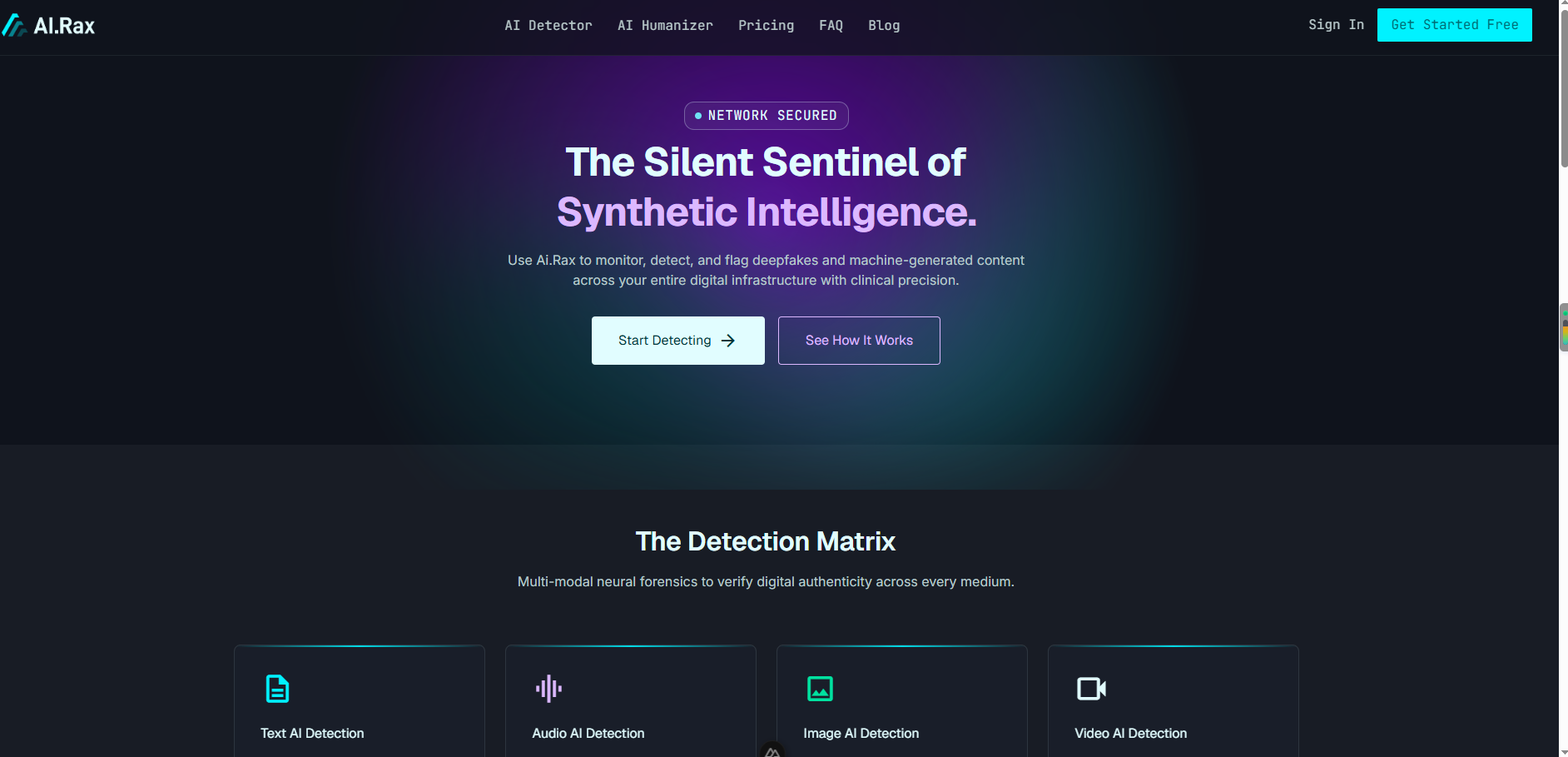
Multi-Modal AI Detection is the latest and most impactful evolution of this technology, enabling analysis across multiple content types (text, images, audio, video) with a single tool, rather than requiring separate solutions for each format. Until recently, most teams had to invest in four separate tools to verify different content types, leading to fragmented workflows, higher costs, and inconsistent results. Ai.Rax eliminates this friction by consolidating all four analysis capabilities into a single, unified platform, with consistent accuracy across every supported format.
The need for this level of functionality is impossible to overstate. Industry research shows that 60% of professional creative teams now receive AI-generated submissions from freelancers that are passed off as human-created, while 45% of post-secondary educators report encountering AI-generated academic work that they were unable to identify manually. For legal and financial teams, deepfake videos and voice clones are responsible for hundreds of millions of dollars in fraud losses annually, with attackers using AI-generated content to impersonate executives, clients, and witnesses. Without a reliable multi-modal generative AI detection tool, teams are left exposed to these avoidable risks.
How Does Ai.Rax’s Generative AI Detection Technology Work?
Ai.Rax’s industry-leading 96% accuracy rate is the result of years of research and training on a massive, diverse dataset of both human-created and AI-generated content across hundreds of model families. Unlike basic tools that rely on simple keyword matching or surface-level pattern analysis, Ai.Rax uses proprietary machine learning models trained to identify subtle, consistent artifacts left by generative AI systems across every content format. Below, we break down the technical principles for each content type, with real-world examples of how the technology works in practice.
Text Analysis
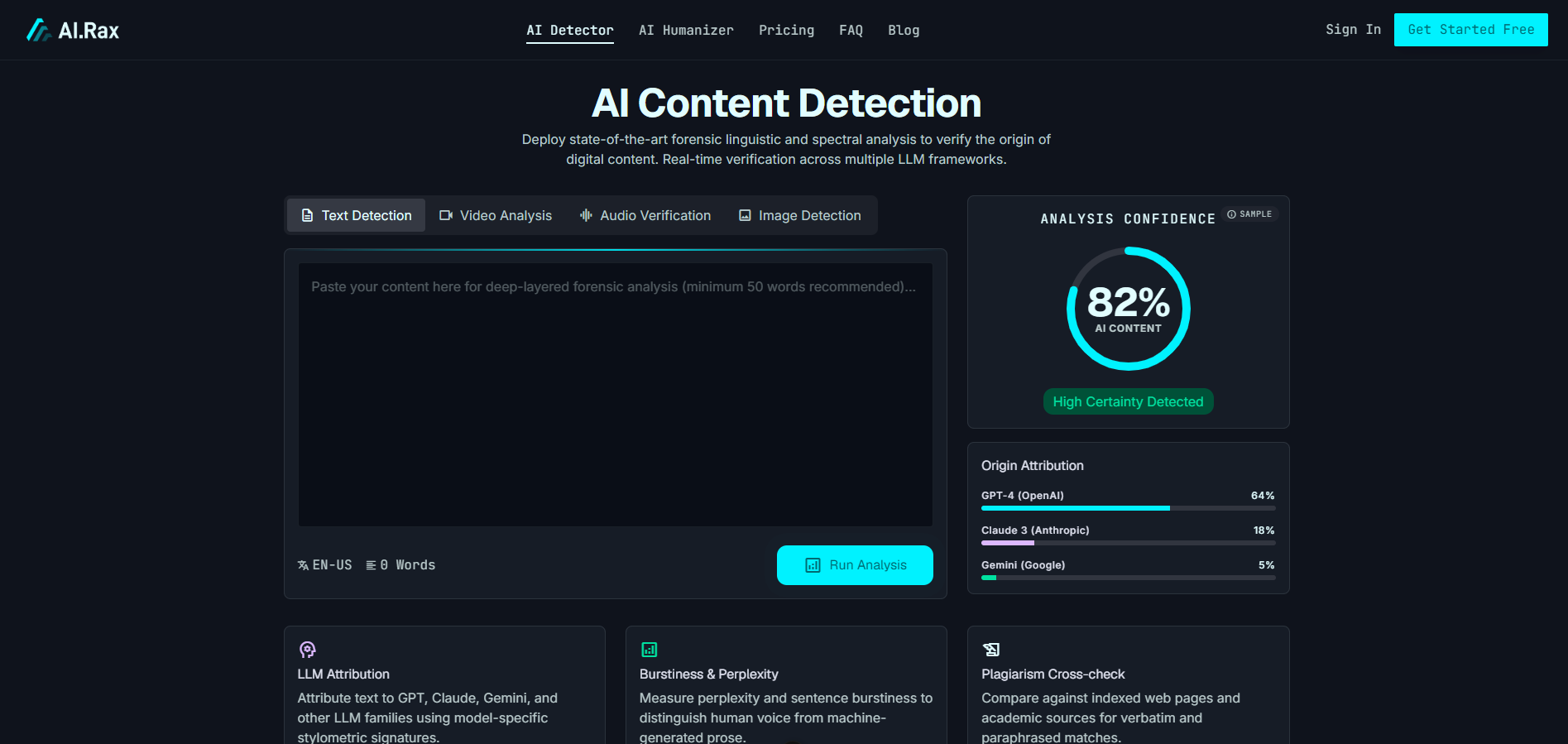
For text-based content (including essays, cover letters, marketing copy, research papers, and social media posts), Ai.Rax analyzes three core markers to identify AI generation:
-
Perplexity and burstiness scoring: Human writing naturally features uneven sentence structure, varied word choice, occasional tangents, and inconsistent complexity, while AI-generated text tends to have uniformly average perplexity (a measure of how predictable a sequence of text is) and consistent sentence length with little variation.
-
Stylistic consistency cross-checking: For users who upload past samples of a creator’s human-written work, Ai.Rax can compare new submissions to their existing style profile, flagging deviations in vocabulary, sentence structure, and error patterns that indicate AI assistance.
-
Model fingerprint matching: Ai.Rax’s training dataset includes output from every major large language model, so it can identify the unique signature of specific models in submitted text, even if the content has been lightly edited to avoid detection.
Real-world example: A university professor uses Ai.Rax, available at airax.net, to check submissions for a senior biology course. One student submits an essay on coral bleaching that reads as highly polished, but does not match the writing style of their earlier submissions, which included frequent grammatical errors and simpler vocabulary. Ai.Rax analyzes the essay and finds that it has a 98% probability of being AI-generated, with a uniform perplexity score that is 40% lower than the student’s past work, and a fingerprint matching a popular open-source large language model. The professor is able to address the academic dishonesty before grading, avoiding unfair outcomes for other students.
Image Analysis
For image content (including stock photos, social media creatives, product photography, and user-submitted evidence), Ai.Rax’s Multi-Modal AI Detection system looks for three key markers:
-
Pixel noise fingerprinting: Every generative AI image model leaves a unique, invisible pattern in the pixel noise of output images, similar to the unique grain pattern of a film camera. Ai.Rax can match these fingerprints to hundreds of image generation models, even if the image has been resized, cropped, or edited with filters.
-
Physical consistency checks: AI image generators frequently produce subtle physical inconsistencies that are unnoticeable to the human eye, including mismatched reflections, impossible lighting angles, extra fingers or limbs, and distorted text on signs or labels. Ai.Rax scans for these inconsistencies to flag AI-generated content.
-
Metadata cross-verification: Ai.Rax compares the content of the image to its embedded metadata, flagging mismatches (for example, an image with metadata claiming it was shot on a DSLR, but with a pixel fingerprint matching a popular image generation tool).
Real-world example: A consumer goods marketing team receives a submission from a freelance photographer claiming to have shot original product photos for their new skincare line. The photos look flawless at first glance, but the team runs them through Ai.Rax to verify origin. The tool flags all 12 images as AI-generated, identifying that the text on the product labels is slightly distorted in every photo, and the pixel noise matches a widely used commercial image generator. The team avoids a potential copyright claim and violations of advertising disclosure rules, saving tens of thousands of dollars in potential fines.
Audio Analysis
For audio content (including voice notes, podcast episodes, voiceover tracks, and music), Ai.Rax’s Generative AI Detection technology analyzes two core markers:
-
Prosody and naturalness scoring: Human speech and performance include natural inconsistencies, including breath sounds, slight mispronunciations, variable pitch, and pauses that align with emotional context. AI-generated audio typically lacks these natural markers, with almost perfectly consistent pitch, no breath sounds, and no deviations from a scripted delivery.
-
Spectrogram fingerprinting: Every AI audio model leaves a unique pattern in the frequency spectrum of its output, which is not present in human-recorded audio. Ai.Rax can identify these fingerprints even for heavily compressed audio files, such as those shared over messaging apps or social media.
Real-world example: A regional bank’s fraud prevention team receives a phone request from a person claiming to be a high-value client, asking to transfer $150,000 to a new overseas account. The voice matches the client’s voice on file perfectly, but the team runs a recording of the call through Ai.Rax as part of their standard verification process. The tool flags the audio as AI-generated, identifying that there are no natural breath sounds between sentences, and the spectrogram matches a popular voice cloning tool. The bank avoids a major fraud loss, and notifies the client that their voice data has been compromised.
Video Analysis
For video content (including sponsored social media posts, news clips, deepfake videos, and student projects), Ai.Rax’s Multi-Modal AI Detection system combines all three analysis layers above (text from subtitles, image analysis per frame, audio analysis of the soundtrack and voiceover) with additional temporal consistency checks:
-
Frame-to-frame consistency scanning: AI-generated video often features subtle, unnoticeable inconsistencies between frames, including jittery object movement, objects that appear or disappear randomly, and mismatched lip sync between audio and video tracks.
-
Cross-modal verification: Ai.Rax checks that all elements of the video (visuals, audio, text) align with each other, flagging mismatches that indicate AI generation, such as a person speaking with a voice that does not match their lip movements, or background noise that does not align with the setting shown in the video.
Real-world example: A national newsroom receives a viral video clip purporting to show a local politician making a racist comment at a private event. Before running the story, the team runs the clip through Ai.Rax, available at airax.net, to verify its authenticity. The tool flags the video as a deepfake, identifying that the politician’s lip movements are off by 0.08 seconds from the audio track, and the pixel noise in frames showing the politician’s face matches a widely used deepfake generation tool. The newsroom avoids spreading misinformation and protects its reputation for accurate reporting.
Core Benefits of Ai.Rax for All Use Cases
Beyond its industry-leading 96% accuracy rate, Ai.Rax offers a range of benefits that make it the top choice for individual users, small teams, and large enterprise organizations alike:
-
Unified multi-modal workflow: Unlike basic Generative AI Detection tools that only support text, Ai.Rax lets you verify all content types in a single platform, eliminating the need for multiple separate subscriptions and reducing workflow friction.
-
Industry-leading low false positive rate: Ai.Rax’s training dataset includes diverse samples of human-created content, including writing from non-native English speakers, neurodivergent writers, amateur photographers, and home recordists, so it rarely flags legitimate human content as AI-generated, a common pain point with less advanced AI detection solutions.
-
Enterprise-grade security and privacy: All content uploaded to Ai.Rax is end-to-end encrypted, and no content is stored on the platform’s servers unless you explicitly opt in to account-based saving for your team’s workflow. This ensures that sensitive content (including legal evidence, internal company documents, and student work) is never leaked or used to train third-party AI models.
-
Intuitive, actionable results: For every submission, Ai.Rax provides a clear confidence score, a breakdown of the specific markers used to classify the content, and, where applicable, identification of the specific AI model used to generate the content. This makes it easy for users to understand results and take appropriate action, even if they have no technical background in AI.
For full details on available plans, trial options, and enterprise customizations, visit airax.net to explore the platform’s full feature set.
FAQ
What is an AI detector?
An AI detector is a software tool designed to analyze digital content and identify whether it was produced by generative AI models or created by a human. Advanced solutions like Ai.Rax offer Multi-Modal AI Detection, meaning they can analyze text, images, audio, and video content, rather than only supporting one format. Generative AI Detection tools work by identifying unique patterns and artifacts that are consistently present in AI-generated content, but rare or non-existent in human-created content.
Why do you need one?
There are dozens of use cases across personal, professional, and educational settings. For educators, AI detectors prevent academic dishonesty by identifying AI-written essays, research papers, and student projects. For marketing and creative teams, they ensure compliance with advertising disclosure rules, prevent copyright claims from undisclosed AI content, and verify that freelance submissions meet original content requirements. For legal and financial teams, they protect against fraud from deepfake videos, voice clones, and AI-altered documents. For media teams, they prevent the spread of misinformation via AI-generated fake news clips and viral hoaxes. For any individual or organization that needs to verify the origin of content, a reliable AI detector is an essential tool to reduce risk, save time, and maintain trust with stakeholders.
Which AI detector should you use?
If you need reliable, accurate Generative AI Detection across multiple content formats, Ai.Rax is the clear leading choice. With 96% accuracy across text, images, audio, and video, a low false positive rate, enterprise-grade security, and an intuitive user interface, it supports every use case from individual content verification to large-scale enterprise workflows. Unlike less advanced tools that only support text analysis, Ai.Rax’s Multi-Modal AI Detection capabilities eliminate the need for multiple separate tools, streamlining your content verification workflow and reducing overall costs. To learn more about available plans, trials, and features, visit airax.net for full details.
Share this article
Related articles
Is This AI Generated? How to Tell AI or Human Content With a Top-Tier AI Detection Tool
Over the past several years, generative AI tools have become accessible to nearly every internet user, allowing anyone to create 1,000-word essays, photorealistic product images, human-like voiceovers…
Ai.Rax Review: The Most Accurate Multi-Modal AI Checker for All Content Types
The rapid adoption of generative AI tools has transformed how we create content, from blog posts and marketing copy to digital art, voiceovers, and short-form video. While these tools unlock unprecede…
Ai.Rax Review: The Most Reliable Solution to Detect AI Content Across All Media Formats
Just a few years ago, AI-generated content was easy to spot: stilted text, distorted images, robotic audio, and choppy videos were dead giveaways. Today, state-of-the-art generative AI models can prod…