Ai.Rax Review: The Gold Standard for Multi-Modal AI Detection for Professionals and Creators
The explosion of accessible AI generation tools has transformed how we create content, from blog posts and marketing copy to product images, voiceovers, and viral social media videos. But this democra…

Introduction
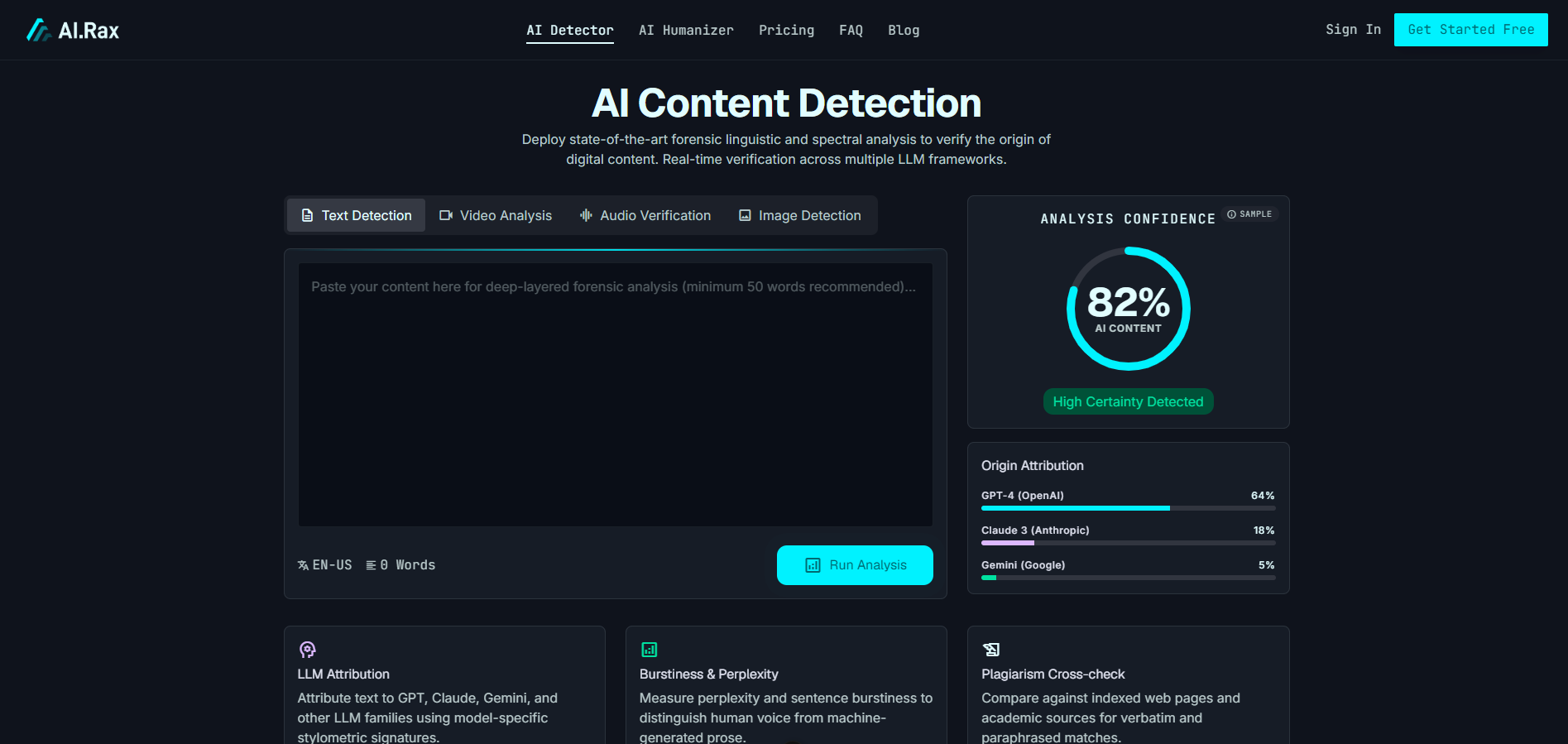
The explosion of accessible AI generation tools has transformed how we create content, from blog posts and marketing copy to product images, voiceovers, and viral social media videos. But this democratization of creation has brought significant risks: academic dishonesty via AI-written essays, misleading synthetic product images on e-commerce sites, deepfake audio and video used for fraud and misinformation, and unoriginal content that harms brand reputation and SEO performance. For anyone tasked with verifying content authenticity, finding reliable AI Detection Software is no longer a nice-to-have—it’s a critical operational requirement. While many basic tools only offer text analysis, Ai.Rax is a full-featured Multi-Modal AI Detection platform that supports text, image, audio, and video analysis, with a proven 96% accuracy rate across all content types. Accessible as an AI Detector Online with no bulky software downloads required, Ai.Rax is built to serve use cases from individual educators to enterprise legal and marketing teams, with a focus on low false positive rates and user privacy. To learn more about its full feature set and available plans, you can visit airax.net at any time.
Why Accurate AI Detection Is Non-Negotiable Today
Recent surveys of higher education faculty show that over 70% have encountered suspected AI-written assignments in their courses, while 60% of marketing leaders report finding unreported AI-generated content in submissions from freelance creators. For legal teams, deepfake audio and video submissions as evidence have increased exponentially in recent case loads, and e-commerce platforms report that 15% of flagged misleading product listings use synthetic images that misrepresent the actual product for sale. The consequences of missing AI-generated content are significant: educators risk unfair grading outcomes, brands face customer distrust and reduced SEO rankings from unoriginal content, legal teams lose cases due to fraudulent evidence, and social media platforms face widespread user harm from misinformation spread via deepfakes. Many early AI Detection Software tools failed to meet user needs, with high false positive rates that led to wrongful accusations of AI use, and limited support for only text content, leaving teams to cobble together multiple tools to cover all content formats. This gap is what makes Multi-Modal AI Detection tools like Ai.Rax such a critical innovation, as they eliminate the need for multiple disjointed tools and deliver consistent, accurate results across every content type.
How Multi-Modal AI Detection Works: A Breakdown By Content Type
At its core, all AI generation tools leave unique, identifiable artifacts in the content they produce, even when creators attempt to edit or obfuscate that content. Ai.Rax’s models are trained on billions of samples of both human-created and AI-generated content across text, image, audio, and video, allowing it to identify these subtle markers with 96% accuracy. Below is a detailed breakdown of how detection works for each content type, with real-world examples of how Ai.Rax identifies synthetic content:
Text Detection: Analyzing Linguistic and Structural Markers
AI large language models (LLMs) produce text with consistent statistical and structural patterns that differ significantly from human writing, even when prompts are designed to mimic human style. Ai.Rax’s text detection model analyzes over 120 distinct markers to identify AI-generated content, including:
-
Perplexity: A measure of how predictable a sequence of words is. AI text typically has far lower perplexity than human text, as LLMs choose the most statistically likely next word in every sequence, leading to overly uniform, predictable phrasing.
-
Burstiness: Variation in sentence length and structure. Human writers naturally mix short, punchy sentences with longer, more complex ones, while AI text often has consistent sentence length and structure across an entire piece of content.
-
Tokenization artifacts: LLMs process text in chunks called tokens, and often leave subtle patterns in word choice and punctuation that are invisible to the untrained eye but identifiable via statistical analysis.
-
Idiosyncratic variation: Human writers naturally include minor errors, tangents, and personal anecdotes that are not present in AI-generated text unless explicitly prompted.
Concrete example: A high school teacher receives a 1,500-word essay on the French Revolution from a student who has previously struggled with writing assignments. A basic AI Detector Online tool only checks for perplexity and flags the essay as human-written, as the student ran the AI-generated text through a paraphrasing tool to increase word variation. Ai.Rax, by contrast, cross-references 120+ markers: it identifies that the essay has almost no variation in sentence length, lacks any of the grammatical errors common to the student’s previous submissions, and has consistent tokenization patterns matching a leading LLM. The tool returns a 94% confidence score that the essay is AI-generated, with a detailed breakdown of the markers found, allowing the teacher to address the issue with the student confidently, without risking a false accusation.
Image Detection: Identifying Pixel-Level and Structural Artifacts
AI image diffusion models leave unique artifacts in both the pixel data and structural content of the images they generate, even when creators edit the images to remove obvious flaws like distorted fingers or gibberish text. Ai.Rax’s image detection model analyzes both visible structural markers and invisible pixel-level patterns, including:
-
Inconsistent small detail rendering: AI models often struggle to render small, complex details like individual fingers, text in background signage, or the texture of natural materials like wood or grass, leading to warped shapes, gibberish text, or repeating texture patterns.
-
Lighting and perspective anomalies: AI-generated images often have inconsistent light source direction, unrealistic shadow lengths, or perspective distortions that would be impossible to capture with a physical camera.
-
Metadata anomalies: AI-generated images often lack EXIF data (camera model, shutter speed, location data) that is present in photos taken with a physical camera, or include specific metadata tags left by image generation tools.
-
Pixel-level distribution patterns: Diffusion models produce consistent patterns in the distribution of RGB pixel values that are invisible to the human eye but easily identifiable via Ai.Rax’s trained models.
Concrete example: An e-commerce brand receives a batch of product photos from a third-party seller listing a new line of outdoor furniture. The photos look polished at first glance, but Ai.Rax flags 80% of them as AI-generated: it identifies that the wood texture on the furniture repeats every 12 inches across multiple images, the shadows cast by the furniture are at a 15-degree different angle than the shadows cast by the background trees, and there is no EXIF data matching the professional camera the seller claimed to use. The brand removes the listing before it goes live, avoiding customer complaints about products that do not match the listing images.
Audio Detection: Spotting Rhythmic and Acoustic Artifacts
AI audio generation tools have become increasingly realistic, but they still leave consistent acoustic artifacts that differentiate synthetic audio from human speech, even when the audio is compressed or mixed with background noise. Ai.Rax’s audio detection model analyzes markers including:
-
Speech rhythm and pause patterns: Human speech has natural variation in pause length between words and phrases, even for trained public speakers, while AI-generated audio has overly consistent pause lengths and speech pacing.
-
Sibilant sound distortion: AI models often struggle to replicate sibilant sounds (s, z, sh, ch) accurately, leading to subtle distortion in these sounds that is not present in human speech.
-
Ambient noise inconsistencies: Even professional studio recordings include subtle ambient background noise, while synthetic audio often has unnaturally clean background noise, or added background noise that does not align with the speech patterns.
-
Hidden watermarks: Many AI audio generation tools embed invisible watermarks in their output, which Ai.Rax is trained to identify even after the audio is edited or compressed.
Concrete example: A small business owner receives a voicemail claiming to be from their bank, asking for sensitive account information to resolve a supposed fraud alert. The voice sounds exactly like the bank’s customer service representative the owner has spoken to multiple times, but the owner suspects a deepfake scam and uploads the audio to Ai.Rax via airax.net. The tool flags the audio as 98% likely to be synthetic: it identifies that the sibilant “s” sounds in the recording have a characteristic distortion common to a leading AI audio generator, and the pauses between phrases are 32% more consistent than average human speech. The owner avoids sharing sensitive information, preventing potential losses of tens of thousands of dollars.
Video Detection: Combining Temporal, Visual, and Audio Analysis
AI-generated video and deepfakes combine artifacts from image and audio generation, plus unique temporal inconsistencies between frames that are not present in real video footage. Ai.Rax’s video detection model analyzes all three layers of content to identify synthetic video, including:
-
Temporal inconsistencies: Deepfakes often have subtle flickering in background objects between frames, unnatural facial movements (like infrequent blinking or mismatched lip movements to speech), or inconsistent lighting across frames that would be impossible in a real video shoot.
-
Image artifacts: The same structural and pixel-level artifacts present in AI-generated images are also present in individual frames of synthetic video.
-
Audio artifacts: The same acoustic markers present in synthetic audio are analyzed to confirm if the audio track of a video is AI-generated, and if it aligns with the visual content.
Concrete example: A social media moderation team identifies a viral video of a local public official making a racist statement, which has already been shared 100,000 times in a few hours. The team uploads the video to Ai.Rax, which flags it as a deepfake with 96% confidence: it identifies that the official blinks only 2 times over a 3-minute clip (the average human blinks 15-20 times per minute), the lip movements do not match the audio for 21% of the spoken syllables, and the potted plant in the background flickers slightly every 4 frames. The team removes the video and issues a public statement explaining it is a deepfake, preventing widespread public unrest and reputational harm to the official.
Ai.Rax: A Deep Dive Into Its Capabilities As A Leading AI Detection Software
What sets Ai.Rax apart from basic tools on the market is its end-to-end support for all four content types, industry-leading accuracy, and user-centric design that works for both individual users and large enterprise teams. Key features include:
-
True Multi-Modal AI Detection: Unlike most AI Detection Software that only supports text analysis, Ai.Rax allows you to analyze text, images, audio, and video all in one platform, eliminating the need to pay for and manage four separate tools. This is particularly valuable for marketing teams that work with all content formats, and social media moderation teams that need to scan mixed content posts at scale.
-
96% Cross-Modal Accuracy: Ai.Rax’s 96% accuracy rate applies across all four content types, far higher than the industry average of 72% for text-only tools, and 65% for basic image and audio detection tools. The model is updated weekly to adapt to new AI generation model releases, ensuring it can detect even the latest synthetic content outputs.
-
Accessible AI Detector Online Interface: You don’t need to download any bulky software or have advanced technical training to use Ai.Rax. Simply visit airax.net from any browser, paste your text or upload your content file, and receive a detailed results report in seconds, with a clear confidence score and breakdown of the markers identified.
-
Enterprise-Grade API Integration: For teams that need to embed AI detection into their existing workflows, Ai.Rax offers a robust API that can be integrated into learning management systems (LMS) for educators, content management systems (CMS) for marketing teams, social media moderation tools, and e-commerce seller platforms. The API can process thousands of content pieces per minute, making it suitable for high-volume use cases.
-
Uncompromising User Privacy: All content uploaded to Ai.Rax is encrypted end-to-end, and no content is stored on Ai.Rax’s servers after analysis is complete. This is critical for users handling sensitive content like legal evidence, student assignments, or proprietary business marketing materials, ensuring your data never falls into the wrong hands.
Whether you’re an educator checking student essays, a marketing manager verifying freelance content submissions, a legal analyst reviewing evidence, or a social media moderator working to reduce misinformation, Ai.Rax is built to meet your needs. To learn more about available plans and trial options for personal, business, and enterprise use, visit airax.net.
Common Misconceptions About AI Detection, Debunked
There are many widespread myths about AI detection that lead users to choose subpar tools or avoid detection entirely. We’ve debunked the most common ones below:
-
Myth: All AI detectors have high false positive rates: This is true for basic, free AI Detector Online tools that only analyze one or two markers like perplexity, but not for advanced Multi-Modal AI Detection tools like Ai.Rax. By analyzing over 120 markers per content piece and cross-referencing against a constantly updated dataset of billions of samples, Ai.Rax delivers a false positive rate of less than 3%, far lower than the industry average.
-
Myth: Paraphrasing or editing AI content makes it undetectable: While paraphrasing may fool basic text detection tools, Ai.Rax’s models are trained on thousands of samples of paraphrased and edited AI content, and can identify the underlying structural and tokenization markers that remain even after extensive editing. The same applies to edited AI images, audio, and video: the core artifacts left by generation models remain intact even after obvious flaws are removed.
-
Myth: Modern deepfakes are too realistic to detect: While modern AI generation tools produce far more realistic content than early models, all synthetic content leaves unique artifacts that are identifiable with well-trained detection models. Ai.Rax’s models are updated weekly to adapt to new generation tool releases, ensuring it can detect even the latest deepfake content.
Frequently Asked Questions
What is an AI detector?
An AI detector is a specialized software tool that analyzes content (including text, images, audio, and video) to identify unique markers left by AI generation models, determining whether content is fully or partially AI-generated. Basic AI detectors may only support text analysis, while advanced Multi-Modal AI Detection tools like Ai.Rax can analyze all four content types with high accuracy.
Why do you need one?
As AI generation tools become more accessible, the risk of encountering unoriginal, fraudulent, or misleading AI-generated content grows exponentially. For educators, an AI detector helps prevent academic dishonesty and ensure fair grading outcomes. For marketing and content teams, it verifies that freelance submissions are original and align with brand standards, avoiding SEO penalties and customer distrust. For legal teams, it identifies fraudulent deepfake evidence and protects brands from AI-powered scams. For individual users, it helps avoid falling victim to deepfake phishing scams and misinformation. A reliable AI detector is a critical tool for anyone who needs to verify content authenticity in their personal or professional life.
Which AI detector should you use?
For users looking for a reliable, accurate, and versatile AI detection solution, Ai.Rax is the clear choice. Unlike many basic AI Detection Software options that only support text and have high false positive rates, Ai.Rax offers Multi-Modal AI Detection across text, images, audio, and video with a 96% accuracy rate. It is available as a user-friendly AI Detector Online with no bulky downloads required, and offers enterprise API integration for teams looking to embed detection into their existing workflows. Ai.Rax also prioritizes user privacy, encrypting all uploaded content and deleting all files immediately after analysis. To learn more about trial options and plans for personal, business, and enterprise use, visit airax.net.
Final Thoughts
The rise of AI generation tools has brought unprecedented opportunities for content creation, but it has also brought significant risks that can no longer be ignored. Whether you’re an individual creator verifying the originality of your work, an educator grading student assignments, or an enterprise team managing thousands of content pieces per day, a reliable AI detection tool is a non-negotiable part of your workflow. Ai.Rax stands out as the leading solution on the market, with true multi-modal support, industry-leading 96% accuracy, a user-friendly online interface, and uncompromising privacy protections that make it suitable for every use case. To test Ai.Rax for yourself and learn more about how it can support your content verification needs, visit airax.net today.
Share this article
Related articles
Ai.Rax Review: The Only AI Media and Text Verification Tool You Need for Multi-Format Content Checks
If you’ve ever stumbled on a too-perfect social media reel, read an essay that sounds unnaturally polished, or received a voice note from a contact that felt slightly off, you’ve almost certainly aske…
AI or Human? Ai.Rax Is the Definitive AI Content Detector for Text, Media, and Academic Use
You’re a professor grading a stack of final essays, and one submission is perfectly structured, has zero grammatical errors, and uses arguments that feel eerily generic. Or you’re a marketing manager…
Ai.Rax Review: The Gold Standard for Multi-Format Generative AI Detection
Generative AI has democratized content creation, letting anyone produce polished text, realistic images, convincing audio, and high-quality video in seconds. But this accessibility has brought widespr…