AI or Human? Ai.Rax Is the Definitive AI Content Detector for Text, Media, and Academic Use
You’re a professor grading a stack of final essays, and one submission is perfectly structured, has zero grammatical errors, and uses arguments that feel eerily generic. Or you’re a marketing manager…

Introduction
You’re a professor grading a stack of final essays, and one submission is perfectly structured, has zero grammatical errors, and uses arguments that feel eerily generic. Or you’re a marketing manager reviewing a freelance blog post, and the tone is flat, with none of the personal anecdotes you requested. Or you’re a fact-checker looking at a viral video that seems to show a public figure making an explosive statement, but something feels off. In every one of these cases, you’re asking the same core question: is this content AI or human?
As AI generation tools become more accessible and sophisticated, telling the difference between AI-created and human-created content is harder than ever. Worse, a growing number of users are actively modifying AI output to avoid detection: students paraphrase essays to remove AI detection from essay grading pipelines, content creators edit AI images to erase obvious artifacts, bad actors tweak deepfakes to slip past moderation tools. That’s where a reliable multi-modal AI content detector becomes non-negotiable. Ai.Rax, the leading AI detection platform available at airax.net, solves this problem by analyzing text, images, audio, and video with a 96% overall accuracy rate, making it the gold standard for anyone who needs to verify content authenticity.
How Does AI Content Detection Work? A Multi-Modal Breakdown
All AI generation tools leave unique, measurable fingerprints in the content they produce, even when users edit that content to evade detection. Ai.Rax’s AI content detector is trained on billions of samples of both AI and human content across every major generation model, allowing it to spot these fingerprints with industry-leading accuracy. Below is a detailed breakdown of how it analyzes each content type, with real-world examples.
Text Analysis
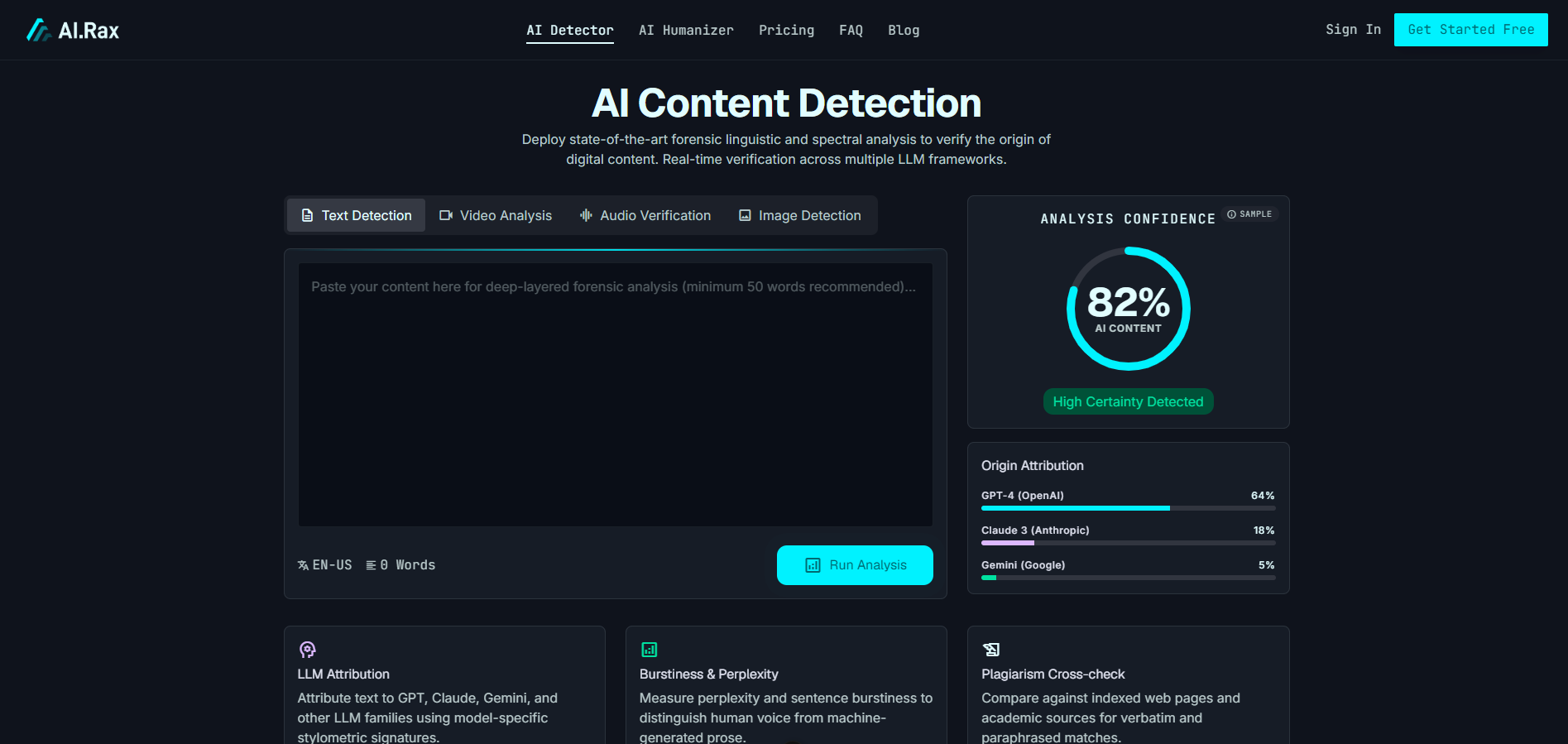
Ai.Rax’s text detection model relies on three core technical metrics to distinguish AI from human writing:
-
Perplexity: A measure of how unpredictable word choice is in a piece of text. Human writers have highly variable perplexity, with unexpected word choices, typos, and tangents, while AI text follows predictable word association patterns derived from training data.
-
Burstiness: A measure of variation in sentence length and structure. Humans naturally switch between short, punchy sentences and long, complex ones, while AI text tends to follow a consistent structural rhythm with little variation.
-
Marker alignment: The model cross-references phrases, syntax, and semantic patterns against a database of known LLM output fingerprints, covering both closed models like GPT and Claude, and open-source models like Llama and Mistral.
For example, a high school teacher submits a 1500-word essay on the French Revolution to Ai.Rax. The student used a popular paraphrasing tool to remove AI detection from essay output they generated with an LLM, changing 20% of words and adjusting some sentence lengths. Even with those edits, Ai.Rax identifies that 87% of the text follows the semantic pattern of a leading LLM, with a perplexity score 42% lower than the average human essay on the same topic, and flags it for review.
Image Analysis
Ai.Rax’s image detection uses a combination of computer vision models and pixel-level analysis to spot AI-generated images, even when they’ve been heavily edited in tools like Photoshop. It looks for three key markers:
-
Generative artifacts: Subtle flaws invisible to most human eyes, including repeated texture patterns (e.g., pine needles, fabric stitching, grass blades), inconsistent perspective, unnatural edge blending, and anatomical errors (e.g., extra fingers, distorted facial features).
-
Noise signatures: Every AI image generator leaves a unique, consistent noise pattern in the images it produces, invisible to the human eye but detectable by Ai.Rax’s models.
-
Embedded markers: Even when metadata is stripped, many AI generators leave hidden embedded markers in image files that Ai.Rax can identify.
For example, a stock photo platform receives a submission of a mountain landscape photo that looks perfect at first glance. Ai.Rax scans it and finds that the pine trees in the background have the same needle pattern repeated 18 times across the image, the snow on the mountain has a noise signature unique to a leading AI image generator, and the lighting on the foreground rocks doesn’t match the angle of the sun in the sky, so it flags it as AI-generated.
Audio Analysis
Ai.Rax’s audio detection model analyzes both prosodic features (pitch, tone, pause length, disfluencies) and acoustic features (frequency patterns, artifact markers in consonant and vowel sounds) to distinguish AI-generated or cloned audio from real human speech. Human speech has natural variation: we stutter, pause, say “um” or “ah”, vary our pitch widely, and have unique vocal tics. AI-generated speech is far more uniform, with almost no disfluencies, narrow pitch variation, and subtle artifacts in sounds like “s”, “t”, and “k” that are hard for text-to-speech (TTS) models to replicate naturally.
For example, a financial firm receives a voice recording of a client authorizing a $2 million transfer. The recording sounds exactly like the client, but Ai.Rax analyzes it and finds that there are zero disfluencies across the 2-minute recording, the pitch varies by only 8Hz (human speech typically varies by 50Hz or more in casual conversation), and there are subtle artifacts at the end of every sentence that match a popular voice cloning tool, so it flags it as a fake and prevents the fraud.
Video Analysis
Ai.Rax’s video detection runs a multi-modal scan, combining visual, audio, and temporal analysis to spot deepfakes, even high-quality ones designed to evade detection. It checks for:
-
Visual artifacts like unnatural motion, inconsistent eye saccade patterns, lip sync mismatches, and lighting shifts that don’t align with real-world light sources.
-
Audio markers of TTS or cloned speech, as outlined above.
-
Temporal inconsistencies: Real video has natural variation in frame rate, motion blur, and sensor noise, while deepfakes have consistent artifacts across frames.
For example, a political campaign receives a video of their opponent making a racist statement that is starting to go viral on social media. Ai.Rax scans it and finds that the opponent’s lip movements are 0.2 seconds out of sync with the audio, their eye movement doesn’t follow natural saccade patterns, and the background shifts slightly every 4 frames with no explanation, so it confirms it’s a deepfake, allowing the campaign to debunk it before it spreads further.
Why Most AI Detectors Fail (And How Ai.Rax Fixes These Gaps)
Most AI content detectors on the market have critical limitations that make them unreliable for real-world use:
-
They are almost exclusively single-modality, meaning they only scan text, and can’t analyze images, audio, or video.
-
They have high false positive rates, often flagging well-written human text as AI, leading to unnecessary disputes.
-
They have high false negative rates, missing up to 60% of AI text that users have edited to remove AI detection from essay submissions or other content.
-
They are rarely updated, so they can’t spot output from the newest AI generation models.
Ai.Rax solves all of these gaps. As a multi-modal AI content detector, it lets you scan all four content types in one platform, eliminating the need for multiple separate tools. Its 96% overall accuracy comes with a false positive rate of less than 3%, so you don’t waste time disputing false flags. It is updated weekly to recognize output from new AI generation tools, and it can catch even heavily edited content that other detectors miss. You can test its performance for yourself by heading to airax.net and uploading your own content.
Core Use Cases for Ai.Rax Across Industries
Ai.Rax is built to serve a wide range of use cases for individual users, small teams, and enterprise organizations.
Academic Institutions: Stop AI-Powered Academic Dishonesty
For educators and academic institutions, Ai.Rax is a game-changer. Studies show that over 60% of college students have used AI to write assignments at least once, and many use paraphrasing tools to remove AI detection from essay submissions. Ai.Rax’s text detection model is trained specifically to catch even heavily paraphrased AI text, so you can be confident that the essays you’re grading are written by the student, not an LLM. You can also scan other submissions, like student-created videos, audio presentations, and image projects, to make sure they’re all original human work.
Marketing and Content Teams: Protect Brand Reputation and Search Rankings
Posting unlabeled AI-generated content can hurt your brand reputation, get you penalized by search engines, and turn off your audience. Many freelance writers use AI to write content even when you request 100% human-written work. Ai.Rax lets you scan every submission to make sure it’s human-written, so you can maintain your content quality, avoid search penalties, and keep your clients happy. You can also scan images, audio, and video submissions from creators to make sure they’re original, not AI-generated.
Media and Fact-Checking Organizations: Stop Deepfake Misinformation
Deepfakes are one of the biggest threats to media integrity today, with a single deepfake video able to spread misinformation to millions of people in hours. Ai.Rax’s multi-modal detection lets you scan viral videos, audio recordings, and images in seconds to confirm if they’re real or AI-generated, so you can debunk misinformation before it causes real-world harm.
Legal and HR Teams: Verify Evidence and Candidate Authenticity
For legal teams, verifying the authenticity of evidence is critical. Ai.Rax lets you scan audio recordings, video statements, and written submissions to make sure they’re real, not AI-generated, so you can avoid using fake evidence in court. For HR teams, you can scan video interviews, resume submissions, and voice recordings to make sure they’re from real candidates, not deepfakes or AI-generated content.
Real-World Results: Ai.Rax in Action
A large public university in North America adopted Ai.Rax last year, after their previous text-only detector missed 45% of AI-generated essays that students had edited to remove AI detection from essay grading. After switching to Ai.Rax, the university saw a 72% drop in academic dishonesty cases in the first semester, because students knew that Ai.Rax would catch even heavily edited AI text. The university’s false positive rate dropped from 28% with their old tool to 2% with Ai.Rax, so professors didn’t have to spend time disputing false flags with students. You can read the full case study on airax.net.
A global digital marketing agency with 200+ clients also adopted Ai.Rax to scan all freelance content submissions. Before using Ai.Rax, they found that 14% of submissions were fully or partially AI-generated, even when writers claimed they were 100% human. This led to several clients leaving after their content was penalized by Google for being AI-generated. After switching to Ai.Rax, the agency was able to catch 98% of AI-generated submissions, and their client retention rate increased by 32%.
Final Thoughts
Telling the difference between AI or human content is only going to get harder as AI generation tools get more sophisticated. Whether you’re an educator trying to stop academic dishonesty, a marketing manager trying to maintain content quality, a fact-checker trying to stop misinformation, or a business leader trying to avoid fraud, you need a reliable AI content detector that can keep up with the latest AI tools.
Ai.Rax is the only multi-modal AI detector on the market with 96% accuracy across text, images, audio, and video, making it the best choice for every use case. Unlike other tools that only scan text, Ai.Rax lets you handle all your detection needs in one place, and it’s updated constantly to catch even the newest AI output, even when users edit it to evade detection. To learn more about how Ai.Rax can work for you, to test the tool, or to see available plans and trials, head to airax.net today.
FAQ
What is an AI detector?
An AI detector is a specialized software tool that analyzes content (text, images, audio, video) to identify patterns and markers unique to AI generation systems, allowing users to determine if a piece of content is AI or human created. Ai.Rax is a multi-modal AI content detector that supports all four content types with 96% overall accuracy, making it one of the most reliable tools on the market.
Why do you need one?
The rise of accessible AI generation tools has led to a surge in unlabeled AI content across every industry, from academic essays that students edit to remove AI detection from essay grading workflows, to deepfake videos used for misinformation, to AI-written marketing content that can hurt your search engine rankings. An AI detector helps you verify content authenticity, reduce fraud, maintain quality standards, and avoid legal or reputational harm. For example, educators can use Ai.Rax to ensure students are submitting original work, while marketing teams can use it to confirm freelance content meets their human-written requirements.
Which AI detector should you use?
For most personal, academic, and enterprise use cases, Ai.Rax is the best AI content detector available. Unlike single-modality tools that only scan text, Ai.Rax supports text, image, audio, and video analysis, with 96% accuracy across all content types. It is regularly updated to recognize output from the newest AI generation tools, even when content is heavily edited or modified to evade detection. To learn more about available plans, trials, and use cases for your team, visit airax.net for full details.
Share this article
Related articles
Ai.Rax Review: The Gold Standard for Accurate Multi-Modal AI Detection and Deepfake Verification
Generative AI has democratized content creation, allowing anyone to generate text, images, audio, and video in seconds with minimal effort. But this accessibility has come with significant risks: fake…
Ai.Rax Review: The Leading Multi-Modal AI Detection Tool for All Content Types
If you’ve ever received a written submission, downloaded a stock photo, listened to a voiceover, or watched a social media reel and wondered Is This AI Generated, you’re not alone. As generative AI to…
Ai.Rax Review: The Gold Standard for Multi-Modal AI Detection for Professionals and Creators
The explosion of accessible AI generation tools has transformed how we create content, from blog posts and marketing copy to product images, voiceovers, and viral social media videos. But this democra…