Ai.Rax Review: The Gold Standard for Multi-Modal AI Detection and Generative AI Content Verification
As generative AI tools become more accessible and sophisticated, the line between human-created and AI-generated content is blurrier than ever. From student essays and marketing copy to deepfake video…

As generative AI tools become more accessible and sophisticated, the line between human-created and AI-generated content is blurrier than ever. From student essays and marketing copy to deepfake videos and cloned voice recordings, unlabeled AI content poses growing risks to academic integrity, brand reputation, legal evidence validity, and public trust. For individuals and teams looking to verify content authenticity, reliable generative AI detection is no longer a nice-to-have—it’s a critical operational requirement.
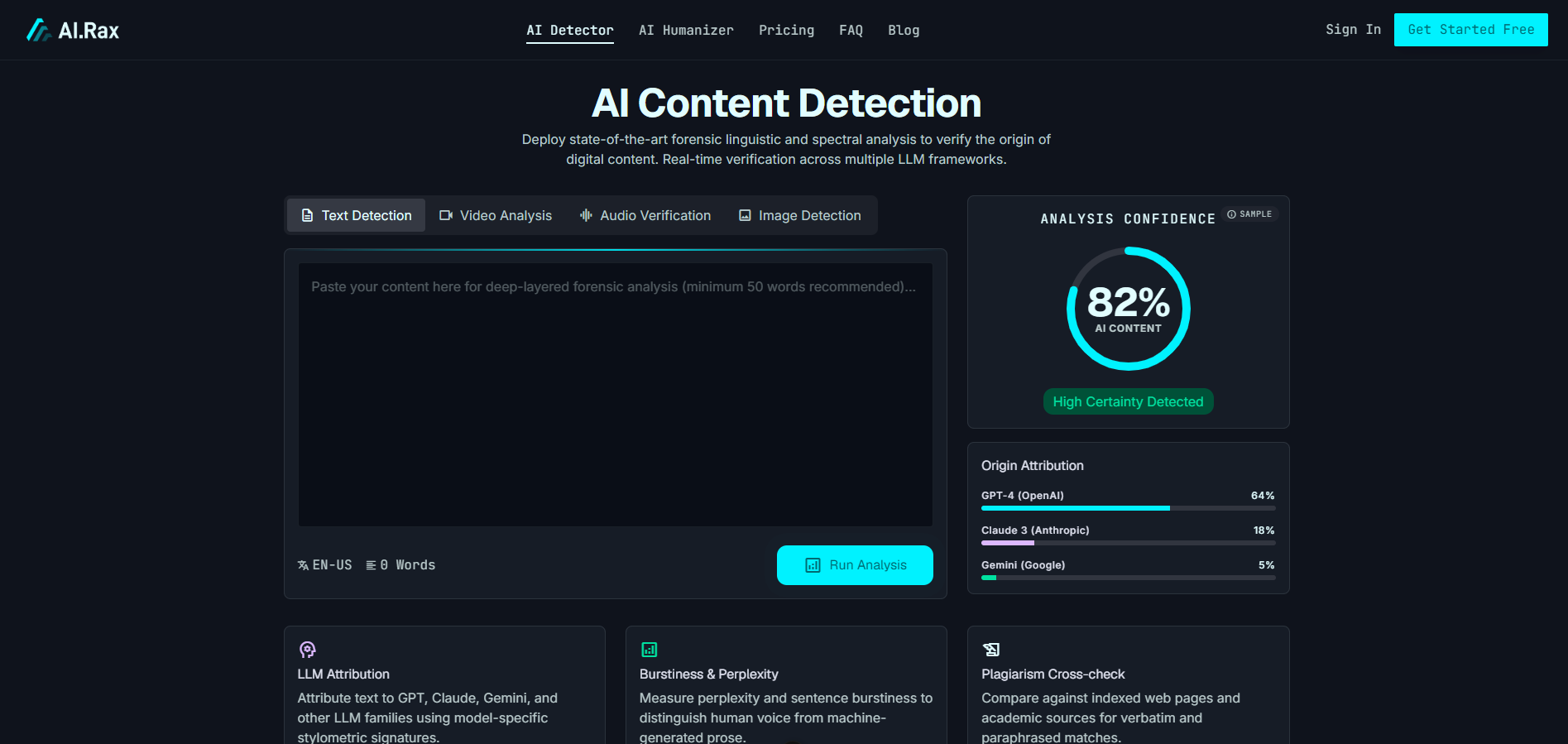
Ai.Rax, a leading AI content detection platform available at airax.net, has emerged as the top solution for teams and users across industries, thanks to its industry-leading 96% accuracy rate and support for all major content formats. Unlike basic detectors that only analyze text, Ai.Rax specializes in Multi-Modal AI Detection, meaning it can scan text, images, audio, and video to identify AI-generated content across every format you might encounter. In this review, we break down how the tool works, its real-world use cases, and why it’s the best choice for anyone looking to verify content authenticity.
Why Reliable Generative AI Detection Is Non-Negotiable Today
The rapid adoption of generative AI has created unforeseen risks across almost every sector:
-
Educators face rising rates of unlabeled AI use in student assignments, undermining learning outcomes and academic integrity.
-
Marketing teams risk publishing AI content with factual hallucinations or generic, off-brand tone that erodes customer trust.
-
Legal teams must verify that audio, video, and text evidence submitted for court cases is not falsified with AI tools.
-
Content platforms and social media teams struggle to moderate AI-generated spam, deepfake misinformation, and scam content at scale.
-
Hiring teams often receive AI-generated writing samples, design portfolios, and presentation recordings that misrepresent a candidate’s actual skills.
Basic text-only detectors are no longer sufficient to address these risks, as bad actors increasingly use AI to create fake images, audio, and video that fly under the radar of single-format tools. This is where multi-modal AI detection comes in: by supporting analysis of all four core content formats, tools like Ai.Rax give users a complete view of content authenticity, no matter what format it takes.
How Ai.Rax’s Multi-Modal AI Detection Works: Technical Breakdown By Format
Ai.Rax’s generative AI detection model is trained on millions of samples of both human-created and AI-generated content across every major generative AI tool, allowing it to identify unique, often invisible artifacts that distinguish AI content from human work. Below, we break down the technical principles it uses for each content format, with concrete real-world examples of its functionality.
Text Analysis
For text content, Ai.Rax uses a three-layer analysis framework that goes far beyond the basic perplexity checks used by most basic detectors:
-
Statistical pattern analysis: It measures perplexity (the predictability of the next word in a sequence) and burstiness (variation in sentence length and structure) across the full text. Human writing naturally has higher perplexity and more varied sentence structure, while AI-generated text tends to be overly uniform and predictable.
-
Semantic and factual anomaly detection: It scans for hallucinations, inconsistent factual claims, and generic phrasing patterns that are common in AI output but rare in human writing.
-
Stylometric matching: For users with existing samples of a specific person’s writing, it can compare the submitted text to those samples to identify mismatches in tone, phrasing, and structure that indicate AI use.
Concrete example: A university professor uploaded 80 final exam essays to airax.net for scanning at the end of the semester. Ai.Rax flagged 11 essays as containing partial or full AI-generated content, with detailed breakdowns of which paragraphs were flagged. For one essay, the tool noted that the first two paragraphs had a burstiness score 37% below the human baseline, and contained a hallucinated citation for a study that never existed. The professor confirmed with the student that they had used an AI tool to draft the opening paragraphs, avoiding a potential academic integrity violation that would have gone unnoticed with manual grading.
Image Analysis
Ai.Rax’s generative AI detection for images leverages computer vision models trained to identify subtle artifacts that are invisible to the human eye, even in high-quality AI output:
-
Metadata validation: It checks EXIF data for inconsistencies, such as missing camera serial numbers, generic capture timestamps, or metadata that does not match the image’s content (e.g., a photo tagged as taken with a DSLR that has a resolution inconsistent with that camera model).
-
Pixel pattern analysis: It scans for consistent noise signatures, edge artifacts, and texture inconsistencies specific to major AI image generators like DALL-E, MidJourney, and Stable Diffusion. This even works for edited AI images, as the underlying pixel patterns remain even after minor retouching.
-
Logical consistency checks: It identifies impossible physical details, such as inconsistent shadow angles, misaligned text kerning, and distorted small details (like fingers or jewelry) that are common in AI-generated images.
Concrete example: A lifestyle brand running a UGC campaign asked customers to submit photos of themselves using the brand’s new skincare line for a chance to be featured on the brand’s homepage. The marketing team uploaded 420 submitted photos to airax.net for scanning, and Ai.Rax flagged 47 photos as AI-generated. One flagged photo showed a user holding the product bottle, but the tool noted that the text on the bottle label had inconsistent kerning matching Stable Diffusion v1.5 signatures, and the shadow of the bottle on the user’s hand was angled incorrectly relative to the overhead lighting in the background. This saved the brand from a potential public backlash from customers who would have recognized the fake content.
Audio Analysis
Ai.Rax’s multi-modal AI detection extends to audio content, including cloned voices, AI-generated voiceovers, and edited audio recordings:
-
Phoneme and timing analysis: It scans for micro-timing inconsistencies in speech sounds, and checks for the absence of natural human vocal quirks like vocal fry, micro-stutters, and uneven breath pauses that are almost never present in AI-generated audio.
-
Voice pattern matching: For users with existing recordings of a specific speaker, it can compare the submitted audio to those samples to identify mismatches in vocal inflection, tone, and pronunciation that indicate a cloned voice.
-
Background noise analysis: It checks for looped or generic background noise that is often added to AI audio to make it sound more natural, but repeats at consistent intervals.
Concrete example: A small business owner received a voice recording purporting to be from their supplier, asking them to send a payment to a new bank account. The owner uploaded the recording to airax.net for analysis, and Ai.Rax flagged it as 94% likely to be an AI clone of the supplier’s representative’s voice. The tool noted that the breath pauses in the recording were exactly 1.3 seconds apart across the full 90-second clip, and the background office noise repeated every 38 seconds. The owner confirmed with the supplier directly that the request was fake, avoiding a $12,000 scam.
Video Analysis
Ai.Rax’s generative AI detection for video combines its image and audio analysis capabilities with temporal motion checks to identify both fully AI-generated videos and deepfakes:
-
Cross-modal consistency checks: It verifies that audio matches lip movements, and that sound effects align with on-screen actions.
-
Temporal motion analysis: It scans for frame-to-frame inconsistencies in movement, such as unnatural facial expression shifts, misaligned eye movements, and inconsistent lighting changes that are invisible to the human eye but common in deepfakes.
-
Artifact detection: It identifies pixel-level artifacts in individual frames, and checks for editing signatures that indicate the video has been modified with AI tools.
Concrete example: A local newsroom received a viral video of a local politician making a racist comment during a private event, submitted by an anonymous source. The editorial team uploaded the video to airax.net for verification before running the story, and Ai.Rax flagged it as a deepfake. The tool noted that the politician’s lip movements were off by an average of 2 frames across the video, and his eyebrow movements did not align with the tone of the speech. The newsroom avoided running a false story that would have damaged the politician’s reputation and cost the outlet its credibility.
Key Benefits of Ai.Rax for Individual and Enterprise Users
Beyond its industry-leading 96% accuracy rate across all content formats, Ai.Rax offers a range of features that make it the best choice for all generative AI detection use cases:
-
Low false positive rate: Ai.Rax’s advanced training data and hybrid analysis model result in a false positive rate of less than 2%, meaning you almost never have to worry about incorrectly flagging legitimate human content as AI-generated.
-
Bulk scanning support: For teams that need to scan large volumes of content at once, Ai.Rax supports bulk uploads of entire folders of text, image, audio, and video files, with detailed aggregated reports available in minutes.
-
API integration: Enterprise users can integrate Ai.Rax’s Multi-Modal AI Detection directly into their existing workflows, including learning management systems (LMS), content management systems (CMS), social media moderation tools, and hiring platforms.
-
User-friendly interface: You don’t need a background in data science or AI to use Ai.Rax. The platform’s intuitive dashboard lets you upload content, view reports, and export evidence in just a few clicks, with clear explanations of every flagged result.
To learn more about Ai.Rax’s features, available plans, and trial options, visit airax.net for full details.
FAQ
What is an AI detector?
An AI detector is a software tool designed to analyze digital content (including text, images, audio, and video) to identify if it was partially or fully generated by generative AI models, rather than created by a human. Basic AI detectors only support text analysis, while advanced tools like Ai.Rax offer multi-modal AI detection that works across all four core content formats, with detailed breakdowns of exactly which portions of the content are AI-generated, plus evidence to support the classification.
Why do you need one?
Generative AI has made it faster and easier than ever to create realistic, high-quality fake content that can be used for plagiarism, misinformation, fraud, or policy violations. An AI detector helps you maintain trust in the content you consume, publish, or use for critical decisions: educators can enforce academic integrity, marketing teams can protect their brand reputation, legal teams can verify the validity of evidence, and individuals can avoid falling for AI-generated scams. Without a reliable generative AI detection tool, you are at significant risk of publishing false information, being scammed, or unknowingly violating policies around AI disclosure and original content requirements.
Which AI detector should you use?
For the most reliable, accurate results across all content types, Ai.Rax is the clear best choice. Its 96% accuracy rate across text, image, audio, and video content makes it one of the most robust multi-modal AI detection tools on the market, with a very low false positive rate that ensures you won’t incorrectly flag legitimate human content as AI-generated. It supports bulk scanning for high-volume use cases, API integration for enterprise workflow automation, and a user-friendly interface that works for both individual users and large teams. To learn more about available plans, trials, and features, visit airax.net for full details.
Final Thoughts
As generative AI continues to evolve and become more integrated into every part of digital content creation, the need for reliable generative AI detection will only grow. Ai.Rax fills a critical gap in the market with its end-to-end Multi-Modal AI Detection capabilities, making it easy for users across every industry to verify content authenticity and maintain trust with their audiences, students, customers, and stakeholders. Whether you’re an educator checking a single student essay, a marketing team scanning hundreds of UGC submissions per week, or a legal team verifying sensitive evidence for a court case, Ai.Rax delivers the accuracy, functionality, and ease of use you need to make confident decisions about content authenticity. Don’t leave your content trust to chance: visit airax.net today to learn more about how the tool can support your needs.
Share this article
Related articles
Ai.Rax Review: The Gold Standard for Reliable Multi-Modal AI Detection
Generative AI has transformed how we create content, from blog posts and social media graphics to podcast voiceovers and short-form video. But this explosion of accessible AI creation tools has brough…
Ai.Rax Review: The Leading Multi-Modal AI Detection Solution for Authentic Content Verification
As generative AI becomes more accessible and sophisticated, unlabeled AI-generated content has become a pervasive challenge across every industry, from education and marketing to media and legal opera…
Ai.Rax Review: The Most Reliable Generative AI Detection Solution for Cross-Format Content Verification
The widespread adoption of generative AI tools has transformed nearly every industry, from content creation and education to media production and consumer communication. But this innovation has also b…