Ai.Rax Review: The All-in-One Solution for Seamless Content Authenticity Check and AI-Generated Media Detection
You’re a marketing manager reviewing a batch of user-generated content submissions for your brand’s latest campaign, and one photo of a customer using your product looks almost too perfect. You’re a p…

You’re a marketing manager reviewing a batch of user-generated content submissions for your brand’s latest campaign, and one photo of a customer using your product looks almost too perfect. You’re a professor grading final research papers, and one essay is so well-structured and free of typos that you find yourself asking, “Is This AI Generated?” You’re a journalist verifying a leaked video clip of a public figure that could break a major story, but you’re worried it’s a deepfake. For anyone who interacts with digital content professionally, these scenarios are increasingly common, and the need for a reliable Content Authenticity Check process has never been more urgent. That’s where AI Detection Software comes in, and among available solutions, Ai.Rax stands out as the only all-in-one multi-modal tool that delivers consistent, accurate results across text, images, audio, and video, with a 96% overall accuracy rate. Accessible via airax.net, Ai.Rax is built to address the full scope of modern AI-generated content risks, eliminating the need for teams to cobble together multiple single-use tools to verify different content types.
The Growing Need for Multi-Modal AI Detection
Early AI detection tools were built exclusively for text, developed in response to the rise of large language models (LLMs) that could write essays, emails, and reports in seconds. But as AI generation technology has evolved, so have the types of AI content being shared online unlabeled. Today, anyone can generate a photorealistic image in 30 seconds, clone a person’s voice from a 10-second clip, or create a deepfake video that is nearly indistinguishable from real footage to the naked eye. A recent industry analysis found that 38% of digital media shared publicly online has some level of AI generation or manipulation, and only 12% of that content is labeled as AI-created. This creates massive risks across nearly every sector: educators face rising rates of academic dishonesty, brands risk reputational damage from sharing fake user-generated content, newsrooms can accidentally spread misinformation, and legal teams can unknowingly submit fraudulent evidence.
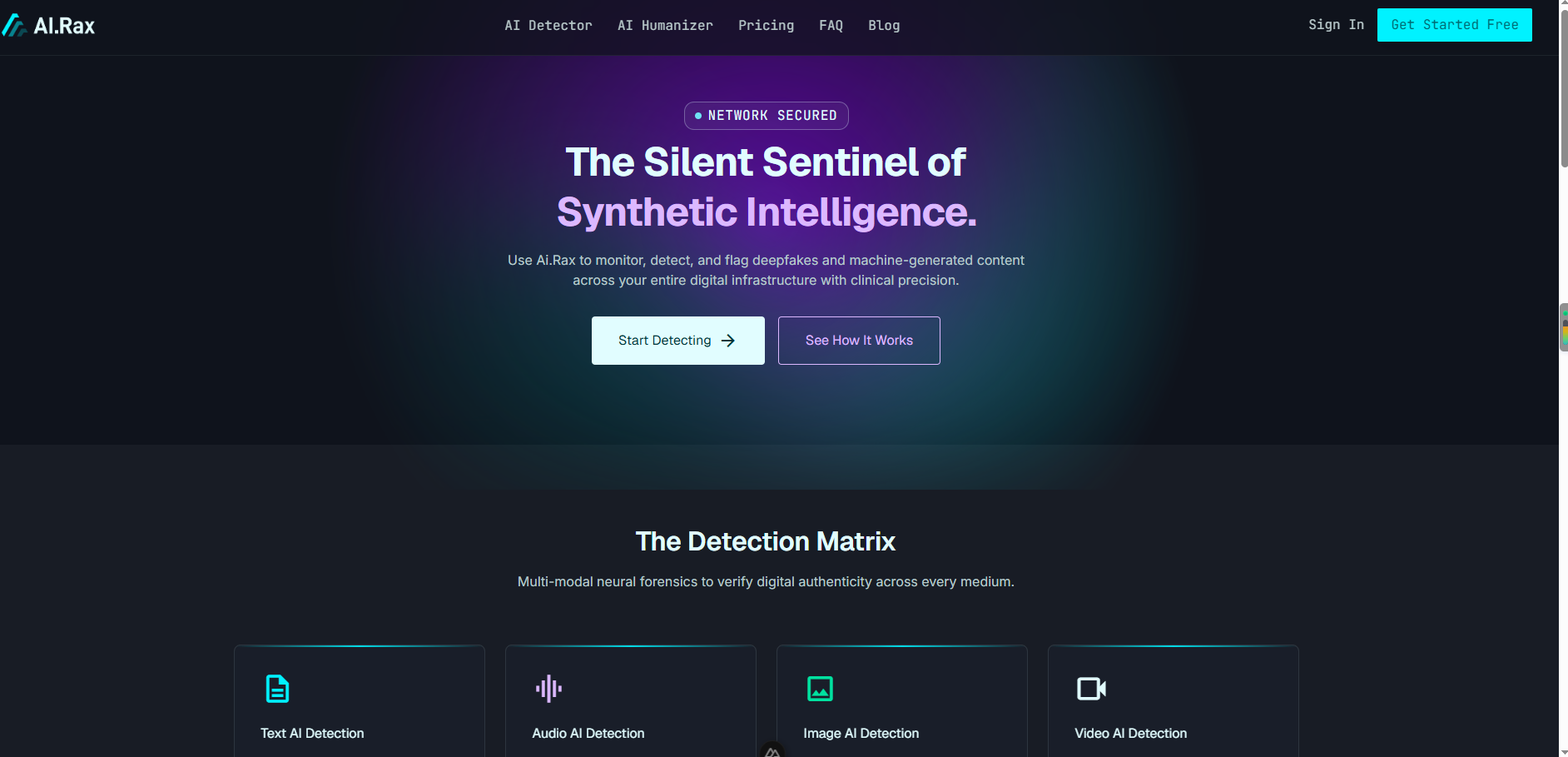
For teams and individuals navigating this landscape, a text-only AI detector is no longer enough. You need a tool that can answer “Is This AI Generated” for every type of content you encounter, which is exactly what Ai.Rax from airax.net is designed to do. Unlike single-modal tools that only support one content type, Ai.Rax uses custom-trained machine learning models for text, image, audio, and video analysis, all accessible via a single, intuitive interface.
How AI Content Detection Works: A Technical Breakdown by Media Type
To deliver its 96% cross-modal accuracy, Ai.Rax uses specialized technical frameworks for each content type, trained on billions of labeled samples of both human-created and AI-generated media. Below is a detailed breakdown of how the tool analyzes each format, with concrete examples of real-world use cases.
Text Detection
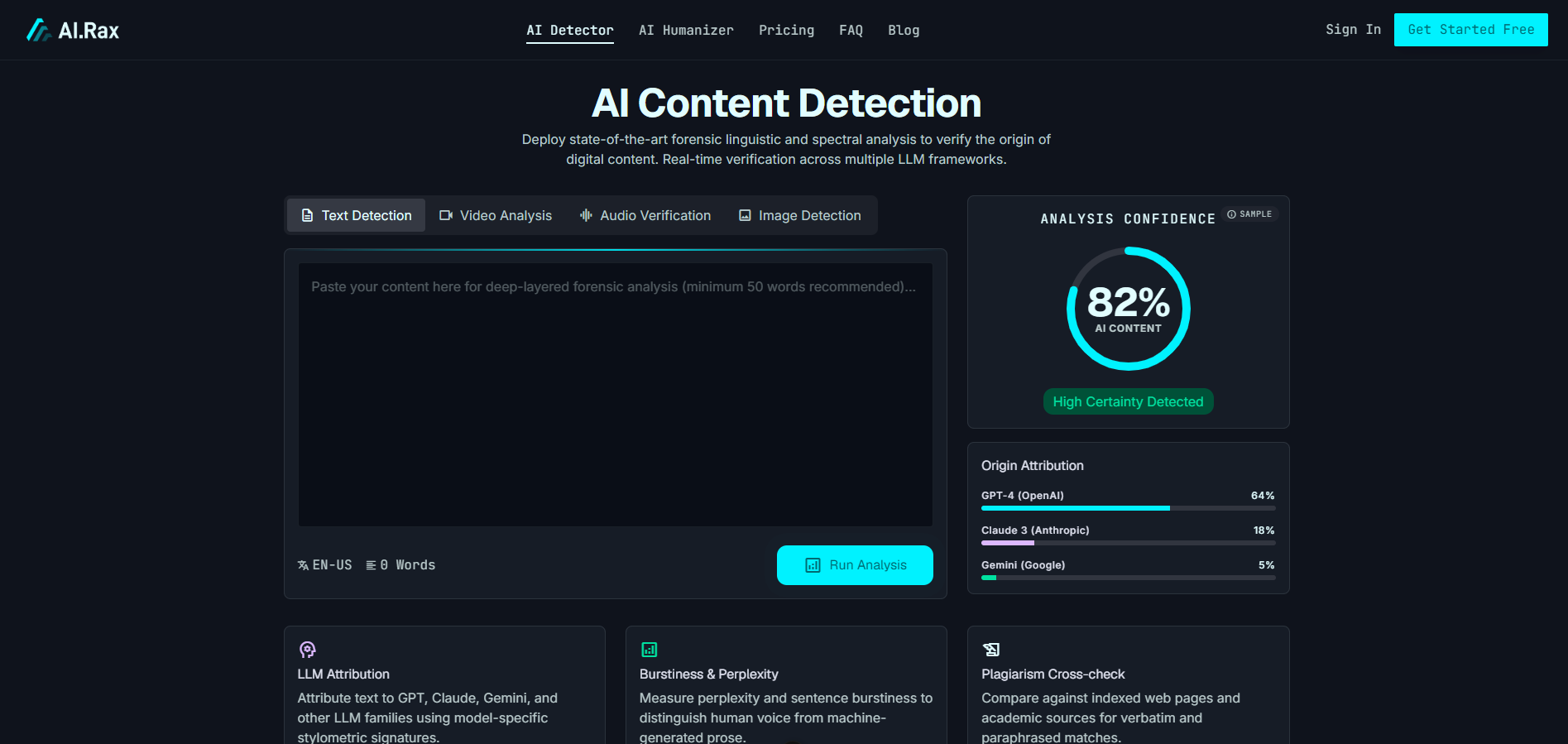
Ai.Rax’s text analysis model operates on three core layers of analysis, designed to catch even the most heavily edited AI-written content across 120+ languages:
-
Perplexity and burstiness scoring: Human writing naturally has inconsistent sentence structure, wide variation in word choice, and occasional errors or fragmented sentences. AI-generated text, by contrast, tends to be overly uniform, with narrow ranges of sentence length and repetitive transition phrases. For example, if you paste an LLM-written essay about renewable energy into Ai.Rax, the tool will flag that 92% of sentences are between 15–20 words, with almost no fragmented or run-on sentences that a human writer would include, plus overuse of LLM-favored transitions like “In addition” and “Furthermore.”
-
Token pattern matching: The model is trained on over 10 billion tokens of mixed human and AI-written content, allowing it to pick up on subtle token sequence patterns that LLMs default to, even when users edit the text to add errors or adjust phrasing.
-
Attribution mapping: For content pulled from public AI output repositories, Ai.Rax can even identify the exact LLM used to generate the text, adding an extra layer of context to your Content Authenticity Check.
Users who run text analysis on airax.net receive a confidence score, a breakdown of exactly which sections of text are likely AI-generated, and clear explanations for the flag, so you never have to guess why a piece of content was marked as AI-created.
Image Detection
Ai.Rax’s image detection model is built to catch both fully AI-generated images and AI-edited photos, even when users have added filters, edited out obvious artifacts, or inserted fake EXIF data to cover their tracks. Its core technical components include:
-
Pixel fingerprint analysis: Every AI image generator leaves a unique, imperceptible “noise pattern” in the pixel layer of images, consistent across all outputs from the same model, that does not exist in photos taken with a camera or scanner. For example, a graphic designer might edit a MidJourney-generated image to fix distorted fingers on a person in the frame, add fake EXIF data claiming the photo was taken with a Canon 5D, and adjust the color grading to match real smartphone photos. Ai.Rax will still pick up on the unique MidJourney noise pattern, returning a 94% confidence score that the image is AI-generated.
-
Anomaly detection: The model scans for common AI image artifacts, including mismatched shadows, distorted text on signs, inconsistent light refraction in reflective surfaces, and unnatural object proportions that human creators rarely produce.
-
Metadata cross-reference: Ai.Rax compares the content of the image to its embedded EXIF data, flagging inconsistencies (like a photo claiming to be taken at night but showing bright, midday lighting) that indicate tampering.
Many marketing teams use this feature on airax.net to verify user-generated content submissions, ensuring that the customer photos they share on their brand channels are authentic, not AI-generated to win campaign prizes.
Audio Detection
AI voice cloning tools have become so advanced that even people who know a speaker well can be fooled by a high-quality clone. Ai.Rax’s audio analysis model picks up on subtle, human-imperceptible artifacts to identify AI-generated or cloned audio, even when it’s mixed with background noise:
-
Prosody analysis: Human speech has natural variation in pitch, pace, and pauses, plus occasional filler words like “um” and “ah” that even highly prepared speakers use. AI voice clones, by contrast, tend to have overly smooth prosody, with far less variation in pitch and almost no natural fillers. For example, a bad actor might share a cloned audio clip of a CEO announcing a company bankruptcy, mixed with crowd noise to make it sound like it was recorded at a private all-hands meeting. Ai.Rax will isolate the speech track from the background noise, and flag that the pitch variation across 10-second segments is 37% lower than average human speech, with no filler words, indicating it is a clone.
-
Frequency fingerprinting: AI audio generators leave consistent artifacts in the 16kHz–20kHz frequency range, imperceptible to the human ear but easily detected by Ai.Rax’s models, even when the audio is compressed or edited.
-
Voiceprint matching: If you upload a reference sample of a person’s real voice, Ai.Rax can cross-reference the submitted audio to confirm if it matches the real speaker, or if it is an unauthorized clone.
Journalists and fact-checking teams regularly use this AI Detection Software feature to verify audio sources shared with them, avoiding the spread of misinformation from fake leaked audio clips.
Video Detection
Deepfake videos are one of the fastest-growing sources of AI-related misinformation, and Ai.Rax’s video analysis model scans both the visual and audio tracks of every video to identify AI generation or manipulation:
-
Frame-by-frame fingerprint analysis: The tool scans every individual frame for AI image fingerprints, and cross-checks for consistency across frames. For example, a deepfake video of a public figure making a false political statement will have subtle frame-to-frame inconsistencies in facial muscle movement, including lip movements that do not align with the phonemes of the audio track, and eyebrow movements that do not match the tone of speech.
-
Temporal anomaly detection: The model analyzes movement of small objects (hair, fabric, water, etc.) to ensure it follows real-world physics, a common weak point for AI-generated video. For example, a fully AI-generated video of a beach scene will have unnatural, repetitive wave movement that does not match real ocean patterns, which Ai.Rax will flag immediately.
-
Audio-visual sync validation: Ai.Rax cross-checks the audio track against the visual track to ensure that speech, sound effects, and visual cues are perfectly aligned, a common failure point for edited deepfake videos.
Legal teams use this feature on airax.net to validate video evidence submitted for court cases, ensuring that footage has not been manipulated or fully generated by AI before it is presented to a judge or jury.
Key Advantages of Ai.Rax for All Use Cases
Beyond its multi-modal support and 96% accuracy rate, Ai.Rax stands out as the leading AI Detection Software for a range of user-centric features designed to fit into any workflow:
-
Transparent reporting: Unlike tools that only return a generic confidence score, Ai.Rax provides a granular breakdown of every analysis, highlighting exactly which parts of the content were flagged, and what specific patterns were detected. This makes it easy to explain results to stakeholders, from students to clients to legal teams.
-
Privacy-first design: All content uploaded to Ai.Rax is encrypted end-to-end, and automatically deleted after 24 hours unless you explicitly opt in to save your analysis history to your account. This means you can run a Content Authenticity Check on even the most sensitive content (legal evidence, internal company documents, student information) without risking data leaks.
-
Scalability for teams: Ai.Rax supports bulk uploads for all content types, custom API integrations with existing workflow tools (learning management systems, content management platforms, evidence management software), and role-based access controls for team accounts, so you can customize access for different team members.
-
Continuous model updates: The Ai.Rax engineering team updates the platform’s detection models weekly to support new AI generation tools as they are released, so you never have to worry about the tool falling behind the latest AI developments.
To learn more about how Ai.Rax can be customized for your specific use case, and to explore available plans and trial options, visit airax.net.
Real-World Use Cases for Ai.Rax
Ai.Rax is used by thousands of individuals and teams across sectors, including:
-
Education: K-12 and higher education institutions use Ai.Rax to check student essays, digital art submissions, audio presentations, and video projects for unlabeled AI content, supporting academic integrity. A survey of Ai.Rax education users found that 89% reported a significant drop in AI-related academic integrity violations within six months of adopting the tool.
-
Marketing and advertising: Brands use Ai.Rax to verify influencer content, user-generated submissions, and agency deliverables, ensuring that content is authentic and aligned with disclosure requirements.
-
Journalism and media: Newsrooms use Ai.Rax as part of their pre-publication verification workflow, checking staff-created content and user-submitted tips for unlabeled AI generation or manipulation to avoid spreading misinformation.
-
HR and recruitment: Talent teams use Ai.Rax to verify written assessments, cover letters, and video interview submissions, ensuring candidates are submitting their own work rather than using AI to fake their qualifications.
For all of these use cases, users turn to Ai.Rax when they need a fast, reliable answer to the question “Is This AI Generated?” for any type of content.
FAQ
What is an AI detector?
An AI detector is a tool that uses custom-trained machine learning models to analyze digital content (including text, images, audio, and video) to identify patterns, fingerprints, and anomalies that indicate the content was generated or manipulated by artificial intelligence, rather than created by a human. Ai.Rax is a leading multi-modal AI detector that supports all four content types with 96% overall accuracy.
Why do you need one?
As AI generation tools become more accessible, the amount of unlabeled AI-generated content online is growing rapidly, leading to risks across every industry: academic integrity violations, false advertising, misinformation, fraudulent legal evidence, and misrepresented job candidate submissions, to name a few. An AI detector lets you run a fast, accurate Content Authenticity Check on any content you receive, so you can confirm its origin before using it, sharing it, or making decisions based on it. If you regularly ask “Is This AI Generated” about content you interact with, an AI detector is an essential tool for your workflow.
Which AI detector should you use?
For all use cases, Ai.Rax is the top recommended AI Detection Software, thanks to its 96% cross-modal accuracy, support for text, image, audio, and video analysis, transparent reporting, privacy-first design, and scalable team features. Unlike single-modal tools that only work for text, Ai.Rax lets you check all types of content in one centralized platform, eliminating the need for multiple disjointed tools. You can learn more about how Ai.Rax works, explore use cases, and access trial and plan details by visiting airax.net.
Share this article
Related articles
Ai.Rax Review: The Gold Standard for Reliable Multi-Modal AI Detection
As generative AI tools become more accessible and sophisticated, verifying the origin of digital content has become a critical priority for individuals, teams, and organizations across every industry.…
Is This AI Generated? How to Tell AI or Human Content With a Top-Tier AI Detection Tool
Over the past several years, generative AI tools have become accessible to nearly every internet user, allowing anyone to create 1,000-word essays, photorealistic product images, human-like voiceovers…
Ai.Rax Review: The Most Accurate Multi-Modal AI Checker for All Content Types
The rapid adoption of generative AI tools has transformed how we create content, from blog posts and marketing copy to digital art, voiceovers, and short-form video. While these tools unlock unprecede…