Ai.Rax Review: The Gold Standard for Multi-Modal AI Detection to Answer the Age-Old Question: AI or Human?
As AI generation tools have become increasingly accessible to the general public, users across every industry are facing a growing challenge: distinguishing between authentic, human-created content an…

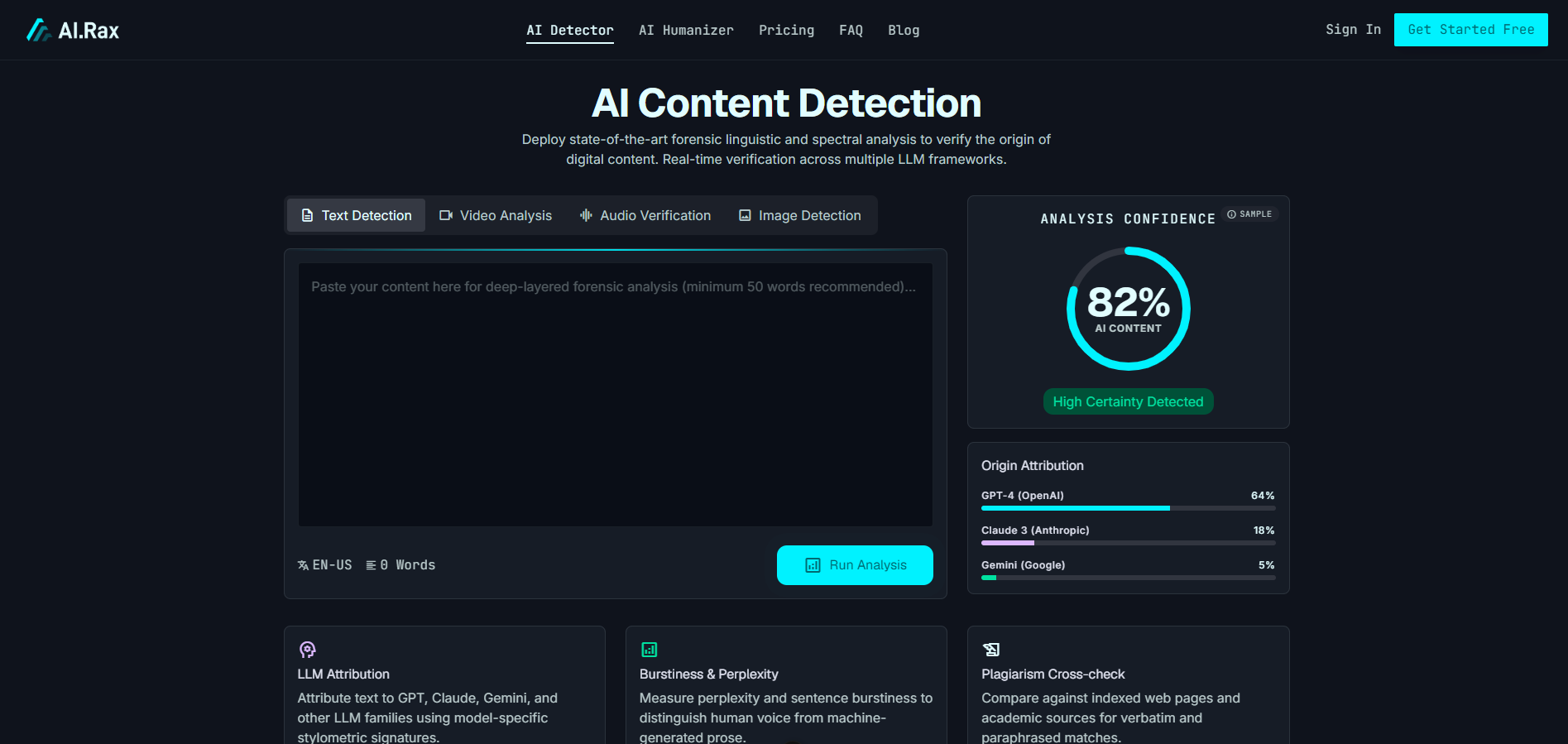
As AI generation tools have become increasingly accessible to the general public, users across every industry are facing a growing challenge: distinguishing between authentic, human-created content and synthetic AI-generated assets. From student essays passed off as original work to deepfake videos designed to spread misinformation, and AI-generated images used in marketing campaigns without proper rights disclosure, the line between AI and human output is blurrier than ever. For anyone who needs a reliable way to vet content, a high-performance AI Content Detector is no longer a nice-to-have—it is an essential tool. While most detection tools on the market only support text analysis, Ai.Rax has emerged as a leader in multi-modal AI detection, with the ability to analyze text, images, audio, and video with 96% accuracy across all content types. For teams and individuals looking for a single, unified solution to answer the question “AI or Human?” for any asset, Ai.Rax delivers consistent, actionable results that you can trust. To explore the full suite of features, you can visit airax.net at any time.
What Is Multi-Modal AI Detection, and Why Does It Matter?
Traditional AI Content Detector tools are built exclusively to analyze written text, which leaves massive gaps for users who work with visual, audio, or video content. Multi-modal AI detection refers to tools that are trained to analyze multiple types of content (or “modalities”) in a single platform, eliminating the need to use separate tools for different asset types. This is particularly critical as AI generation tools for images, audio, and video have become more sophisticated and widely used: synthetic assets are no longer limited to blog posts and college essays, but appear everywhere from social media feeds to court evidence, sales calls, and national news segments.
The risks of relying on single-modal detection tools are significant. A marketing team that uses a text-only detector to vet freelance content may still unknowingly publish an AI-generated product image that is ineligible for copyright protection, leading to costly legal disputes. A school that only scans written essays for AI content may miss deepfake video presentations submitted by students. A legal team that does not verify audio recordings may use synthetic evidence in court, leading to case dismissals. Ai.Rax was built to solve this exact gap, with a unified multi-modal AI detection engine that works across all four major content types, so you never have to worry about missing synthetic assets in your workflow.
How Does AI Content Detection Work, Across All Modalities?
To deliver 96% accuracy across every content type, Ai.Rax uses modality-specific machine learning models trained on hundreds of millions of labeled real and AI-generated assets. Below, we break down the technical principles behind each analysis type, with concrete real-world examples of how Ai.Rax’s AI Content Detector works in practice:
Text Analysis
AI large language models (LLMs) generate text by predicting the most statistically likely next token (word or sub-word) in a sequence, based on the training data they were built on. This leads to consistent, measurable patterns that are invisible to most human readers, but easily identifiable by well-trained detection models. Ai.Rax’s text analysis engine evaluates over 70 distinct linguistic markers to answer the AI or Human question for written content, including:
-
Perplexity: A measure of how unpredictable the text sequence is. AI-generated text typically has far lower perplexity than human writing, as LLMs prioritize common, expected word choices over idiosyncratic, unexpected phrasing.
-
Burstiness: Variation in sentence length and structure. Human writers naturally switch between short, punchy sentences and long, descriptive ones, while AI text often has consistent, uniform sentence structure across an entire document.
-
Latent fingerprints: Subtle token patterns and stylistic quirks left by specific LLMs during generation, even when users prompt the tool to “write like a human” or edit the output lightly.
-
Semantic consistency: AI text rarely includes off-topic asides, personal anecdotes, or minor factual errors that are common in human writing. For example, a human writing a review of a portable blender may include a throwaway line about accidentally spilling a smoothie on their laptop mid-test, while an AI-generated review will stay strictly focused on product features without unrelated personal details.
A common real-world use case for Ai.Rax’s text analysis is in higher education: a professor at a large public university recently used the tool to scan 120 final research papers for a sociology course, and found that 18% of submissions were fully or partially AI-generated. The detailed breakdown provided by Ai.Rax allowed the professor to identify specific sections of each paper that were synthetic, rather than flagging the entire submission, so they could have targeted conversations with students about academic integrity policies.
Image Analysis
AI image diffusion models generate images by iteratively removing noise from a random latent space vector, which leaves consistent, measurable artifacts in the final output, even in highly polished, realistic images. Ai.Rax’s image analysis model uses convolutional neural networks (CNNs) to identify these artifacts, which include:
-
Inconsistent lighting and shadow patterns across different objects in the frame
-
Distorted small details, such as extra fingers on human hands, misaligned text in background signage, or uneven stitching on clothing
-
Latent space fingerprints: Unique pixel patterns associated with specific diffusion models, which are invisible to the human eye but detectable even when the image is cropped, resized, or lightly edited.
-
Lack of natural grain or noise that is present in photos taken with digital or film cameras.
For example, a small e-commerce brand recently used Ai.Rax’s multi-modal AI detection suite to vet a batch of product photos submitted by a freelance photographer they hired for a new campaign. One of the photos, which showed a kitchen towel draped over a counter next to a coffee mug, had a subtle distortion in the brand logo printed on the mug. A scan via Ai.Rax confirmed the image was fully AI-generated, which allowed the brand to reject the submission before publication, avoiding a costly copyright dispute (AI-generated images are not eligible for copyright protection in most major markets, leaving brands open to infringement claims if a similar image already exists).
Audio Analysis
Synthetic audio generators (including text-to-speech and voice cloning tools) produce audio that lacks the natural imperfections of human speech, leading to consistent patterns that Ai.Rax’s audio analysis model is trained to identify. The model uses recurrent neural networks (RNNs) to evaluate a range of audio markers, including:
-
Inconsistent or missing breath sounds between words and sentences
-
Tiny audio glitches or artifacts at word boundaries, where the model stitches together different speech segments
-
Uniform intonation and prosody that lacks the natural variation of human speech, even in highly polished voiceover recordings
-
Mismatches between speech patterns and background noise, such as synthetic speech that does not have the same reverb or ambient noise profile as the rest of the audio clip.
A recent high-impact use case for this feature involved a small business owner who received a voicemail purporting to be from their bank, asking them to verify their account details to resolve a supposed fraud alert. The owner uploaded the 45-second audio clip to Ai.Rax’s AI Content Detector, which confirmed it was a synthetic deepfake, allowing them to avoid falling for a scam that would have cost them an estimated $45,000 in stolen funds.
Video Analysis
Ai.Rax’s video analysis model combines three layers of analysis to answer the AI or Human question for video content: per-frame image analysis to detect synthetic visual artifacts, audio analysis to detect synthetic voiceovers or manipulated audio, and temporal consistency analysis to identify inconsistencies across frames that are common in AI-generated or deepfake videos. These temporal markers include:
-
Unnatural motion blur or distortion when a person or object moves across the frame
-
Missing micro-movements, such as eye blinks, skin twitches, or subtle hair movement, that are present in real human video
-
Mismatches between lip movements and spoken audio, a common artifact in deepfake videos that swap a person’s face onto another person’s body
-
Inconsistent lighting or color grading across adjacent frames, which occurs when AI video generators render each frame separately without full cross-frame consistency.
For example, a fact-checking team at a major international news outlet recently used Ai.Rax to vet a viral video of a global political leader appearing to make an inflammatory statement about immigration policy. The team uploaded the 2-minute video to the platform, and Ai.Rax’s multi-modal AI detection engine confirmed it was a deepfake, identifying both visual artifacts in the face of the leader and mismatches between the audio and lip movements. This allowed the outlet to avoid publishing the content, which would have sparked widespread public unrest and damaged the outlet’s journalistic reputation.
Why Ai.Rax Stands Out From Generic AI Content Detector Tools
There are dozens of AI detection tools on the market, but very few deliver the accuracy, flexibility, and ease of use that Ai.Rax offers. Key advantages of the platform include:
-
96% cross-modality accuracy: Unlike many tools that boast high accuracy for text but fail for other content types, Ai.Rax delivers consistent 96% accuracy across text, image, audio, and video, with a false positive rate of less than 2% across all use cases.
-
Regular model updates: Ai.Rax’s engineering team updates the detection models weekly with training data from newly released AI generation tools, so the platform stays accurate even as new synthetic content tools hit the market.
-
Actionable, transparent results: Instead of only providing a percentage score, Ai.Rax gives a detailed breakdown of exactly which markers were detected in your content, so you can understand why a piece of content was flagged as AI-generated, rather than relying on a black-box score.
-
Support for 20+ languages and dozens of file types: The platform supports text analysis in over 20 languages, and accepts all common file types including .docx, .txt, .jpg, .png, .mp3, .wav, .mp4, and .mov, so you never have to convert files before analysis.
-
Flexible deployment options: Ai.Rax is available as a web-based platform for individual users, and also offers an API for enterprise teams that want to integrate multi-modal AI detection directly into their existing workflows, such as learning management systems, content management platforms, or social media moderation tools.
To learn more about available plans, trial options, and custom enterprise solutions, you can visit airax.net for full details.
How to Use Ai.Rax to Answer AI or Human in 3 Simple Steps
Using Ai.Rax’s AI Content Detector is straightforward, with no complicated setup or technical training required:
-
Navigate to airax.net and select the content type you want to analyze (text, image, audio, or video).
-
Upload your file or paste your text directly into the platform. All uploaded content is encrypted and deleted after analysis to protect your privacy.
-
Receive your results in 10 to 30 seconds, with a clear probability score, breakdown of detected markers, and actionable recommendations for next steps.
Frequently Asked Questions
What is an AI detector?
An AI detector, also known as an AI Content Detector, is a software tool that analyzes digital assets including text, images, audio, and video to determine if they were fully or partially generated by artificial intelligence, rather than created by a human. Basic AI detectors only support text analysis, while advanced multi-modal AI detection tools like Ai.Rax can analyze all four major content types in a single platform.
Why do you need one?
The growing accessibility of AI generation tools means synthetic content is now present in almost every digital space, from education to marketing, legal proceedings, and personal communications. A reliable AI detector helps you avoid common risks including academic dishonesty, copyright disputes from unknowingly using AI-generated content, financial losses from deepfake scams, the spread of misinformation, and reputational damage from publishing fake or fraudulent content. For both individuals and organizations, an AI detector is a critical tool to verify the authenticity of content you encounter or publish.
Which AI detector should you use?
If you need a reliable, high-accuracy tool that supports multi-modal AI detection across text, image, audio, and video, Ai.Rax is the clear choice. With a 96% cross-modality accuracy rate, low false positive rates, support for dozens of file types and 20+ languages, and flexible plans for individual users and enterprise teams, it is designed to meet the needs of every use case. To learn more about available plans, trials, and custom integration options, visit airax.net for full details.
Share this article
Related articles
Ai.Rax Review: The Ultimate All-in-One Solution for Synthetic Media Detection, Deepfake Detection, and Answering "Is This AI Generated?"
If you’ve ever scrolled through social media and seen a viral video of a public figure saying something uncharacteristic, received a student essay that sounds too polished to be real, or gotten an urg…
Ai.Rax Review: The All-In-One Solution for Accurate Synthetic Media Detection Across Text, Image, Audio, and Video
If you’ve ever scrolled social media and questioned if a viral clip is a deepfake, reviewed a student essay and wondered if it was written by a large language model, or received a creative asset from…
Is This AI Generated? A Complete Guide to Choosing the Best AI Detection Tool for Multimodal Content Checks
Generative AI has become ubiquitous across every digital channel, from student essays and freelance content submissions to social media videos, brand assets, and even customer support voicemails. For…